The Public Council of Uzbekistan for Supporting Entrepreneurship under the President rejected a draft decree that proposed restoring import duties of 15–30% on twelve categories of food products currently exempt from tariffs.
Chairman of the Chamber of Commerce and Industry Davron Vakhabov recommended returning the document to the Ministry of Investment, Industry, and Trade for review. The Ministry was instructed to conduct additional analysis, consult with enterprises, and resubmit the proposal.
The draft presidential decree was presented at the meeting by Sarvarkhojay Khonkhodzhayev, head of the Tariff and Non-Tariff Regulation Department of the Trade Policy Directorate in the Ministry's Foreign Trade Department. According to Khonkhodzhayev, this proposal was developed to fulfill two presidential directives.
Presidential Decree No. UP-269 of December 17, 2025, requires submitting proposals for revising the list of goods subject to zero import duties, taking into account food security, availability of essential products, and price stability. Another, Presidential Decree No. UP-175 of August 27, 2026, calls for measures to eliminate unnecessary permits not required by importing countries and to accelerate the issuance of export certificates.
The draft is divided into two main parts. The first concerns expiring customs benefits for essential food products and consumer goods, and the second focuses on simplifying export certification procedures and other foreign trade operations.
Currently, 56 categories of essential food products and consumer goods benefit from zero import duties according to Presidential Decrees No. UP-145 of May 31, 2022, No. UP-41 of March 23, 2023, No. UP-217 of December 28, 2023, and No. UP-269. These benefits are set to expire on January 1, 2027.
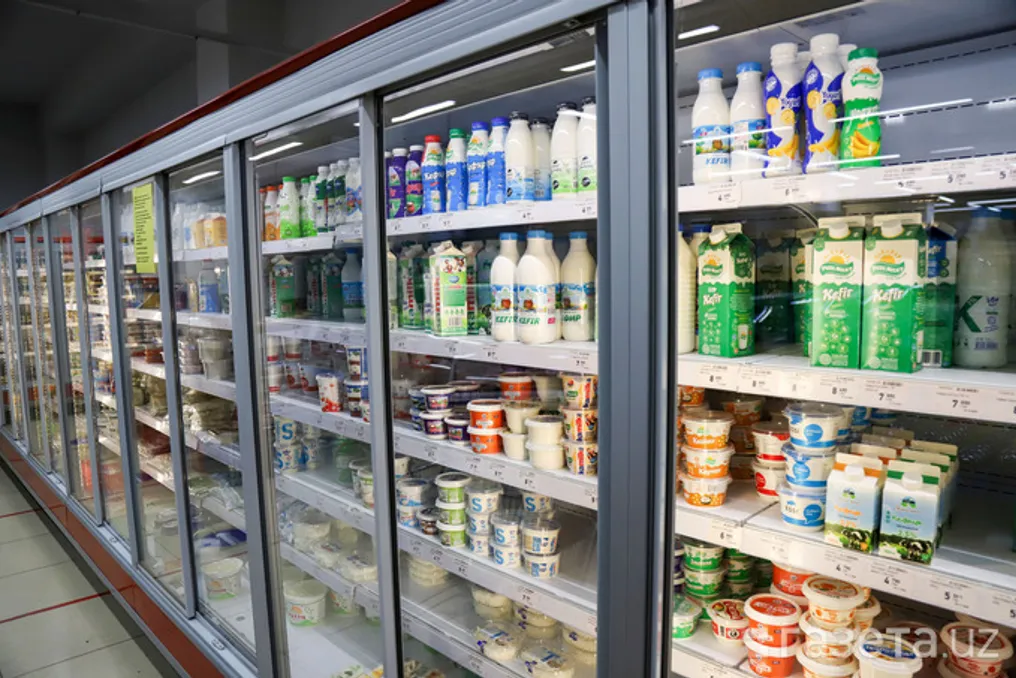
The ministry proposes extending these benefits for another year, until January 1, 2028, fully for 45 commodity categories and partially for two tariff lines. However, the ministry does not plan to extend benefits for the remaining products. These include condensed milk and cream, yogurt, cheese and cottage cheese, apples, pears and figs, confectionery, chocolate, pasta, mineral and carbonated water, as well as non-alcoholic beverages.
Khonkhodzhayev explained that the products are not being excluded from the list by a separate decision; instead, their existing benefits will simply expire according to schedule. He noted that the proposal is based on an assessment of domestic production capacity, output volumes, and the degree of demand fulfillment by local producers.
During the meeting, the chairman asked questions regarding statistical data and research supporting the ministry's conclusions. He asked whether the decision not to apply certain benefits reflects growth in domestic production, changes in consumption, or other factors.
Questions were also raised about who assessed the extension of industrial customs benefits and what the consequences of exempting buses from processing fees would be. In response, Khonkhodzhayev presented production and import figures for January-August 2026.
According to the ministry, 84 enterprises in Uzbekistan produced milk and cream, reaching a domestic volume of 84,000 tons compared to 15,000 tons imported. Yogurt was produced by 77 enterprises, while imports over the eight-month period amounted to 9,800 tons. Imports of cheese and cottage cheese reached 10,300 tons.
The meeting chairman objected that production volumes alone are insufficient to justify the proposed changes. He demanded clarification on whether domestic supplies meet recommended consumption levels, if prices are affordable relative to household incomes, and how the removal of benefits will affect the market.
Khonkhodzhayev stated that the ministry conducted an analysis of prices and domestic consumption but did not present the results at the meeting. He added that the ministry is ready to provide this information to the council separately.
Economist and public activist Otabek Bakirov spoke out against the proposal, arguing that prices for the affected products have risen faster than general inflation over the previous nine months. He stated that the conclusion regarding sufficient domestic production was not supported by adequate economic and financial calculations.
Bakirov reminded that the presidential decree adopted late last year required regular proposals on the list of subsidized products. He expected an expansion of the list, not a reduction, given inflation, domestic production conditions, and consumer choice importance.
In Bakirov's opinion, the expiration of benefits will lead to the introduction of a 15% duty on cheese and cottage cheese, and a 20% duty on yogurt, apples, and pears. He noted that previously these products were stored at home, and Uzbeks have recently started living in a way where they do not hide these products from children or reserve them for guests.
Bakirov also criticized the practice of extending customs benefits for only one year. He argued that economists have expressed concerns about this approach since 2021, as it sends misleading signals to producers, importers, and consumers. According to him, annual uncertainty forces market participants to wait until the end of December to find out if current benefits will continue.
He pointed out that the same draft will extend benefits for producers, including cotton-textile clusters, until 2030, while food import benefits will only be extended for one year. Industrial provisions include extending customs benefits for 82 categories of raw materials and semi-finished products used in various industries, according to Resolution No. PQ-5262. They also cover benefits for 47 categories of raw materials, components, and spare parts for the textile industry according to Presidential Decrees No. UP-171 and No. UP-2.
Bakirov proposed keeping all products whose benefits are due to expire and extending the zero-duty regime for at least three years. He also called for abolishing the provision exempting domestic electric and hybrid buses from processing fees and customs duties on their components.
Zafar Khashimov, Chairman of the Anglesey Food Supervisory Board and founder of the Korzinka supermarket chain, supported Bakirov's proposals. Khashimov argued that the ministry failed to provide sufficient evidence that domestic production can meet market demand. He noted that even with adequate harvests, fruits are not always delivered to consumers in their original form; some fruit is processed into jam and juice, and another part is lost during storage.
Khashimov stated that rising prices above the inflation rate indicate an objective shortage in the market. According to his data, cheese prices have increased by more than 18% this year. He warned that raising import duties will lead to price increases not only for imported goods but also for domestic equivalents. In his view, if imported goods become 20% more expensive, local producers will also raise their prices, and a 20% tariff increase could ultimately lead to a 25–26% rise in consumer prices.
He added that household incomes usually grow in line with labor productivity, not inflation. Citing studies, Khashimov said that food expenses account for up to 40% of income in typical households. He warned that rising dairy prices could change household diets; if cheese, cottage cheese, and yogurt become less accessible, families might replace bread and tea with sugar more often, potentially affecting their health.
Khashimov argued that state policy should encourage greater dietary diversity. The entrepreneur also noted that annual uncertainty regarding customs benefits artificially inflates prices. He explained that December is a period of particularly high demand for coffee, chocolate, and other products, but suppliers sometimes store goods in warehouses awaiting decisions on customs duties. Businesses also factor in the risk of tariff increases in their pricing, meaning consumers pay about 10% more, according to Khashimov. He argued that such unpredictable measures increase inflationary expectations and contribute to further price growth.
Khashimov proposed reviewing customs duties, for example, every three years, and announcing any changes at least six months in advance. He also advocated for uniform rules for identical goods, regardless of their intended use or the importer's ownership structure. As an example, he cited the benefit related to the requirement that vehicles not be leased.
Meeting participants also expressed concern that higher import duties could stimulate smuggling. They warned that goods might be brought into Uzbekistan from neighboring countries, including Kyrgyzstan, without customs inspection or tax payment. They stated that this would deprive the state budget of revenue, undermine local producers, and potentially reduce food safety. Khashimov added that food transported across borders without refrigeration could pose a health threat.
Shokir Bokiyev, founder of the law firm Turon-Himoyasi, highlighted issues affecting local livestock and dairy production. He reported that an outbreak of African swine fever among livestock temporarily led to the disappearance of dairy products from store shelves this year. Restrictions on pasture use have also reduced livestock numbers and contributed to rising meat and milk prices. According to Bokiyev, beef in Uzbekistan is currently more expensive than in Germany. He added that some dairy enterprises have reduced staff or closed down.
Bokiyev strongly urged decision-makers to consider transit trade and goods imported through freight services that are not fully reflected in official customs statistics. Another participant recalled that the working group conducted a broader analysis when customs benefits were extended last year. According to him, the assessment showed that the total domestic production of cheese in Uzbekistan is insufficient to ensure the continuous operation of even one processing plant. He called for considering the potential loss of jobs in production and retail, as well as reduced tax revenues.
The second part of the draft decree concerns non-tariff regulation of trade. It proposes including all administrative procedures for laboratory testing of goods under the supervision of the State Veterinary Service in the Single Window system. The Business Ombudsman will constantly monitor compliance with legislation when issuing permits through this system. The draft also proposes introducing a Unified Sanitary Certificate on a pilot basis from April 1 to October 1, 2027. The new document will replace the veterinary certificate, sanitary-epidemiological conclusion, and phytosanitary certificate. Under the proposed system, exporters will submit a single electronic application. Repeated sampling of the same products will be prohibited, and one sample will be sent simultaneously to the relevant laboratories. If all checks yield positive results, the exporter will receive a Unified Sanitary Certificate. However, the meeting chairman expressed concern about the legal basis of the proposed document. He noted that Uzbekistan's licensing legislation recognizes veterinary and phytosanitary certificates as separate permitting documents, whereas the draft does not define the legal status of the new certificate.