Bajaj Chetak Reaches One Million Sold Electric Scooters
Read more
Aaj Tak
www.aajtak.in

Bajaj Chetak Reaches One Million Sold Electric Scooters

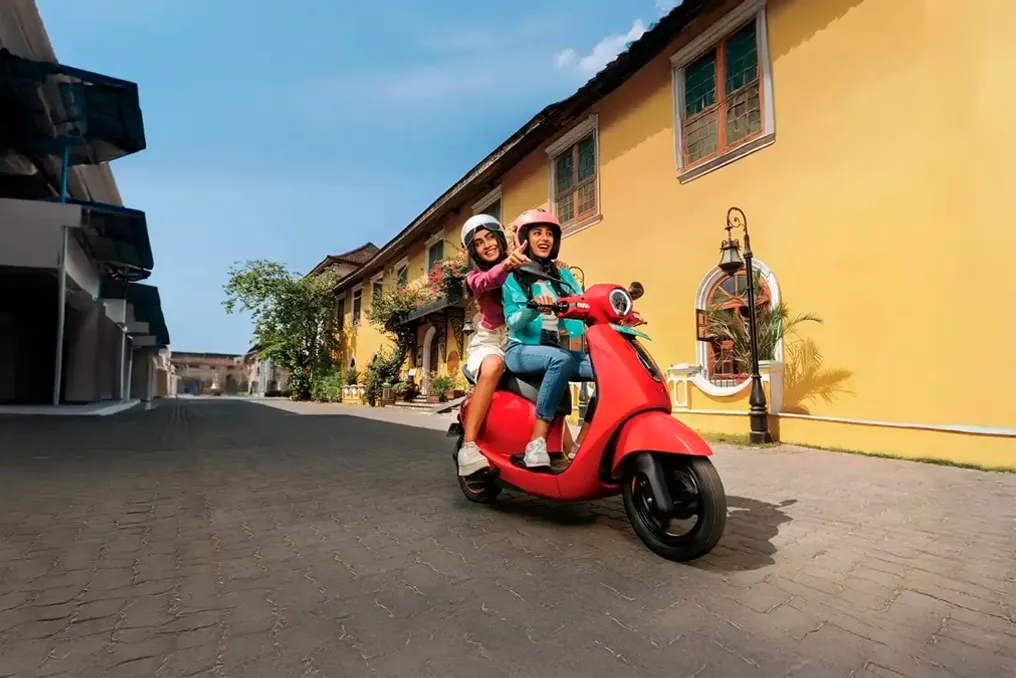
Since the active promotion began, the Bajaj Chetak has demonstrated impressive results. Bajaj Auto has become the third company in India to reach the milestone of selling one million electric two-wheelers. Previously, this figure was achieved by Ola Electric and TVS Motor Company.

Since January 2020, the company has sold 1,011,135 units of Chetak in the domestic market. Demand for this scooter has significantly increased this year, with the company already reaching sales figures of 300 thousand and 400 thousand scooters for the year. There is a possibility that the 500 thousand unit mark will be exceeded this year.

In the early years, sales of this Bajaj scooter were slow: only 1,243 units were sold in 2020. Subsequent years showed growth: 4,765 units were sold the following year, the brand realized 26,758 Chetaks in 2022, 75,112 units in 2023, 201,167 units in 2024, and 279,691 units in 2025.

By 2026, the brand had sold 412,409 Chetaks. This Bajaj scooter is available in several battery variants. The lowest power model, C2501, is equipped with a 2.5 kWh battery, which provides a claimed range of 113 kilometers. Assuming home charging at a rate of 10 rupees per unit, the cost for a full charge will be about 25 rupees, providing a range of 113 kilometers. It is important to note that the actual range depends on many factors, including riding style and road conditions.

The Bajaj Chetak is manufactured in three series: in addition to the Series 25, Series 30 and 35 are available. The highest-end option is the C3503, which has an export price of 124,157 rupees. It is equipped with a 3.5 kWh battery, providing a claimed range of 153 kilometers. The basic model C2501 has an export price of 99,802 rupees and features such as a fully metallic body, music control, and an LCD display, as well as call and message notification functions.

Similar stories

Honda Overtakes Hero MotoCorp in Two-Wheeler Sales for October
Read more
www.aajtak.in

Honda Overtakes Hero MotoCorp in Two-Wheeler Sales for October

In October, the two-wheeler market demonstrated the influence of the festive season, recording high sales from two major companies—Hero MotoCorp and Honda. Both companies sold over 1.4 million two-wheeled vehicles. Data from these companies indicates sustained high demand for motorcycles and scooters, which is expected to continue until Diwali.

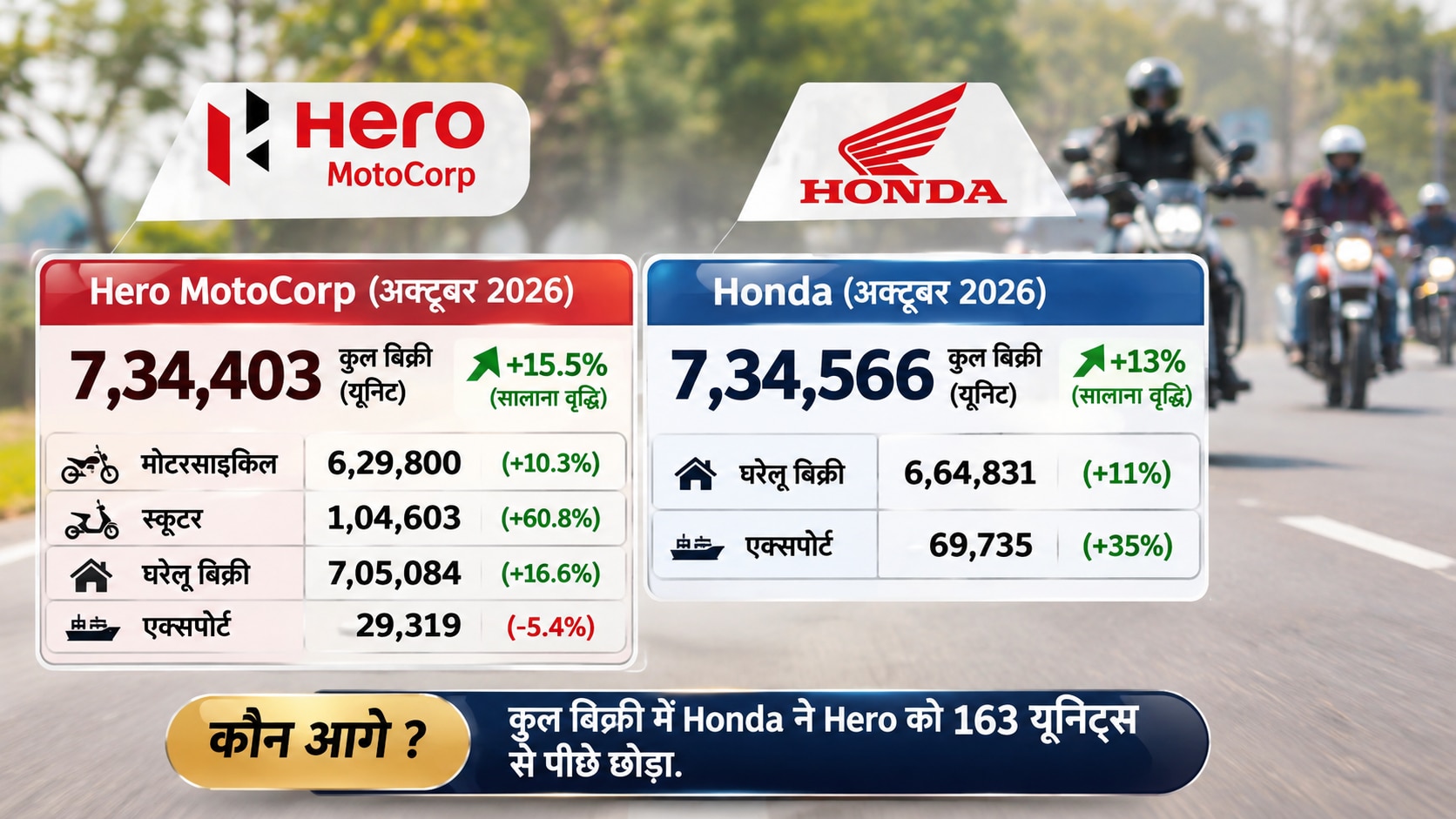
According to Hero MotoCorp's reports, 734,403 two-wheeled vehicles were sold in October 2026. This exceeds the figure from last year (October 2025), when the company sold 635,808 units, representing an annual sales increase of approximately 15.5%. This significant growth was driven by both the motorcycle and scooter segments.

Looking at the segments separately, Hero MotoCorp sold 629,800 motorcycles last October, compared to 570,753 units in the same month last year, which is an increase of 10.3%. The scooter segment showed even more impressive results: the company sold 104,603 scooters in October, compared to 65,055 units in October 2025, demonstrating a 60.8% growth in scooter sales.

In the domestic market, Hero MotoCorp also performed well, selling 705,084 two-wheeled vehicles in India in October, compared to 604,829 units the previous year, an increase in domestic sales of 16.6%. However, the company faced a slight decline in the export direction: in October, it shipped 29,319 vehicles abroad, compared to 30,979 units in October 2025, reflecting an export decrease of approximately 5.4%.

For the fiscal year 2026-27, Hero MotoCorp achieved total sales of 4,279,878 units. This is more than the 3,693,580 units sold in the previous fiscal year, marking a 15.8% increase. Meanwhile, motorcycle sales grew from 3,373,019 to 3,742,465 units, and scooter sales also showed strong growth, reaching 537,413 units in the current fiscal year compared to 320,561 units in the same period last year.

Honda Overtakes Competitor

Honda Motorcycle and Scooter India, despite a similar overall sales volume (including domestic and export markets), surpassed Hero MotoCorp. Last month, Honda sold 734,566 two-wheeled vehicles, while Hero MotoCorp's total sales amounted to 734,403 units. Thus, Honda led Hero by 163 units, becoming the leader in total sales for October, although the difference between the two companies was minimal.

Honda's annual sales grew by approximately 13%. In October of last year, the company's total sales were 650,596 units. Regarding the domestic market, Honda sold 664,831 units in October, compared to 598,952 units in October of last year, corresponding to an 11% increase in domestic sales.

Nevertheless, in terms of domestic market performance, Honda still lags behind Hero MotoCorp. In October, Hero MotoCorp sold 705,084 two-wheeled vehicles domestically, whereas Honda sold only 664,831 units, indicating ongoing competitive rivalry between the two companies.

The most positive aspect for Honda was the export segment. The company shipped 69,735 two-wheeled vehicles abroad last month, compared to 51,644 units exported in October 2025. This marked an impressive annual growth in the company's exports of 35%.

Tata Motors shows impressive results, selling over 200 thousand vehicles in 90 days
Read more
www.aajtak.in

Tata Motors shows impressive results, selling over 200 thousand vehicles in 90 days

The fiscal year 2027 proved to be very successful for Tata Motors in the second quarter, as the company achieved record sales figures. In this quarter, domestic sales of Tata Motors reached 196,674 units. This significantly exceeds last year's figure of 140,189 units in the same quarter, demonstrating a 40% year-on-year growth in the company's sales.

On the global market, the company exported 5,049 units. Compared to the previous fiscal year, when exports amounted to 4,208 units, total vehicle sales reached 201,723 units. Last year, the company sold only 144,397 units during this period.

Considering the entire fiscal year 2027, Tata Motors sold 376,840 vehicles in the first half of the year. Whereas in the first half of the previous fiscal year, 264,028 units were sold, which represents an increase of 42.7% year-on-year. Thus, the company sold 112,812 more units.

A significant share of sales comes from the second quarter, where 201,723 units were sold. Tata's portfolio includes many electric vehicles; in the second quarter of fiscal year 2027, 47,150 electric vehicles were sold, compared to 24,855 electric vehicles in the second quarter of fiscal year 2026.

In the last quarter, the share of electric vehicles in Tata Motors' total sales volume was 23%, and the share of Compressed Natural Gas (CNG) models was 28%. Combining these two categories, 51% of Tata Motors' vehicles were sold in electric or CNG variants.

September proved to be a particularly successful month for Tata Motors, when the company sold a total of 70,210 passenger cars in domestic and global markets. Last year, 60,907 units were sold during the same period. In September 2026, Tata Motors sold 68,810 units domestically and exported 1,400 units.

Among Tata Motors' products, the Tata Punch and Nexon are the most popular cars. In September, Tata Motors sold 15,384 electric vehicles.

LEQI aims to transform daily transport by developing innovative mobile devices
Read more
technode.com

LEQI aims to transform daily transport by developing innovative mobile devices

According to the QYResearch report for 2026, LEQI's Megawheels brand ranked fourth among manufacturers in the global market of self-balancing two-wheeled scooters. In Japan, Megawheels topped the rankings with two million users. These achievements reflect LEQI's ambition to enter foreign markets and build a sustainable global business.

In urban environments, where a two-kilometer trip can be problematic due to traffic jams, parking difficulties, or lack of public transport, electric scooters offer an alternative, provided they are portable, reliable, and easy to use.

This is the market segment that LEQI, based in Shenzhen and founded in 2016, has captured. Today, its product line includes electric scooters, self-balancing vehicles, e-bikes, electric luggage systems, and motorcycles.

The company's main objective is to create products that align with local commuting habits, meet regulatory requirements, and gain user trust in unfamiliar territories. Although the idea seems simple, its execution presents a significant challenge.

One of LEQI's new developments is the L3 Smart Electric Suitcase, which goes beyond the traditional scooter. This product was recognized in the Red Dot Award: Product Design list for 2026. It combines luggage with a riding platform: a foldable chassis and handle allow the suitcase to be used as a scooter, while wide wheels ensure stability both while moving and while seated.

According to the Red Dot description, the suitcase is equipped with LED strips and sensors that allow it to follow the owner and avoid obstacles. The design was praised for successfully merging luggage functions with personal mobility. The L3 model demonstrates LEQI's ambition to integrate mobility technologies into everyday objects, offering travelers a way to combine luggage and transport in one device when moving through large airports or stations.

This concept is part of a broader trend in personal mobility—the integration of transport technologies into items people use daily. Currently, LEQI's portfolio covers city travel, active recreation, and sports, offering products ranging from e-bikes and luggage systems to high-speed motorcycles and dirt bikes.

Within these categories, the company develops competencies in electric drive systems, battery management, sensor control, and connected software. LEQI's expertise in battery management and electric drive systems is applicable to both scooters and e-bikes, while sensors and software can support various types of control and vehicle interaction.

However, having common technology does not imply universal design. An urban scooter must be practical and portable for daily commutes, an off-road motorcycle must handle complex terrain, and a riding suitcase must comply with airport transit restrictions.

Thus, LEQI's task is to adapt its core technologies to diverse needs while simultaneously developing products that are complete solutions in themselves. In 2021, LEQI approved a global branding strategy, utilizing two proprietary brands—Megawheels and LEQI. This step was part of the company's efforts to penetrate foreign markets, where it sold goods through platforms like Amazon and eBay, its own website, and B2B channels.

Furthermore, in 2025, LEQI ranked first globally in electric scooter shipments, and its Megawheels brand had 2 million users and led in Japan. Despite LEQI expanding distribution beyond the domestic market, turning overseas sales into brand recognition, repeat purchases, and reliable after-sales support remains a complex task.

Online marketplaces help manufacturers reach international customers without needing to establish their own retail network. Nevertheless, buyers quickly compare prices, features, and reviews, whereas established brands may have more trust regarding repairs and spare parts.

Regulation adds another layer of complexity. Rules governing electric scooters vary across countries, affecting speed limits, road access, and necessary permits. Products may require different specifications to comply with local norms, and adhering to these rules does not end after customs clearance.

LEQI has experience with these issues. In a 2023 review, the German technology publication heise noted the LEQI smart A11 model as one of the few Chinese scooters possessing the German operating permit Allgemeine Betriebserlaubnis, or ABE.

Each market has its own demands. Understanding local expectations and providing after-sales support can be as crucial for international expansion as the vehicle itself.

In March 2026, LEQI completed a Series B funding round with participation from Xiaomi Group and Shunwei Capital. These funds will be directed towards research in high-power density electric drive systems, real-time decision-making based on artificial intelligence and adaptive control, and next-generation interaction systems. The company also plans to accelerate overseas expansion and strengthen global supply chains and distribution.

The next stage of LEQI's development may not only involve launching new products. It requires engineering, manufacturing, and distribution capabilities to support these products in different markets. LEQI's history reflects a broader issue for Chinese equipment manufacturers: engineering and production skills enable products to reach the market, but they do not guarantee the creation of a global brand.

The L3 model illustrates how LEQI explores new ways of combining mobility with everyday objects, while its scooter business provides a stable product category. Whether this becomes a long-term advantage depends on execution: products must comply with local regulations, function as expected, and remain practical to maintain.

Ratings and design awards attract attention, but building a sustainable international business requires something less obvious: products that organically fit into people's lives, backed by service that continues long after the novelty wears off.
Popular