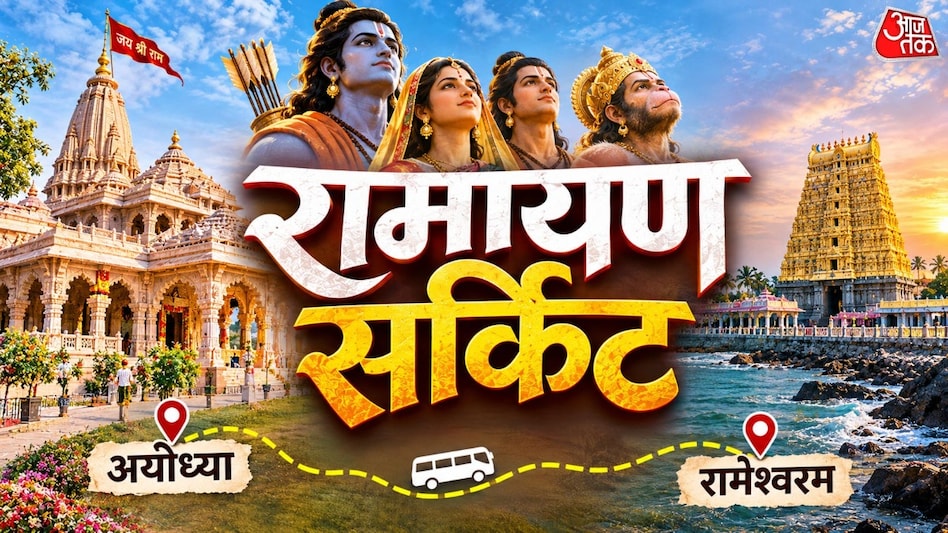
Ramayana Route: How to Travel from Ayodhya to Rameshwaram and How Long It Will Take
Read more
Aaj Tak
www.aajtak.in

Ramayana Route: How to Travel from Ayodhya to Rameshwaram and How Long It Will Take

Hearing the name Ramayana, many recall stories associated with Lord Rama, Sita, and Lakshmana. The country has numerous places considered connected to these Ramayana tales. From Ayodhya to Chitrakon, Nasik, and Rameshwaram, there are many religious sites that continue to attract a large number of pilgrims. These places are valued not only for their religious significance but also for their rich history, culture, and picturesque landscapes.

If you also wish to see these places related to Ramayana, you can plan a trip along the Ramayana route. Below is presented which places can be included in this journey and how long it can take to complete it.

Starting the Ramayana Route Journey in Ayodhya

The Ramayana route journey can begin in the city of Ayodhya, Uttar Pradesh, which is considered the ancestral land of Lord Rama. Here, you can visit major sites such as the Rama Temple, Kanak Bhavan, Hanuman Garhi, and Ram Ki Paidi. Watching the evening Aarti on the banks of the Sarayu River can also be a wonderful experience.

After Ayodhya, you can proceed to Nandigram and Shringaverapur. According to legends, Bharat waited for Lord Rama's return in Nandigram, and Shringaverapur is associated with the meeting of Nishadaraja and Lord Rama. Next, you should visit Chitrakon, where you can see religious sites like Ramghat, Kamdagri, and Hanuman Dhara.

Visiting Religious Sites in Sitamati, Baxar, and Darbhanga in Bihar

After Uttar Pradesh, you can include sites related to Ramayana in the state of Bihar. Sitamati is considered the ancestral land of Mother Sita; it houses religious sites such as Punaura Dham, Janki Temple, and Sita Kund. Furthermore, Baxar and Darbhanga are also among the key points of the Ramayana route. In Baxar, you can visit Ramrekha Ghat and other religious places, while Darbhanga has many historical and religious sites to explore during the trip.

Overview of Religious Attractions in Madhya Pradesh and Odisha

The Ramayana route also includes Chitrakon in Madhya Pradesh. This is the same area as Chitrakon, which is associated with Lord Rama's period of exile. Pilgrimages can be made here at temples and ghats. After this, you can plan a trip to Maendhgri in Odisha. This hilly region is known for its natural beauty and, according to beliefs, holds religious significance. It is recommended to find out information about local routes and weather before visiting.

Trip to Jagdalpur (Chaddagar) and Nasik (Maharashtra)

The Ramayana route also includes Jagdalpur in Chaddagar. Here, you can view religious sites and enjoy the surrounding natural scenery. There are many waterfalls and beautiful spots near Jagdalpur for planning excursions. Next in the route are Nasik and Nagpur in Maharashtra. Nasik features major sites such as Panchvati, Kalaram Temple, and Sita Cave. According to legend, Lord Rama, Mother Sita, and Lakshmana spent time in Panchvati during their exile. The banks of the Godavari River are also a place for walks.

Nagpur is also included in the Ministry of Tourism's Ramayana route list.

Visiting Bhadrachalam in Telangana and Hampi in Karnataka

After Maharashtra, you can travel to Bhadrachalam in Telangana. The main religious site here is the Sri Sita Ramchandra Swami Temple, located on the banks of the Godavari River, where devotion is paid to Lord Rama, Mother Sita, and Lakshmana. Next, you should visit Hampi in Karnataka. Some places around Hampi are linked to Kishkindha, according to the Ramayana. Here, you can see the Anjanadri Hill and surrounding temples. Anjanadri Hill is considered associated with Hanuman, and its natural landscapes attract tourists.

Concluding the Journey in Rameshwaram

The last stop on the Ramayana route can be Rameshwaram in Tamil Nadu. The most significant religious site here is the Ramanathaswamy Temple. According to belief, Lord Rama performed worship of Shiva here before departing for Lanka. In addition to visiting the temple in Rameshwaram, you can walk along the beach and its surroundings. If you have time, you can also visit Dhanushkodi, located near Rameshwaram, known for its scenic sea views and religious beliefs.

To see all the main sites of the Ramayana route, it is best to allocate approximately 20–30 days or even more. The duration of the trip will depend on your itinerary, transportation, and the time spent at each location. It is not necessary to visit all places simultaneously. If you have 5 to 7 days, you can visit Ayodhya, Nandigram, Shringaverapur, and Chitrakon. With 7 to 10 days, you can plan to explore Nasik and nearby areas.

Important Points to Consider

All sites on the Ramayana route are in different states, so you must determine your route before starting the trip. You should study the distances between places and information on means of transport. Train and flight tickets should be booked in advance. Also, arrange in advance for temple visiting times, local transport, and hotel accommodation. If you are traveling through multiple states simultaneously, allow time for rest. This way, you can visit these special places related to Ramayana without rushing.
Similar stories

Review of the Ramayana Film: Conflict Between Visual Splendor and Spiritual Content
Read more
www.aajtak.in

Review of the Ramayana Film: Conflict Between Visual Splendor and Spiritual Content

The story of the Ramayana for the Indian audience is not merely a religious text or a mythological tale, but a profound saga connected with emotions, faith, and traditions, where every character holds a distinct significance. As attempts are made to present the Ramayana on screen in a new format, audience expectations rise. The reviewer watched the film about the Ramayana, directed by Nitesh Tiwari and produced by Namit Malhotra, but encountered disappointment in many aspects, although some scenes managed to capture his attention.

Instead of discussing the plot, the author focuses on the approach to presenting the material, as the main events of the Ramayana are known to most people. A deep analysis of the facts and events reveals moments that raise questions. In several instances, the film employs cinematic license, deviating from reality in pursuit of creating a spectacular visual experience. However, this aspect will be addressed in the next article; for now, the focus is on the author's personal opinion of the film.

Nitesh Tiwari's film begins with the voice of Anupam Kher, who narrates the story of the creation of the world. From the very beginning, the picture strives to create a majestic world. Next, the battle between Ravana's mother, Kaikasi, and other deities led by Indra is shown, in which they suffer defeat. This scene reminded the author of the film 'Kalki 2898 AD,' where people suffering from poverty and hunger await their savior—Ravana.

Nevertheless, it is regrettable that the film does not even touch upon the backstory of Ravana's birth. Mention of his father, Rishi Vishrava, occurs only once, through Kaikasi. Before that, only Ravana's interest in music is shown. After learning the truth from his mother, he goes into asceticism and returns as Dashanan, becoming Ravana.

As a viewer and a devotee of the Ramayana, the author notes the absence of Ravana's connection to Mahadeva. Although Ravana's penance for Brahma is shown in the film, much of the worship of Mahadeva was omitted. Instead, his ascent was depicted through Ravana's Tandava dance. In striving to portray Ravana as a powerful and fierce character, director Nitesh Tiwari missed the opportunity to reveal other facets of his personality.

One might argue that this is cinema, and it is impossible to show every detail. However, if one takes the liberty of creating the film in multiple parts, the author believes that adding a five-minute extra scene could have improved the picture.

In the first half of the film, the pace of development is so high that many scenes are not properly connected to each other. Especially important is the 15-minute exile scene shown before the interval, which should have deeply moved the viewers. This scene truly touched the heart: when Dasharatha, played by Arun Govil, suffers from grief, and Rama goes into exile, the father's cry confuses the son. Despite this, the devoted Rama continues his journey.

The attempt to depict Ravana's reign and its influence was done too quickly, causing the true essence of the Ramayana to be left behind. Due to the rapid progression of dialogues and events, there is a perceived lack of pause in the story. Viewers interested in this subject do not just want to see the events but also to feel the emotions hidden behind them. In this regard, the film causes significant disappointment. Furthermore, the manner of speech and the language of the characters sometimes raise questions.

Usually, when speaking of mythological stories, a sense of reverence arises in the soul. However, here the characters quickly switch from addressing each other with 'you' to using an informal address. The author wonders how common such language usage is in films or series based on sacred scriptures. Thus, the use of linguistic constructions like 'teri-tera' and 'tu-tum' in Nitesh Tiwari's Ramayana leaves a distinct impression.

This creates the impression that the film failed to properly grasp the personality and influence of its characters. The dialogues lack the seriousness and measured pace expected from this story. Seriousness in language is only evident in the manner of speech of Arun Govil, which differs from the other characters.

The visual effects (VFX) in the film are at an acceptable level. The majestic world created with divine artifacts and VFX attempts to give the viewer a unique experience. The film's strengths are its visuals and large-scale cinematography. However, the creators find themselves caught between this splendor and emotional connection. On one hand, the film wants to attract viewers through divine artifacts, massive battles, and a grand world, while on the other, it tries to capture the emotional aspects of the story. The result is a loss of balance, and the soul of the Ramayana remains behind.

Description of Rama and Sita's Wedding Rituals in Valmiki Ramayana
Read more
www.aajtak.in

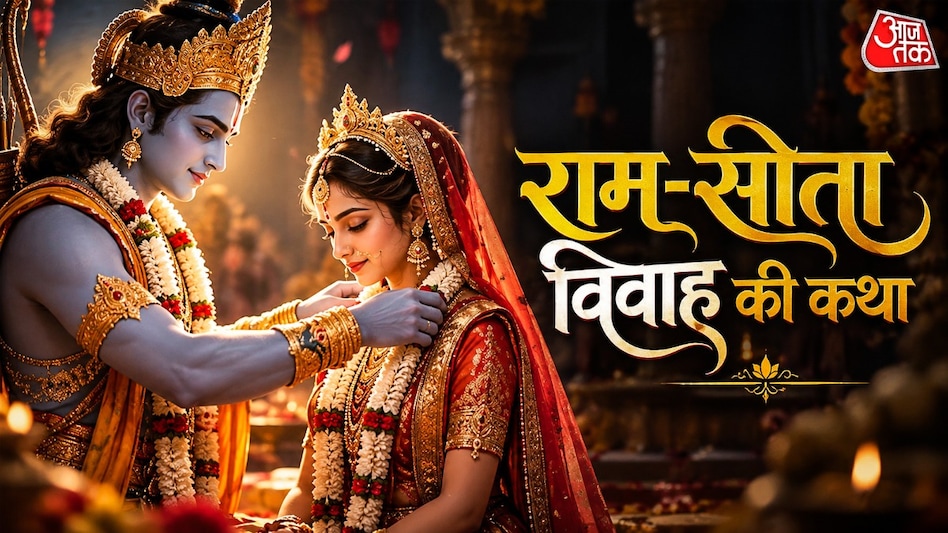
Description of Rama and Sita's Wedding Rituals in Valmiki Ramayana

Following the release of the teaser and the musical track 'Mangal Rang' from the film 'Ramayana,' scenes and rituals from the wedding of Rama and Sita are being actively discussed. This has generated interest in how the wedding of Lord Rama and Mother Sita is described in Valmiki Ramayana, what rituals were performed, and what the wedding traditions of that time were.

Details of Rama and Sita's marriage are presented in the Balakanda of Valmiki Ramayana. According to the text, King Mithila, Sita's father, set a condition for the swayamvara: the marriage would take place with whoever could lift and string the bow of Lord Shiva. When Lord Rama attempted to lift this bow, it broke, after which King Mithila decided on the marriage of Sita to Rama. Subsequently, King Dasharatha arrived in Mithila with his family and sages, and preparations began for the wedding of Lord Rama and his brothers.

How is Rama and Sita's wedding described in Valmiki Ramayana?

Serge 73 of the Balakanda of Valmiki Ramayana contains the narrative of the entire history of the marriage of Lord Rama and Mother Sita. Various preparations were made before the wedding, including determining an auspicious moment. Lord Rama and his brothers were adorned with jewels, and then all the solemn rituals were performed. The 'Kautuka Mangala' is also mentioned in this episode.

Furthermore, Serge 73 of the Balakanda of Valmiki Ramayana states that during the ceremony, the sage Vasistha prepared the altar. After this, fire was lit using Vedic mantras, and offerings were made into it, emphasizing the special significance of fire in the marriage of Lord Rama and Mother Sita.

How did King Mithila give away Mother Sita?

Serge 73 of the Balakanda of Valmiki Ramayana recounts how the adorned Mother Sita was brought before Lord Rama. Following this, King Mithila declared to Rama that Sita was his daughter and would support him in matters related to Dharma. He then handed over Sita's hand to Lord Rama. This moment describes the transfer of the daughter from the father to the groom, which corresponds to modern traditions of Kanyadaan and Panigrahana.

Serge 73 of the Balakanda of Valmiki Ramayana also mentions that when handing over Mother Sita to Lord Rama, King Mithila performed a water ritual accompanied by chanting of mantras. This was followed by the honoring of gods and sages, the sound of drums, and a shower of flowers from the heavens.

The wedding concluded with the circumambulation of fire

Serge 73 of the Balakanda of Valmiki Ramayana also contains a description of the marriages of Lord Rama and his brothers. King Mithila organized weddings for Lakshmana, Bharata, and Shatrughna. The sage Vasistha conducted the wedding rituals according to Vedic canons. According to verses 35-36, all four brothers, along with their wives, performed the circumambulation of the fire, the altar, King Mithila, and the sages, after which the marital rites were completed.

A question arises as to whether rituals involving turmeric and henna are mentioned in Valmiki Ramayana. Serge 73 of the Balakanda of Valmiki Ramayana describes solemn pre-wedding rituals, the lighting of the fire, the use of sacred water, and the circumambulation of fire. However, there is no explicit mention in this excerpt of the rituals of applying turmeric and henna, as is customary today.

Popular