Film about Wuhan lockdown canceled without justification before premiere
Read more
Noticias ao Minuto
noticiasaominuto.com

Film about Wuhan lockdown canceled without justification before premiere

The Chinese film titled 'White Heroes,' which depicts the period of lockdown in the city of Wuhan during the COVID-19 pandemic, was not shown in cinemas on the scheduled date despite having been previously announced. The premiere was set for November 6th, six years after filming and after generating discussions on social media.

Chinese ticketing platforms, Taopiaopiao and Maoyan, did not list screenings for the feature, and those responsible for the production did not publicly communicate the reasons for this apparent postponement.

The project was directed by Hong Kong filmmaker Herman Yau and stars Andy Lau and Chinese actress Yang Zishan. The film narrates the 76 days of isolation in Wuhan, which occurred between January and April 2020, focusing on the experiences of healthcare professionals, patients, and residents who dealt with the consequences of the emergence of the new coronavirus.

The absence of tickets caused confusion among users of the Taopiaopiao platform, who began commenting and questioning the production's status. Some expressed surprise at the cancellation, while others voiced support, defending the importance of watching the film regardless of criticism.

On the other hand, other users raised doubts about the relevance of revisiting a period that is still very difficult for a segment of the population. The trailer, released on October 17th along with the premiere announcement, showed scenes of overcrowded hospitals, circulation restrictions, lack of supplies, and families separated due to isolation measures.

Filming was completed in December 2020, shortly after the end of the lockdown, but the reasons why the production remained out of cinemas for six years were never revealed. The initial premiere announcement had already sparked divided opinions on Chinese social media, with some rejecting the idea of reliving those difficulties and others defending the memory of those who faced the health emergency.

It is important to note that Wuhan was under lockdown for 76 days in early 2020, being one of the first and strictest isolation measures adopted during the pandemic. This measure preceded China's 'zero-COVID' policy, characterized by collective lockdowns, border closures, extensive PCR testing, and mandatory quarantines, which lasted until the end of 2022.


Similar stories

Chinese film 'Sanxingdui: Future Past' becomes the first feature film created using fully artificial intelligence
Read more
pandaily.com

Chinese film 'Sanxingdui: Future Past' becomes the first feature film created using fully artificial intelligence

The film 'Sanxingdui: Future Past,' which runs for 100 minutes and was created using an end-to-end AI-driven workflow, premiered in Chinese cinemas on October 23rd. According to IT Home, this is the first film of its kind to receive public screening approval from the National Cinema Administration of China.

The film's production was carried out by Bona Film Group utilizing its proprietary Boka Film Cloud Studio platform. Over a period of more than two years, the team generated over 1.2 million base images and conducted more than a hundred full iterations of the film. The creators emphasize that every character is an original digital creation, and there are no digital copies of real actors in the movie.

Bona states that AI is primarily responsible for generation and execution, while ideas, script, shot design, and aesthetic judgments come from the AIGMS team of the company. The production process was organized according to the principles of a traditional film crew, involving about 100 people and 17 specialists, including screenwriters, directors, producers, production designers, cinematographers, lighting, sound, and editing specialists.

The plot unfolds in the future, where humanity has delegated all decisions to algorithms, triggering a global crisis. Clues to resolving this problem lie within seven ancient symbols from the Sanxingdui Bronze Age archaeological site located in Sichuan Province. The creators describe this structure as answers from the past and a crisis in the future.

The film's attendance has been modest. The publication National Business Daily reported low occupancy rates during the initial days of release. Specialists working in the AI content sector told the publication that long films created with AI still face challenges regarding consistency of characters, scenes, and details over 100 minutes, as well as image realism. One expert noted that viewers might perceive the AI-generated characters as artificial, hindering emotional connection. Another argued that the original script determines the final outcome: it is a content market, not a production market.

Bona announced that other AI-involved projects are in development, including the sci-fi animation 'Unplanned: Operation Guanghan,' which has not yet received a screening license. Other Chinese studios, such as Huayi Brothers and Huace, have also announced film and series projects utilizing AI. Currently, the film serves as a test to see if a complete AI-based production pipeline can create a picture that audiences will prefer over traditionally made films.

First Chinese AI film, created over two years, receives mixed audience reaction
Read more
www.aajtak.in

First Chinese AI film, created over two years, receives mixed audience reaction

The first feature-length film entirely created using artificial intelligence (AI) premiered in Chinese cinemas on Friday. Due to low demand for advanced tickets, this film may pose a significant challenge to box office revenue in the country's rapidly growing technology industry.

According to ticketing platform 'Maoyan', over 10,000 screenings of the sci-fi thriller 'Sansindui: Past Future' were scheduled for Friday. However, audiences did not show much enthusiasm. According to 'Maoyan', preliminary sales reached only 65,000 yuan by Thursday evening (equivalent to $9,700 or 900,000 Indian rupees). It is projected that total box office collection will remain below 100,000 yuan, which constitutes only a small fraction of the film's stated production cost.

Jiang Defu, CEO of the production company 'Bona Film Group', admitted in a recent interview that the public reaction to the film was reserved. Nevertheless, he emphasized that the picture aims to explore new boundaries. He stated in the publication 'Julie' that they are the first to take such a step, receive permission for theatrical screening, and present their work to the audience for the first time.

'Bona Film Group' reported that creating this film took over two years of work by about 100 people, with costs exceeding 10 million yuan ($1.5 million, or 150 million Indian rupees). Despite this, the film failed to impress Iris Yang. She watched a free preview on Thursday and noted that given the quality of the picture, she would never pay for a ticket.

Yang added that if any AI-created film could provide a cinematic experience comparable to 'Avatar', she would be willing to consider buying a ticket. While AI-generated videos are gaining popularity in China, the world's second-largest economy, AI dramas on the Chinese version of TikTok, 'Douyin', were viewed over 200 billion times in September. Meanwhile, independent AI director Zhang Jun told AFP that the mere fact of creating a film with AI does not guarantee viewers' willingness to pay for it.

Chinese social media users are also not showing much interest in the appearance of AI films in theaters. One Weibo user commented that the film could become very popular if it were available to watch for free on streaming platforms, but people are not yet ready to pay for viewing.

Media Tour 'China Walk' Launched in Sanya for ASEAN Partners
Read more
cgtn.com

Media Tour 'China Walk' Launched in Sanya for ASEAN Partners

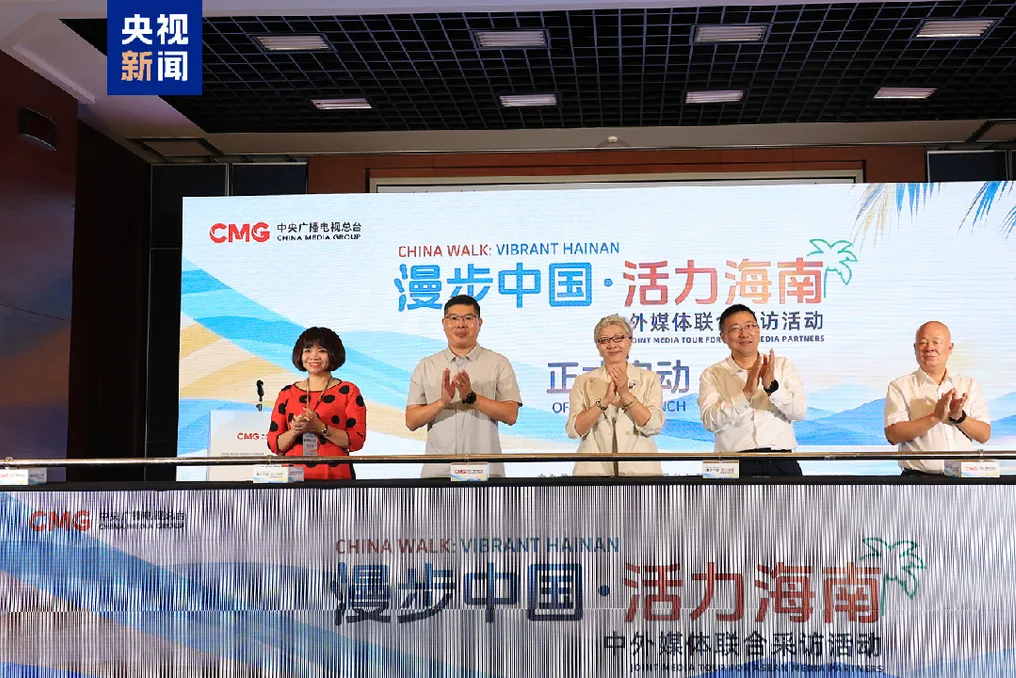
The joint media tour 'China Walk: Vibrant Hainan' 2026 for ASEAN media partners began on October 19th in Sanya, the island province of Hainan in southern China. The event brings together journalists from 11 media outlets across eight ASEAN countries to study the theme of rural revitalization in the Hainan Free Trade Zone (FTZ).

The tour is organized jointly by the Center for Asian and African Languages Programming of China Media Group (CMG) and the Hainan Bureau. The main focus of the tour is on the relationship between the development of the Hainan FTZ and the process of rural revitalization.

Journalists from Cambodia, Indonesia, Laos, Malaysia, Myanmar, Thailand, Timor-Leste, and Vietnam will visit the cities of Sanya and Qijishan, as well as the Linshui Li autonomous county, from October 19th to 24th.

During the reporting period, participants will examine Hainan's efforts in developing unique industries, environmental protection, improving people's lives, and innovations in rural governance. They will also study how the FTZ policy supports rural revitalization and how ecological advantages can transform into development opportunities, highlighting cooperation between Hainan and ASEAN countries in industrial development, joint agriculture, and cultural and tourism exchange.

The tour takes place during the first year of special customs operations in the Hainan FTZ. It also coincides with the 35th anniversary of establishing dialogue relations between China and ASEAN, as well as the fifth anniversary of their comprehensive strategic partnership. The multimedia content created will be distributed through media platforms in ASEAN countries.

'China Walk' is a flagship international media initiative of CGTN, which invites journalists from around the world to personally experience China and cover its development from their own perspective, promoting mutual understanding and cultural exchange.

Popular