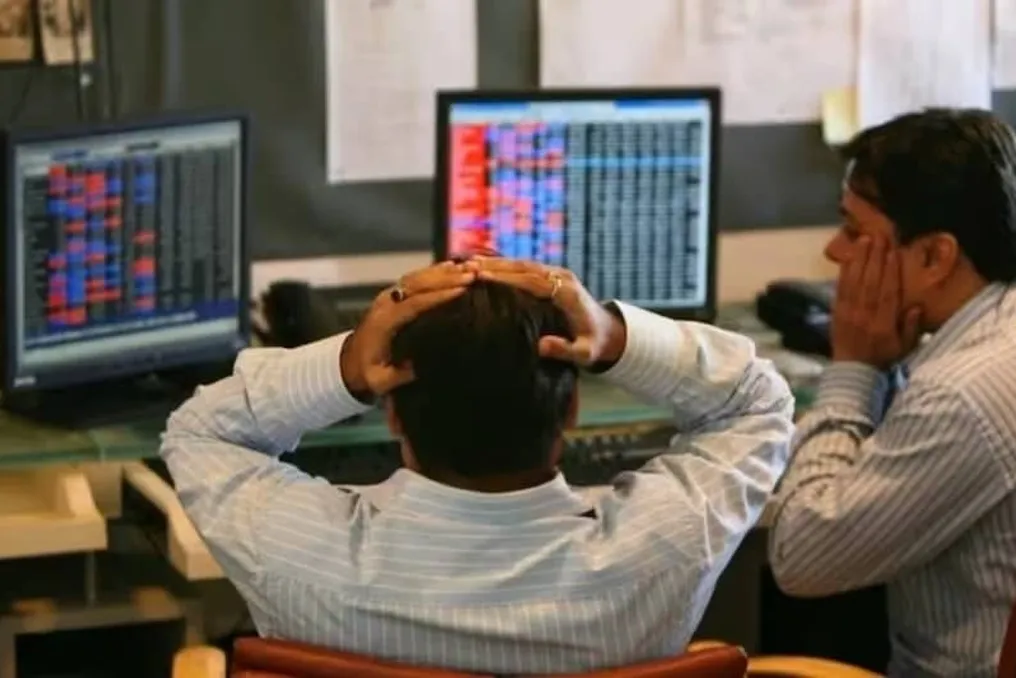
Indian market shows growth, surpassing the 80,000 mark, while US, Japanese, and Chinese markets experience decline
Read more
Aaj Tak
www.aajtak.in

Indian market shows growth, surpassing the 80,000 mark, while US, Japanese, and Chinese markets experience decline

Stock markets, from America to Japan, are experiencing a significant downturn. On Friday, the Nasdaq index in the US fell by approximately 6 percent, resulting in a loss of $3 trillion for investors. Similarly, the Japanese market recorded a decline of over 6 percent. The South Korean market experienced such a sharp drop that it reached its lower price level, leading to a 20-minute trading halt.

However, the Indian market is showing impressive results. The Sensex and Nifty indices are demonstrating strong growth, and the rally has continued for the seventh consecutive day. Due to the Dhanteras festival, the Sensex index once again surpassed the 80,000 mark.

On the last trading day, the Sensex rose by 1074 points, reaching the level of 80,376. Meanwhile, the Nifty increased by 273 points and exceeded the 24,800 mark. Bank Nifty showed a rise of 810 points and went beyond 58,500.

Despite the impressive growth of the Sensex, investors incurred losses as the BSE market capitalization decreased by 100 billion rupees. The BSE capitalization reduced from 501 billion rupees to 500 billion rupees.

Regarding the top 30 BSE stocks, nine of them showed a decline, while the remaining 21 stocks demonstrated steady growth. Mahindra & Mahindra showed the largest increase, rising by almost 5 percent. ICICI Bank shares grew by 4 percent, and Titan shares rose by 3 percent.

Similar stories

Fears of AI led to stock market crashes in the US, South Korea, and Japan
Read more
www.aajtak.in

Fears of AI led to stock market crashes in the US, South Korea, and Japan

A significant decline occurred in the American stock market late at night, resulting in investors losing over 3 trillion dollars, equivalent to more than 270 million crore rupees. As part of this correction, the S&P 500 index fell by more than 3%, the Dow Jones dropped by more than 4%, and the Nasdaq closed at 24,315.00 points, losing 5.52%.

The primary reason cited for this collapse is concern related to artificial intelligence (AI). Investors are worried that following the Democratic Party's victory in the US midterm elections, new restrictions may be imposed on expanding AI infrastructure and data centers. This casts doubt on future revenues and major investments in AI companies. The situation was exacerbated by active sell-offs in chip company stocks.

Due to similar fears regarding AI, chaos began on the South Korean market immediately after trading opened. The KOSPI market fell by more than 8% and reached its lowest price level. During initial trading, it dropped to 8.5%, falling below the 5000 mark. After reaching the lowest price level, trading was suspended for 20 minutes.

Following KOSPI, the Japanese market was in the worst condition among Asian exchanges. The Nikkei index fell by more than 6% or more than 3600 points, reaching the 57,434.77 point level. Over the last month, the Japanese market has shown a decline of more than 18%.

Despite the downturn in Asian markets, the Indian market is showing steady growth. The Sensex index rose by 900 points and exceeded the 80,000 level. The Nifty index also rose by 200 points, surpassing the 24,740 mark.

Despite the impressive growth of the Indian market, investor portfolios remain in the red. Experts explain this by noting a drop of approximately 2% in the small and mid-cap segments, as most investors hold stocks in these categories. Meanwhile, portfolios holding large-cap stocks are performing well.

Investors profit by 20.8 lakh rupees in five days due to stock market growth
Read more
www.aajtak.in

Investors profit by 20.8 lakh rupees in five days due to stock market growth

A sudden shift is observed in the dynamics of the stock market, as the last five days have been characterized by steady growth, while global markets are under pressure, especially American ones. However, the Indian market continues to grow confidently, which has brought significant relief to investors.

According to statistical data, over five trading sessions, the main index of the Bombay Stock Exchange (BSE), SENSEX, increased by more than 4055 points, leading to a substantial increase in the total capital of investors. On Wednesday, after trading, SENSEX closed at 77,301.40 points, showing a rise of 383.55 points, or 0.50 percent.

Similarly, the NIFTY index of the National Stock Exchange demonstrated an increase of 149.75 points or 0.63 percent on Wednesday, closing at 23,960.60. Over the past five days, NIFTY rose by a total of 1261.75 points.

The continuous growth over the last five days significantly increased investors' wealth. Only on Wednesday's trading day, the total capitalization of companies listed on the BSE reached 493.44 lakh rupees, providing an asset increase for investors of approximately 6.65 lakh rupees in one day. If we consider the total income over five sessions, the total increase in investors' assets amounted to a substantial 20.81 lakh rupees.

During this growth period, mid-cap and small-cap stocks showed greater strength compared to large-cap stocks. The Nifty Midcap 100 index demonstrated strong growth of 1.55 percent, and the Nifty Smallcap 100 index—a 2 percent increase. Regarding sectors, all major indices except IT closed in the green zone, with media, real estate, and metallurgy stocks being the leaders.

According to market experts, various domestic and global factors are behind this growth. News about tax benefits in the upcoming central budget boosted the market. Specifically, the statement by Finance Minister Nirmala Sitharaman regarding the consideration of reducing the Long Term Capital Gains (LTCG) tax strengthened investor confidence.

Furthermore, the decrease in crude oil prices provided some relief. Strong demand during the festive season and positive quarterly reports supported market morale. The Indian rupee strengthened against the US dollar for the fourth consecutive time, and the weakening dollar and slowing crude oil prices provided additional support to the domestic market.

Following the results of the US midterm elections, there was a positive sentiment in global markets. This generated hope for a balanced approach to trade and tariff policies, which could stimulate investment from foreign institutional investors (FII) in emerging markets.

Experts believe that thanks to strong domestic demand and visible earnings, the market trend may remain positive in the near future, although periodic profit-taking may occur due to geopolitical risks and fluctuations in crude oil prices.
Stock Market Decline: Three Main Reasons, Losses of 700 Billion Rupees, and Popular Stocks Dropped by Up to 17%
Read more
www.aajtak.in

Stock Market Decline: Three Main Reasons, Losses of 700 Billion Rupees, and Popular Stocks Dropped by Up to 17%

A decline was observed in the stock market on the last trading day and throughout the fourth consecutive session. The Sensex index fell by 1250 points from its daily high, but after the market closed, it showed a significant recovery. Nevertheless, investors in the Indian market incurred losses amounting to about 700 billion rupees.

The market capitalization of the BSE reached 458 billion rupees on Thursday, and by Friday, it decreased by approximately 700 billion rupees to 451 billion rupees. The main reason for this sharp drop was the massive sell-off of stocks in the small and mid-cap segments.

After the sharp fall on Friday, the BSE Sensex recovered, declining by only 125 points and settling at 73,123.83. The Nifty index dropped by 87 points, reaching the level of 22,600. Previously, Nifty had touched the lower level of 22,372, and Sensex had touched 72,452.37.

On Friday, stocks of mid-cap and small-cap companies experienced a serious decline. At the close of trading, the BSE 150 Midcap index fell by 2.10%, closing at 15,143.47, while the BSE 250 Smallcap declined by 2.68%, ending trading at 6,440.65. Shares of Jammu & Kashmir Bank lost more than 16 percent, while Swiggy shares fell by approximately 17%. These two companies became the stocks of the day in the mid-cap and small-cap sectors.

Most stocks in the small and mid-cap segments were in a decline zone of more than 3 percent on Friday, leading to a significant reduction in investor portfolios. Among the top 30 BSE stocks, the largest drop was recorded by Tata Steel, which fell by 3.21 percent. Twenty stocks closed in the red, and the remaining ten closed in the green. Eternal's shares, conversely, closed with a gain of about 4 percent.

The primary reason cited for the decline is the crude oil situation, whose price reached $115 per barrel. Brent Crude Oil rose by 1.33% on Friday, reaching $114.67 per barrel. This rise is attributed to the Houthi attack on Saudi Arabia. Furthermore, foreign investors continue to increase their selling. On October 22, foreign investors sold Indian stocks worth 16,113.89 crore rupees, while DII supported the market by buying stocks worth 14,519.12 crore rupees.

Large-scale selling was observed among both retail investors and foreign participants in the small and mid-cap segments. The results of some companies' reports also influenced the market.

Popular