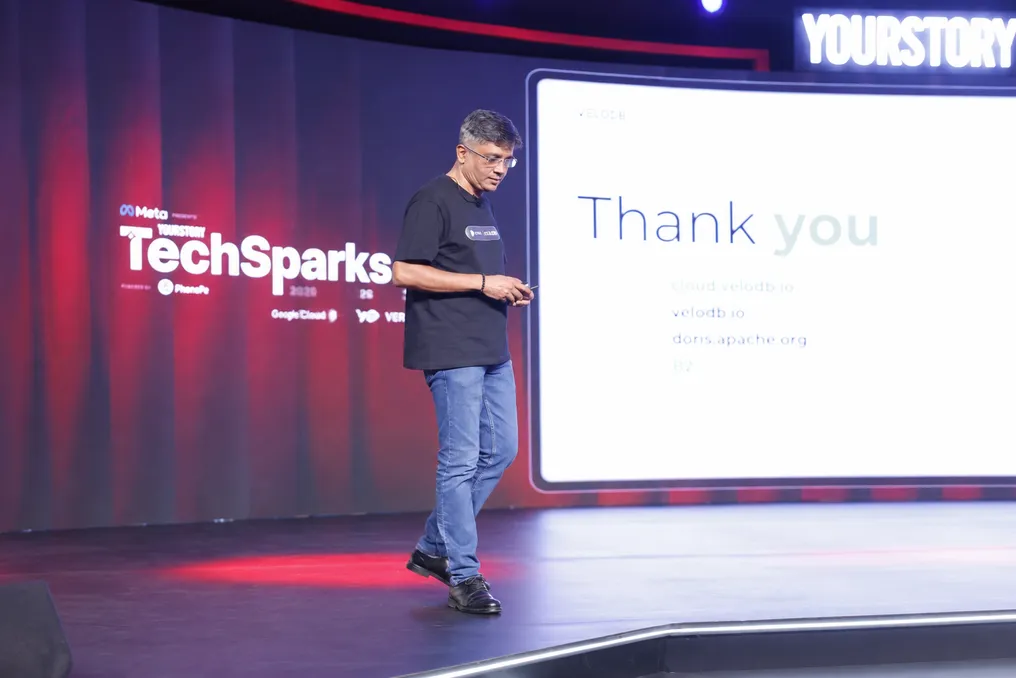
Nitin Vagulde from VeloDB explains the reasons for AI agent failures after the demonstration phase
Read more
YourStory [india, en]
yourstory.com

Nitin Vagulde from VeloDB explains the reasons for AI agent failures after the demonstration phase

Artificial agents often show good results during pilot testing because the scope of application is narrow, data is controlled, and requests are predictable. However, the production environment is different, and this gap leads to the halt of many projects.

Gartner predicts that by the end of 2027, over 40% of AI agent projects will be canceled due to rising costs, uncertain business value, or insufficient risk control. According to Nitin Vagulde, Regional Director for Asia-Pacific at VeloDB, a significant part of the problem lies not in the model itself, but in the data level.

In his presentation titled 'AI Agents at Scale: Surviving After Demonstration,' Nitin detailed how AI agents use data differently from humans, what they need to operate reliably at large volumes, and how companies are restructuring their data infrastructure to support these systems.

Nitin started with an example: in a traditional system, a manager could get last year's sales data by running a ready-made report. The situation changes drastically when you ask an AI agent to explain the drop in sales over the last three quarters. The agent must extract order records from ERP and CRM systems, analyze support tickets and chats for major client issues, and study sales department reports on territory dynamics. If its reasoning is incomplete, it asks for more information.

He noted: 'What used to be completed with one simple search or one simple query now requires hundreds of search operations to obtain the same information.' Previously, the main consumers of business data were people and reports, and systems were built around fixed reports with clear boundaries.

Now, according to Nitin, AI has become a new customer of this data, and it behaves completely differently. Agents work around the clock, ask numerous questions simultaneously, and function in an iterative cycle: asking, thinking, searching, and repeating attempts until an answer is received. Their questions are also not pre-written, creating a strong and unpredictable load on the data layer.

The complexity is compounded by the fact that business data is distributed across multiple locations: transactional records, chat memory, documents, dashboards, and vector stores for semantic search. The agent has to search all these sources and combine the results before providing an answer.

Every additional data query increases costs. If the data is outdated, the answer will be incorrect. Nitin compared this to driving with an inaccurate traffic map. Furthermore, when data comes from multiple sources, it becomes harder to determine the source of the answer, which creates a trust issue.

He compared this situation to sending a person to five filing cabinets to collect papers. By the time the person returns from the fifth cabinet, the information from the first may already be outdated.

Nitin outlined four requirements that agents must meet to transition from pilot mode to full operation. VeloDB's answer is a unified engine that satisfies all these needs. The company was founded in 2023 by initial developers of Apache Doris, an open-source real-time analytics database that became a top-level project of the Apache Software Foundation in June 2022. According to VeloDB, Apache Doris has over 14,000 stars on GitHub and 700 contributors, and is used by more than 5,000 enterprises worldwide.

To reduce the number of back-and-forth queries slowing down agents, VeloDB supports hybrid queries. One query can combine SQL, vector search, and text search, performing deterministic and probabilistic searches in parallel. The result is a single reliable source instead of disparate data.

Nitin presented two examples of companies using such an architecture in their work. The first is one of the largest cryptocurrency exchanges with over 120 million users, which he did not name. The exchange provides transaction data to AI agents, which retail investors can request, for example, to see the positions of major traders in a certain asset. He reported that its agents process about 33,000 dialogues with a final latency of about 3 milliseconds, operating around the clock.

The second example is the Chinese AI company MiniMax, which listed on the Hong Kong Stock Exchange in January 2026 and serves 212 million users in over 200 countries. MiniMax rebuilt its logging system on Apache Doris after abandoning Grafana Loki, as logs became a valuable source of information worth retaining and querying.

Nitin specified that MiniMax uploads data at a rate of 10 Gbps and can query about 10 petabytes in less than two seconds, while reducing costs by 70%. VeloDB separately stated that the Doris-based system now supports logs across all of MiniMax's business lines in petabyte scale with availability exceeding 99.9%.

The same problems apply to early-stage startups creating agents, added Nitin. VeloDB collaborates with fintech startups facing the same scaling challenges as MiniMax or the crypto exchange, just at an earlier stage.

His concluding thesis was that agents will always ask hundreds of questions, so the infrastructure must ensure that each one is cheap, fast, and up-to-date. For Nitin, scaling AI agents depends less on finding the best model and more on providing agents with reliable, real-time data from a single source. He argued that companies that correctly configure the data layer can make decisions faster, reduce costs, and confidently move their agents from pilot mode to operational use.


Similar stories

Nasdaq index falls amid concerns over AI spending and data center expansion
Read more
techcentral.co.za

Nasdaq index falls amid concerns over AI spending and data center expansion

The Nasdaq index significantly declined after its record close on Thursday, losing more than 10%. This movement suggests a potential correction driven by concerns regarding massive artificial intelligence expenditures and increased scrutiny over data center expansion.

The composite Nasdaq index, which is heavily reliant on the technology sector, fell nearly 4% during trading in New York. This drop exceeded 10% from the record closing high reached on October 6th.

Thursday's decline erased previous daily gains as Democrats won both chambers of Congress. Investors began assessing the potential for closer attention to further infrastructure build-out for AI.

Samir Samana, Senior Global Market Strategist at Wells Fargo Investment Institute, noted that the transition from complete unified control by one party to complete unified control by another can cause significant uncertainty, disruption, and sharp policy shifts.

He added that when it seemed Democrats would gain a significant majority in both the House and the Senate, analysts anticipated at least a temporary pause in the markets.

The 10% drop from the last record high is widely viewed as a correction, marking the second Nasdaq correction this year. Sentiment toward AI-related stocks has worsened in recent weeks, and Nasdaq has lost over $2.5 trillion in market value in October.

Several large technology companies are tapping debt markets to finance multi-billion dollar investments planned for data centers, chips, and other necessary infrastructure for AI development.

Investors are increasingly questioning the speed at which these investments will translate into profits, especially against the backdrop of persistent geopolitical tensions in the Middle East and fears of prolonged inflation, which sustain high borrowing rates.

Reporting published last month by Alphabet and Meta, two of the largest hyperscalers building and operating the world's largest data centers, failed to reassure investors about the return on AI spending, contributing to a broader sell-off of AI-related assets.

The main problem with artificial intelligence lies not in the model itself, but in the data infrastructure
Read more
yourstory.com

The main problem with artificial intelligence lies not in the model itself, but in the data infrastructure

Despite the growing availability of artificial intelligence models, turning them into reliable commercial products remains a complex task, especially when enterprises face fragmented data infrastructure.

At the TechSparks 2026 event, Michael Cronin, Vice President of Sales for Asia Pacific, Japan and India at Couchbase, participated in a discussion with Shivani Mutanna, Senior Director of Strategic Content and Video at YourStory. They discussed the transition of AI from the experimentation stage to full production, management challenges, customer experience, and the increasing role of India in AI innovation.

For decades, large corporations have implemented various databases and highly specialized solutions to solve specific problems. While each solved an immediate issue, the result was often a fragmented data layer composed of multiple systems that interact poorly with each other.

Cronin considers this fragmentation a serious obstacle to AI adoption. He cites industry estimates suggesting that 70–80% of AI development projects never reach the production stage, and MIT research showed that 95% of such projects do not become profitable.

Couchbase's operational data platform is designed to address this problem by helping companies consolidate their data infrastructure. Instead of trying to fix everything at once, Cronin advised companies to start small, recommending that founders and enterprises struggling with data layer fragmentation first choose the most critical use cases.

He cited the example of UK retailer Tesco, which has a large Global Capability Center (GCC) in Bengaluru. Many of this retailer's systems negatively impacted the customer experience, especially during peak shopping periods like Black Friday and weekends. Tesco began consolidating its data layer, starting with one instance and one use case before expanding efforts across its entire technology stack. This consolidation allowed the retailer to process millions of transactions per second with less than a millisecond latency. In Cronin's view, this example demonstrates how companies can begin solving the fragmentation problem through one use case before scaling changes across their entire operation.

The pressure associated with developing AI products has prompted many enterprises to prioritize models and applications. However, pilot projects are often conducted on small datasets in controlled environments, which does not prepare organizations for real-world production demands. Cronin pointed to the growing scale of machine traffic. He stated: 'In eighteen months, machine traffic surpassed human traffic on the internet. That is the scale of AI. That is the scale of machine speed at which businesses must operate.'

When AI applications encounter real-world workloads, fragmented data systems can prevent them from functioning reliably at scale. The increasing use of AI agents exacerbates this issue. As agents become more autonomous and take on decision-making functions, enterprises must ensure they can access the necessary data within appropriate governance structures.

Fragmented systems can hinder communication and management, limiting agents' ability to act autonomously. Cronin also urged enterprises to reconsider their approach to allocating AI investment. While models evolve rapidly, corporate data remains a critical asset. He emphasized: 'Models can be rented. The best model today is yesterday's newspaper. The true asset for an enterprise is data.'

As enterprises began to realize that fragmented data was slowing down their AI initiatives, many responded by adding APIs and connectors to link existing systems. However, Cronin warned that this method could create additional complexity instead of solving the core problem. Every extra connection increases latency, risk, and creates another potential point of failure.

Instead, he recommended consolidating the data layer so that AI applications and agents could interact with it more directly, bringing data closer to the customers. According to Cronin, many enterprises, including large GCCs in India, are currently re-architecting to eliminate data fragmentation. Without these changes, further investments in AI development may lead to the same problems.

Data consolidation can also improve customer experience by helping systems handle growing demand, remain available, and respond quickly. As customers expect more from AI-based services, having data at the edge is becoming increasingly important.

Cronin noted that business cultures vary across the Asia Pacific region, but fragmented data infrastructure remains a common challenge for AI adoption. At the same time, India is emerging as a vital hub for AI innovation and decision-making. He noted that 80% of Couchbase's top 50 global customers have a significant presence in India, with much of their AI innovation and leadership based in the country. Couchbase is also expanding its presence in India, moving its Asia Pacific headquarters to Bengaluru. Among Couchbase's corporate clients in India are Air India, Airtel, BigBasket, and Mahindra Finance. In Cronin's opinion, India's role in global business extends beyond cost savings; innovation, leadership, and important business decisions are increasingly happening there. He mentioned Air India's next-generation entertainment platform, which is built on Couchbase. This platform aims to provide passengers with a personalized shopping and entertainment experience even without network connectivity on board the aircraft. For Cronin, this project illustrates how Indian enterprises are using technology to enhance customer experience in real-world operations.

Forge Code Expert Explains Why an AI-Based 'Software Factory' is Necessary for Effective Software Development
Read more
yourstory.com

Forge Code Expert Explains Why an AI-Based 'Software Factory' is Necessary for Effective Software Development

Although artificial intelligence is capable of generating code at unprecedented speeds, the process of testing, verifying, and deploying it into a working environment remains a separate complex task. Engineering teams are increasingly using AI agents to write code, fix bugs, and create new features, but faster coding does not guarantee faster software delivery.

As code generation gains momentum, the volume of checks increases, testing slows down, and teams find it difficult to coordinate the growing amount of changes.

At the TechSparks 2026 conference, Tushar Matur, CEO of Forge Code, highlighted this issue in his session 'Anatomy of a Software Factory.' He explained how AI-focused engineering organizations can move beyond automating individual coding tasks and start creating systems that manage the entire Software Development Life Cycle (SDLC).

Matur noted that just because code generation has become easier and faster does not mean the overall SDLC will accelerate. He reminded that the traditional development approach focused on writing code efficiently, requiring teams to define requirements, prepare specifications, and design architecture to reduce the load on the implementation phase.

However, since AI takes on much of the coding work, bottlenecks shift to other areas. Matur described a situation where organizations face a huge number of pull requests awaiting review, longer testing cycles, and more errors than existing regression suites can detect.

He emphasized that solving the problem does not necessarily involve hiring more engineers or launching more AI agents. Additional staff can increase coordination costs, and adding agents without effective feedback mechanisms can lead to code that overwhelms the verification and testing systems.

'The reason for this is the lack of signal,' Matur explained, clarifying why simply connecting automated steps does not create an effective software factory.

Matur presented Forge Code as a software factory that coordinates AI agents throughout the development cycle. The process begins with sorting requests, creating specifications, and implementing features. Then, agents check the changes before they are deployed, with human engineers intervening when decisions or feedback are required.

The system also monitors in the working environment, using the gathered data to inform future tasks. This forms a feedback loop, allowing the factory to identify issues, improve its workflows, and generate new work based on the experience gained. During the presentation, Matur reported that Forge Code used about 100 agents in the background to work on features, compatibility, and bug detection.

He outlined six principles for building an effective software factory: autonomy, scalability, cost-effectiveness, measurability, self-improvement, and alignment with business goals. The last principle is particularly important.

The factory should not operate as a task of writing code for every request, but rather be aimed at achieving specific outcomes, such as increasing customer retention or meeting regulatory compliance. Teams can then prioritize features based on the value they bring. In this model, engineers spend less time managing each task and more time observing results, analyzing signals, and improving the system itself. Business leaders can also provide requests and priorities directly, allowing the factory to translate organizational goals into a development backlog.

Code writing speed is good, but creating better software is the real victory. For engineering teams, the key is transforming AI-driven speed into reliable products, measurable progress, and real business results.

Popular