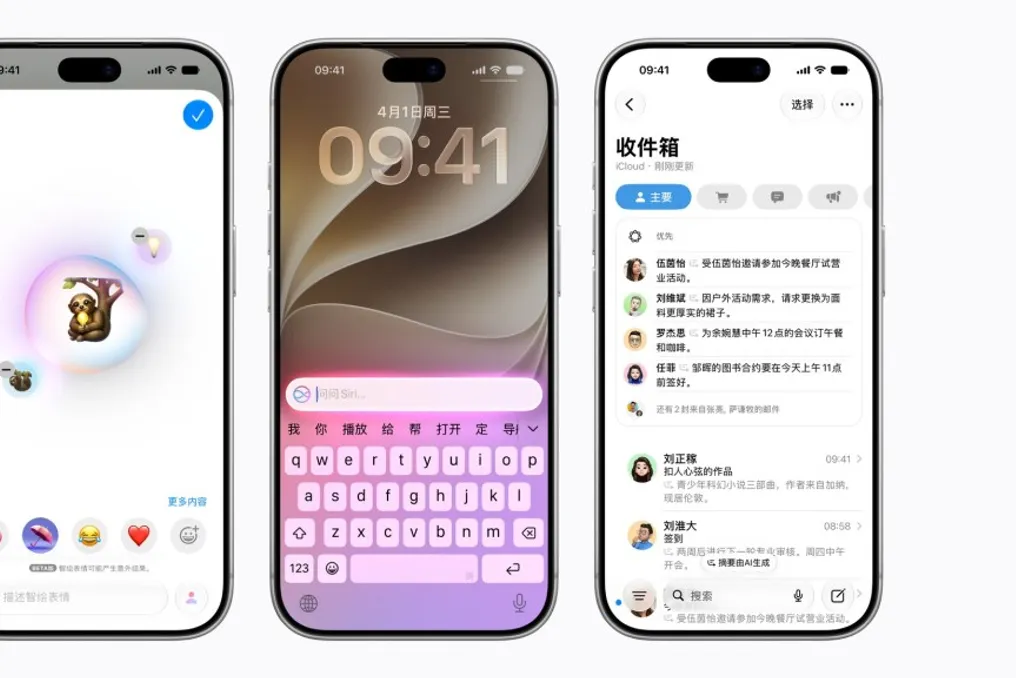
Apple's partnership with a Chinese artificial intelligence company has gone through a difficult period. On November 4th, Apple Intelligence began beta testing in China, utilizing Alibaba's Qwen model in select features of Siri, Writing Tools, and Visual Intelligence. This collaboration marked an unusually rapid ascent for the family of models launched in 2023.
According to data from Hugging Face, in the first seven months of 2026, the Qwen model received over 2 billion downloads on its Hub, surpassing Google and Meta. However, Qwen's journey was not smooth: the model faced internal skepticism, fierce competition, and the departure of key employees before achieving global recognition.
Qwen's path to Apple did not begin as a story of inevitable victory. Alibaba introduced Tongyi Qianwen in April 2023, months after ChatGPT triggered a race in China's tech industry to develop large language models. The model soon began publicly releasing weights, gradually making open source code a central element of Qwen's strategy.
Even within Alibaba, Qwen was not the automatic choice. Some teams continued to use Meta's Llama until 2024, while Fliggy and Alibaba.com experimented with DeepSeek's R1. The models had to earn the trust of their own company before they could capture a wider market.
Open source became part of the solution. Developers refined Qwen, created derivative versions, and fed improvements back to the team, which noted this feedback in the Qwen2.5 expansion across language, coding, and mathematics.
By the end of 2024, Qwen2.5 began gaining traction among developers in China and the US, as well as more teams within Alibaba. Then came DeepSeek. Its R1 reasoning model raised the stakes across the Chinese AI industry, putting new pressure on competitors to achieve stronger reasoning at lower costs.
According to The Information, Alibaba founder Jack Ma repeatedly demanded development updates from executives. In the final push, mattresses appeared under desks for short naps, and some employees slept only a few hours in the last week.
Qwen3, released in April 2025, entered this new battleground with eight open models and hybrid reasoning, switching between a slower 'thinking' mode for complex tasks and faster responses when deep reasoning was not required. Its largest open model utilized a Mixture-of-Experts architecture, activating only 22 out of 235 billion parameters simultaneously to reduce inference costs.
Reuters presented this launch as part of the intensifying Chinese AI race following DeepSeek's growth. Over the next year, Qwen continued to expand its model family and developer reach. However, by early 2026, the pressure on the team became not only technical.
In March, technical lead Junyang Li suddenly announced his departure in three words: 'Goodbye, my beloved Qwen.' Head of Post-Training Boweng Yu also left after senior researcher Binyuan Hui earlier that year. Alibaba did not publicly disclose the reasons for Li's departure.
36Kr reported tensions related to proposed reorganization, team boundaries, hiring, and computing resources. At an emergency meeting, researchers questioned why Alibaba Cloud customer payments could secure computing power while the Qwen team itself faced resource shortages. Management acknowledged communication issues, stating that the changes were intended to strengthen, not weaken, Qwen.
This incident highlighted the broader tension facing cutting-edge AI labs: the most advanced models require centralized capital and massive computational resources, whereas top research groups often rely on autonomy and rapid decision-making. Alibaba responded by tightening coordination. In June, the company created Token Foundry, merging key model development teams under CEO Eddie Wu.
By September, Daichen Liu, a long-time Qwen researcher, was appointed head of the Qwen large language model project, bringing clarity after several rounds of reorganization. Qwen evolved from a simple family of models into a broader stack: foundational models for language, coding, and multimodal tasks; Alibaba Cloud Model Studio for developers and enterprises; and consumer products like the Qwen App.
This breadth of coverage was significant for Apple. After evaluating Chinese AI providers, including Baidu, Tencent, ByteDance, Alibaba, and DeepSeek, Apple selected Alibaba as its partner for Apple Intelligence in China. By August 2026, Apple also trained a China-specific model with Alibaba's support, with the approved configuration including Qwen.
Apple's broader AI investment strategy also encompasses foundational models and native AI applications, as well as integrating AI into existing business processes. By May 2026, Alibaba stated that its expenditures would exceed the initial plan of 380 billion yuan. The deal with Apple marks a new phase. Maintaining Qwen's pace, focus, and ingenuity may become a more complex challenge as its surrounding infrastructure becomes increasingly massive.