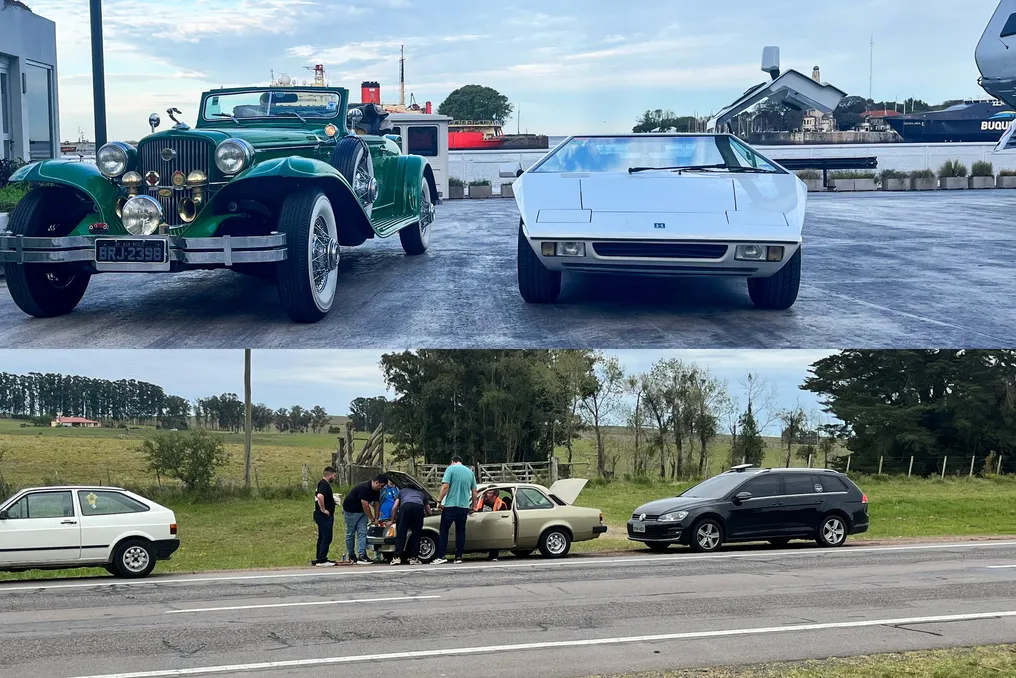
The first part of the Expedição Autoclásica 2026 adventure began in São Paulo with the participation of 1982 Chevette, 1992 Gol, 1972 Triumph GT6, and an auxiliary Golf Variant. The author joined the group in Santa Catarina, and they then traveled through Rio Grande do Sul and Uruguay into Argentina. During the trip, two Brazilian cars not part of the standard series, the Concorde and Hofstetter, were transported.
Four days on the road were marked by mechanical problems, border bureaucracy, a missed ferry, and other unforeseen circumstances, including the appearance of Lionel Messi. Two sports cars were delivered to San Isidro, and the group arrived in Balcarce shortly before midnight. The full group was only assembled at four in the morning when Marco and his father finally appeared with the Triumph after covering approximately 1100 kilometers in about 20 hours.
They were now in Balcarce, the city of Juan Manuel Fangio. In the following days, a visit to Crespi Competición, the local racetrack, and the Fangio Museum was planned before returning to Buenos Aires for the main event of the expedition—Autoclásica.
Balcarce: A City with Culture
The next morning, the participants woke up later. After waiting for the Triumph until four in the morning, despite lack of sleep, they did not have to rush early in the morning for the first time since the start of the expedition. Breakfast became an opportunity to meet Fernando and Leonardo, two participants who had arrived by plane and were in Balcarce from the previous day. After a brief chat, they went to visit Crespi Competición and then headed to the racetrack.
Balcarce is located just over 60 kilometers from Mar del Plata and more than 400 kilometers from Buenos Aires. The municipality has fewer than 50,000 residents, distributed between the city and surrounding rural areas. It is a small settlement that possesses a vast amount of automotive history: Juan Manuel Fangio was born here, there is a museum dedicated to him, a nearly 4.6-kilometer racetrack, and an operating race car manufacturer dating back to the 1960s.
Crespi Competición was founded by Tulio Crespi, who began building race cars in the 1960s and became one of the leading manufacturers of training monopost cars in Argentina. His cars participated in many national categories, and the company also produced street sports cars such as the Tulia GT and Tulieta, which were presented at the Paris Exhibition in 1975.
Mazza met Tulio a year earlier during his trip through Argentina, and it was then that the opportunity arose to organize a trip to the racetrack. Unfortunately, they could not meet: Tulio passed away on September 22 at the age of 88, just fifteen days before their visit. His sons, Luciano and Matias, hosted them, showing them the factory, projects, and cars being built or prepared on site.
Crespi designs and creates its own chassis, bodies, and components. This is not a workshop that takes a ready-made car and modifies it for racing; here, cars are literally born among tools, machinery, and components produced by the company itself.
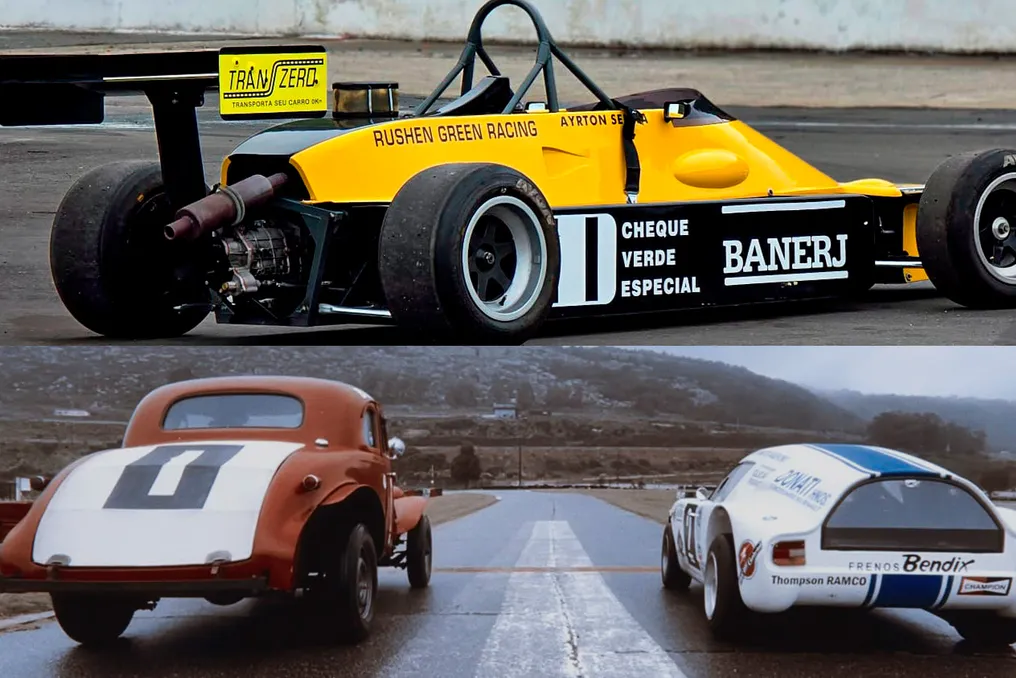
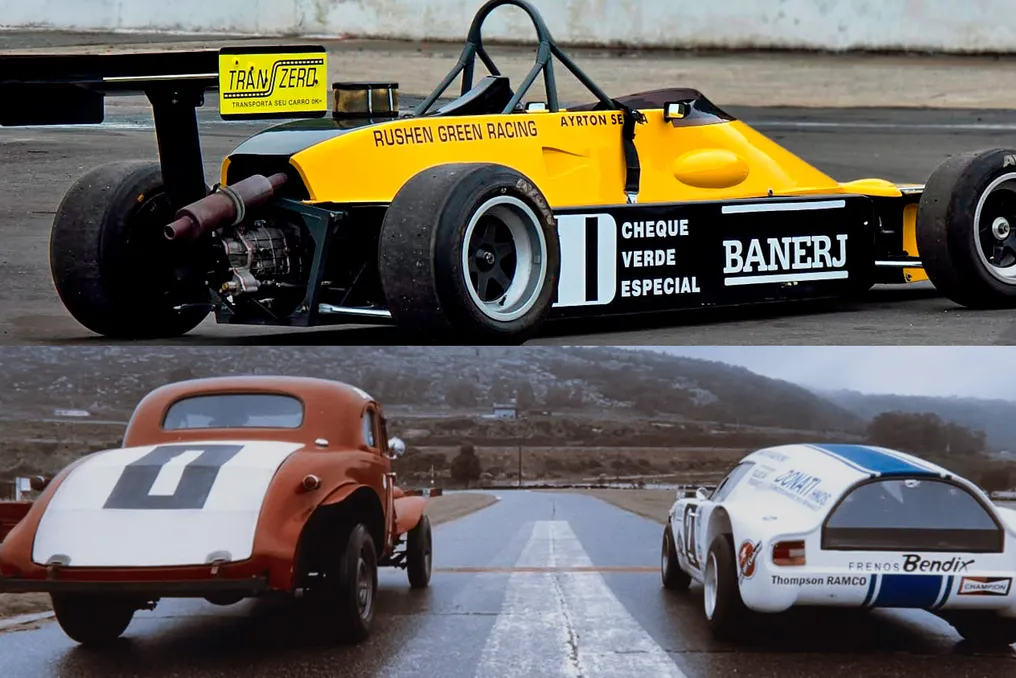
Among the cars at the factory were the Tulieta GT convertible and several monoposts used in the filming of the Netflix mini-series Senna. The Crespi family built 22 functional replicas for production, reproducing various race cars from Ayrton Senna's trajectory. Luciano also drove these cars in the filming, while Matias played Alan Prost in the racing scenes. This is a story the author plans to tell in another report, as there is a great deal of interesting engineering and manufacturing in this piece.
From the factory, they headed to the Juan Manuel Fangio Racetrack, one of the most beautiful tracks the author had ever seen. Balcarce is located near the Tandil mountain range, which interrupts the endless plains of the province of Buenos Aires. The racetrack was built on the slope of Serra La Barra, with mountains on one side and open fields on the other. The track follows the terrain, featuring turns of varying radii, changes in direction, and significant altitude variation over its 4592 meters.
The racetrack opened in January 1972 and reopened in September 2026 after about fifteen years without national competitions. Restoration work included safety and infrastructure interventions, but they did not change what most attracted the author to this place.
Juan Manuel Fangio is modest. Simple, but not primitive. There are no large buildings or complex facilities for guests. The workspace is mainly a hangar capable of accommodating several dozen cars, although less than ten can work comfortably there. There are toilets, a covered area, a viewing platform, and the necessary structure for managing races.
The author recalled Willow Springs in the United States. These are completely different tracks, but both demonstrate that having a racetrack does not require building an entertainment complex. The track, hangar, and necessary facilities for organizing events can be sufficient—although this does not mean that building or maintaining a track is cheap, obviously.
This structure explains the tradition of motorsport in Balcarce. The racetrack creates demand for mechanics, preparers, component manufacturers, workshops, and all types of services related to competitions. Crespi is an example of this, although the city's history in motorsport predates the opening of the track.
This aspect is particularly interesting to the author because in Brazil, the cost of building racetracks and the viability of major competitions are often discussed, but what a track can represent for local motorsport is not always considered, regardless of whether it hosts national or international events.
However, the main focus that day was on two monoposts prepared by the Crespi brothers. The first was a recreation of the Van Diemen Formula Ford used in Senna's filming. The second was the Crespi FC-1, inspired by 1980s Formula 1 race cars. The FC-1 weighs about 600 kg and can use various engines. The available unit is equipped with a turbocharged 1.8 Volkswagen 20-valve engine, prepared to about 300 hp, according to the Crespi brothers—a ratio of 2 kg/hp.
The participants were set to drive the cars themselves, following a lead car that set the pace. That day, it was the Crespi brothers' own Mercedes-Benz C250. The problem was the rain. From the morning, they faced cold, wind, and very fine precipitation that sometimes resembled hail. Even with slick tires, the monoposts could move on the track, provided the pace matched the conditions. Participants got into the cars and completed laps while the author waited for his turn.
The author was curious to know if he could get into a car. He is 1.85 m tall and weighs 120 kg, which does not make him an ideal candidate for a Formula Ford cockpit. He did not manage to sit in the seat, but wanted to try at least. Around 3:30 PM, the drizzle began to turn into heavier rain. The track became too wet, and Crespi decided to pack up the cars. This was unsuccessful.
He did not find out if he would fit in the Formula Ford, and most importantly, did not get the chance to drive the car. It would have been interesting to drive a monopost on this track, but the rain prevented it.
On the same day, another tour was planned. After visiting the Crespi family factory and the racetrack, they went to the center of Balcarce, where the Fangio Museum is located.
From the racetrack, they headed to the Museo Fangio, in the center of Balcarce. This was one of the places the author had wanted to visit for years, long before the opportunity to drive Crespi cars. The building has a rather unique architecture. Its several levels are connected by a spiral ramp that allows one to go through the entire collection without interrupting the visit to change floors. Cars are displayed along this route, accompanied by photographs, documents, trophies, and items that help tell not only about Fangio's career but also about the history of Argentine motorsport.
For those who grew up reading about the early years of Formula 1, seeing the original Maserati 250F and Alfa Romeo 308—of which only four examples were made—would already be a sufficient reason to visit Balcarce. There were also Talbot-Lago T26C and other race cars from different eras. The author could examine these cars, familiar from books and photographs, up close, studying the proportions, body construction, suspension, and details that are not always visible in pictures. The museum also houses authorized replicas of very rare cars, such as the Mercedes-Benz W196, Ferrari 166 Formula 2, Bugatti Type 32, and Lancia D50. Ferrari, incidentally, will appear again in the author's trip: next week he will find an original at the Automóvil Club Argentino museum in Buenos Aires.
After touring the galleries, they walked past the souvenir shop and returned to Casco de Fangio, where they planned to visit the main house of the estate that the pentacampeon used when he was in Balcarce. Unlike the guest quarters, the residence was preserved almost as it was in the final years of the driver's life. The furniture, decor, and even the placement of objects seem left in place. It looks like stepping into a house from 1991, waiting for its owner's return.
There are photos and memories everywhere, many of them reproductions of historical images. Among this material, the author found a painting that made him stop for long minutes. It was a photograph signed by Rudolf Uhlenhaut, Piero Taruffi, Juan Manuel Fangio, Stirling Moss, Karl Kling, and Alfred Neubauer. The names need no introduction for those who know the history of Mercedes-Benz in 1950s racing. They included signatures of drivers, the engineer responsible for some of the brand's most important cars, and the man who managed their teams on the track. And these were real autographs—traces of pen could be seen on the photo paper. The author stared at it for a long time. The photograph, signed by six legends of motorsport, hung unnoticed on the wall of the house in Balcarce. Who would have thought?
After the visit, they had another Argentine dinner with meat, potatoes, and wine. The rain had not stopped, and the author hoped for a break the next morning, as they still had two historical cars from the Fangio Foundation to drive.
Another Side of the Museum
The next morning, the wind continued to howl in the trees surrounding Casco de Fangio. The air was piercingly cold, and the fine precipitation did not cease. At times, it seemed like micro-hail, burning upon hitting the face. Despite the weather, the Fangio Foundation decided to hold an event with historic cars. The activity was moved to the Balcarce karting track, where it was safer to drive on the wet track.
Two cars were available. The first was a Torino MK TC Liebre III, a late 1960s Turismo Carretera model designed by Periberto Pronello and driven by Gastón Perkins, the 1969 Argentine champion. The second was a recreation of a 1939 Chevrolet Coupé, which Fangio used in road races in the 1940s, including the 1948 South American Grand Prix, better known as Buenos Aires–Caracas. The author started with the Torino. This is a race car...