
Taobao's MNN team releases MNN-Pocket-0.3B model, sized at 173 MB, for on-device operation
Read more
Pandaily
pandaily.com

Taobao's MNN team releases MNN-Pocket-0.3B model, sized at 173 MB, for on-device operation

The MNN team from Taobao has released the MNN-Pocket-0.3B model to the public. This language model, containing approximately 300 million parameters, is designed to function directly within mobile applications. According to a report by IT Home on November 6th, the model is built on the MNN inference engine and is intended for large-scale universal service and e-commerce applications, such as Taobao, where limited computational power, memory, and battery life on the device must be distributed across numerous functions.

The team set four key goals for their model, which they termed an application-native large model. These goals included achieving a decoding speed of over 200 tokens per second on specific devices. Peak memory consumption had to remain below 300 MB, leaving a buffer of about 500 MB within the overall model budget for context growth and integration overhead. Furthermore, a single typical inference process should not consume more than one-hundredth of the reference phone's battery charge, meaning 100 runs would cost less than 1%. Finally, when performing specified business tasks, the model must demonstrate results comparable to 8B class models.

Testing showed that MNN-Pocket-0.3B operates fully offline on the iPhone 18 Pro using the MNN engine, achieving an average decoding speed of about 350 tokens per second. The INT4 deployment package, which includes weights, tokenizer, computation graph, and inference configuration, is 173 MB in size. On the iPad Pro with the M5 chip and using the Metal backend, the team recorded a decoding speed of 466 tokens per second and a prefill speed of 8721 tokens per second, with peak memory increasing by 228 MB relative to the baseline. On the Snapdragon 8 Gen 5 phone using the CPU backend, 251 tokens per second was recorded, and the additional energy cost for 100 runs on the OnePlus 13 was about 0.3% of the battery charge.

The model was trained from scratch, with a particular focus on Chinese and English languages. After testing dense configurations ranging from 50 million to 1.3 billion parameters, the team determined that the size around 300 million was the largest that simultaneously met memory and speed requirements. It was decided to use 28 layers with grouped-query attention, as transitioning to 36 layers did not increase average performance but slowed down decoding. The vocabulary was reduced from approximately 151,000 tokens from the Qwen3 tokenizer to 64,000, which allowed for reduced embedding and output layer costs.

The team reports an IFEval score of 73.20, a Chinese IFEval of 74.59, and an average of 50.00 across 11 Chinese and English benchmarks, surpassing similarly sized and larger models, including Qwen3-0.6B. The model card notes that, like other models with fewer than a billion parameters, it is not recommended for complex mathematical tasks or long-horizon code generation.

Variants published on Hugging Face include a base model for continued pre-training, a supervised fine-tuning checkpoint, an instruction-tuned model, a GGUF build, an MNN INT4 build, and a decision-making head model for candidate selection. The release also contains a draft speculative decoding model, DFlash2, which, according to the team, can double decoding throughput in certain tasks.

Similar stories

Lenovo unveils AI host Kaitian with Zhaoxin KX-7000 processor and Houmo LQ50 NPU for local 35B model execution
Read more
pandaily.com

Lenovo unveils AI host Kaitian with Zhaoxin KX-7000 processor and Houmo LQ50 NPU for local 35B model execution

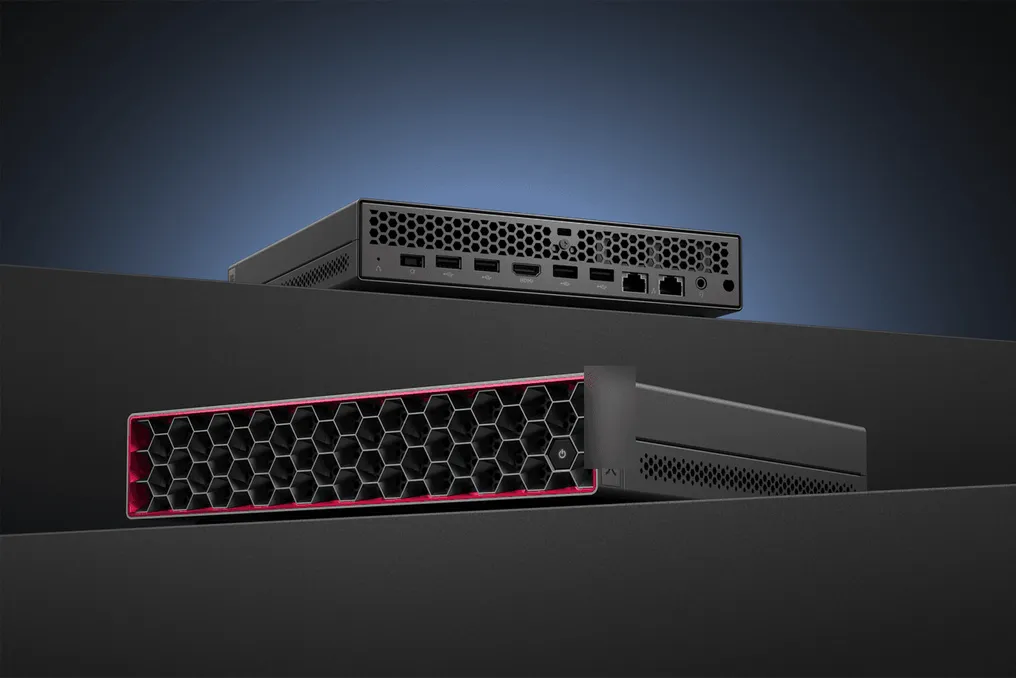
Lenovo has released the first AI host system in its Kaitian lineup, intended for China's IT innovation market (Xinchuang). This 1.6-liter desktop computer integrates a Zhaoxin processor with a Houmo AI NPU, enabling the local execution of models around 35 billion parameters.

The device is equipped with an eight-core Zhaoxin KX-7000 processor and the Houmo Liqing LQ50 NPU. In the standard configuration, the system provides 160 TOPS of computing power in INT8 format, which can reach 320 TOPS with the NPU option. The NPU features 24 GB of dedicated memory with a bandwidth of 153.6 GB/s. The host runs on Kylin OS and comes pre-installed with Lenovo's Tianxi AI Pro agent.

The company tested the device using open models, including the Qwen3.5 and Qwen3.6-35B-A3B series. When utilizing the 24 GB NPU and W4A8 quantization, the Qwen3.6-35B-A3B model generated text at a rate of approximately 28.99 tokens per second during local inference. The system supports input data up to 200,000 tokens for processing long documents and multi-turn tasks. The Houmo platform provides developers with tools for profiling, compiling, runtime management, and model quantization.

Lenovo positions this host as a perpetually active digital employee designed for round-the-clock operation. This allows agents to perform scheduled tasks such as local knowledge retrieval, document drafting, and information summarization, with output processing occurring directly on the device rather than through cloud tokens, thus keeping data local. During the event, Tianxi AI Pro testers instructed the device to check a mobile operator's application, and the device successfully executed a test call, measured the delay of a verification SMS code, and provided a report.

Regarding thermal dissipation, the processor and NPU have separate air channels behind the hexagonal front panel with high-pressure fans. Lenovo reports that at idle, the chassis temperature is about 33 degrees Celsius in a 25-degree room, and under full load, it reaches 41 degrees. In a 35-degree room, the temperature reaches approximately 46 degrees under full load. The noise level is 19.4 dB in standby mode and about 29.5 dB during full NPU inference. The device weighs about 1.5 kg and is equipped with two independent 2.5GbE ports.

It should be noted that the Kaitian host differs from the Lenovo AI Host P7, which was introduced in October with Houmo M50 and CIX P1 chips.

Xiaomi releases Xiaomi-OCR-0 model with 0.8 billion parameters, leading in the OmniDocBench class
Read more
pandaily.com

Xiaomi releases Xiaomi-OCR-0 model with 0.8 billion parameters, leading in the OmniDocBench class

Xiaomi has announced the release of the Xiaomi-OCR-0 model, a lightweight document understanding model. The weights and inference code for this model are available on Hugging Face and GitHub, the company reported on October 30th.

The model boasts 0.8 billion parameters and is designed to perform three types of tasks within a single system: document parsing, key information extraction, and visual question answering via OCR.

The parsing functionality includes recognizing main text, tables, and mathematical formulas, outputting structured results in reading order with support for native Markdown and LaTeX formats. For key information extraction, the model focuses on invoices, receipts, IDs, and business forms, locating requested fields and providing the result in JSON format for automated workflows.

Visual question answering goes beyond simple transcription, enabling cross-regional searching, numerical calculations, and reasoning based on documents and charts.

Training and Methodology

Xiaomi states that the model is built upon the Qwen3.5-0.8B-Base model and was trained on approximately 170 million OCR and document samples. Data labels were filtered by achieving consensus among several expert OCR models that performed mutual verification and voted on areas of text, tables, and formulas.

When working with complex tables and formulas, the team utilized a 'predict, re-render, and compare' loop: candidate results were re-rendered into images and compared with the original at the pixel and structural level to detect shifted rows or missing characters. Synthetic complex cases included multilingual text, historical handwriting, screen moiré effects, and distorted lighting.

The training process occurred in three stages: first, textual fine-tuning to align visual regions with text tokens; second, continued pre-training of OCR on tens of billions of tokens; and finally, reinforcement learning for mixed tasks with verifiable rewards, such as edit distance and table matching scores.

Testing Results

On the OmniDocBench v1.6 benchmark, the model achieved a score of 96.83, ranking second overall, only 0.04 points behind the leader, and becoming the top performer among models with less than one billion parameters. In the Real5-OmniDocBench test, which simulates scanning, crumpled paper, screenshots, lighting variations, and tilted frames, the model scored 95.24. Its performance on Wild-OmniDocBench was 87.94.

The model reaches 97.84 on the UniMER-Test reference formula test and 92.27 on PubTabNet for table structure evaluation. Averaging results across DocVQA, InfoVQA, ChartQA, OCRBench, and TextVQA, it scores 83.2, surpassing HunyuanOCR-1.5 with 76.5 and 8B MiniCPM-V-4.5 with 82.6, although it trails Qwen3.5-4B with a score of 84.9. It should be noted that all presented figures are proprietary data from Xiaomi.

Xiaomi reports that this technology is already integrated into the Super XiaoAi assistant on its phones, where it can extract boarding passes, queue numbers, bill details, and meeting times directly from the screen. In addition to the model weights, Xiaomi provides developers with a browser demo version, the MCP service, and an Agent Skill toolkit.

01.AI Company Kai-Fu Lee Receives Hundreds of Millions of Yuan in State Investment from Hangzhou
Read more
technode.com

01.AI Company Kai-Fu Lee Receives Hundreds of Millions of Yuan in State Investment from Hangzhou

01.AI, founded by Kai-Fu Lee, has attracted investments amounting to hundreds of millions of yuan from state investors in Hangzhou and the Linping district of the city. This agreement was announced on October 30 after being signed two days earlier.

Under the terms of the deal, 01.AI plans to locate its headquarters in Linping and establish a base to assist enterprises in implementing artificial intelligence. These funds are aimed at supporting the company's growing focus on enterprise applications and specialized AI systems for industries.

The company is gradually phasing out consumer-oriented services, shifting towards corporate AI solutions. In September, the public models platform stopped offering trial versions of models and API services. Lee stated that the company is now adapting Chinese open models, such as DeepSeek, Qwen, and GLM, for business clients, with approximately half of its revenue coming from outside China.

Popular