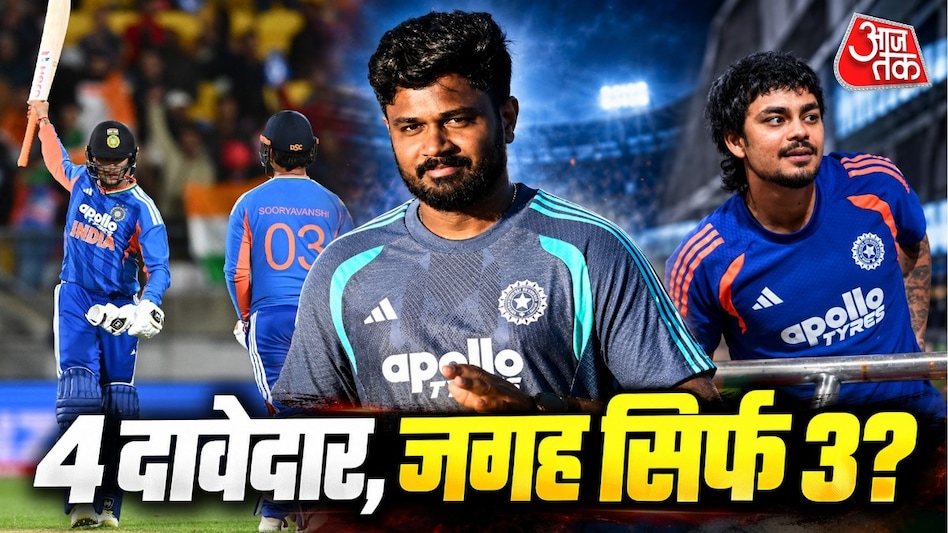
Second match of the India vs New Zealand series to be held in Wellington; team changes being discussed
Read more
Aaj Tak
www.aajtak.in

Second match of the India vs New Zealand series to be held in Wellington; team changes being discussed

The second match of the five-match one-day series between India and New Zealand will take place at Henry Stadium in Wellington on Saturday (November 7). The match is scheduled to start at 7:30 AM Indian time. Following a victory in the first match, the Indian team leads the series 1-0, and the team, led by Shubman Gill, now aims to continue its winning streak.

Some changes may occur in the Indian squad for this match. Experienced fast bowler Mohammed Siraj might get a chance to feature, while Akib Nabi may be dropped. Siraj was not included in the squad for the first match but has now joined the team, and his return will add extra strength to India's attack line.

At the beginning of the game, Rohit Sharma and Shubman Gill will bear significant responsibility. Although Rohit failed to score any runs in the first ODI, the team management might give him another chance. Gill will also look to strengthen the top order while playing as captain. Virat Kohli will come in at number three, who made a significant contribution to India's victory in the first match by scoring 74 runs off 51 balls.

Is it possible that Axar will play again at number five? Shreyas Iyer could earn a spot at number four, despite failing to convert a good start into a big score in the previous match. Axar Patel might be placed at number five in the middle order. KEL Rahul could bat at number six and also take on wicket-keeping duties. Naman Dihr could strengthen the team in the lower middle order.

The pitch in Wellington is expected to favor fast bowlers. Arshdeep Singh, Anshul Kamboj, and Gurnoor Baar have performed well in the first ODI and may be given another chance. On the other hand, Akib Nabi failed to take any wickets, conceding 33 runs in six overs, making his exclusion from the starting XI highly probable. Mohammed Siraj could utilize his experience to take wickets with new ball.

Meanwhile, New Zealand opener Devon Conway has been ruled out of the entire series due to a concussion. He will be replaced by Nick Kelly. Good news for New Zealand is that star fast bowler Matt Henry is fit, and his return to the starting lineup is inevitable. Consequently, Blair Tickner might be left out of the squad.

The projected Indian squad for the second ODI includes: Rohit Sharma, Shubman Gill (captain), Virat Kohli, Shreyas Iyer, Axar Patel, KEL Rahul (wicketkeeper), Naman Dihr, Anshul Kamboj, Gurnoor Baar, Mohammed Siraj, and Arshdeep Singh. The projected New Zealand squad for the second ODI includes: Tim Seifert, Will Young, Henry Nicholls, Daryl Mitchell, Tom Latham (wicketkeeper), Glenn Phillips, Mitchell Santner (captain), Nathan Smith, Kyle Jamieson, Matt Henry, and Jacob Davies. Full squads for both the Indian and New Zealand teams are also provided.

Similar stories

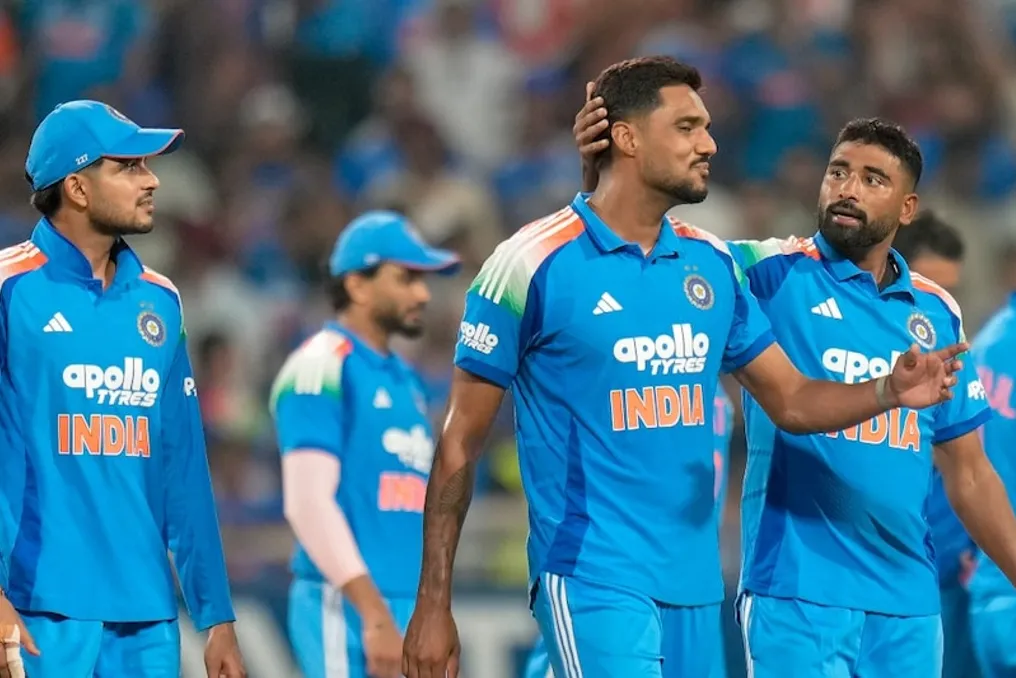
India and New Zealand Squads Ahead of First ODI in Auckland: Changes in India's Lineup
Read more
www.aajtak.in

India and New Zealand Squads Ahead of First ODI in Auckland: Changes in India's Lineup

The first ODI match between India and New Zealand will take place in Auckland. Indian captain Shubman Gill decided to win the toss and start the game with a toss. For this match, the Indian team selected four fast bowlers.

Gill explained his choice by noting that there are clouds overhead and mentioned that if the number of overs is limited due to weather conditions, having a target on the board would be advantageous. The team expressed enthusiasm and readiness for the series. Gill also suggested that the conditions in New Zealand would be very similar to those found in South Africa.

Four fast bowlers were included in the Indian squad: Anshul Kamboj, Akib Nabi, Guruveer Barar, and Arshdeep Singh. Additionally, Axar Patel and Naman Dir were part of the starting lineup. The team also includes captain Shubman Gill, Rohit Sharma, Virat Kohli, Shreyas Iyer, and KL Rahul.

It should be noted that the squad was different in the last match against West India, which took place on October 3rd in New Chandigarh: Shubman Gill (captain), Rohit Sharma, Virat Kohli, Rituraj Gaikwad, KL Rahul (wicketkeeper), Nitish Kumar Reddy, Naman Dir, Anshul Kamboj, Kuldeep Yadav, Mohammed Siraj, Guruveer Barar. In that match, Mohammed Siraj, Rituraj Gaikwad, Kuldeep Yadav, and Nitish Reddy did not get a chance.

In that match on October 3rd, the Indian team scored 351/7 runs, but thanks to Sai Hope's unbeaten knock of 162 runs, West India won by 5 wickets with 10 balls remaining. Nevertheless, the Indian team won the series 2-1.

New Zealand captain Mitchell Santner announced that Devon Conway sustained a head injury the day before and will rest, thus not participating in this match. He will be replaced by Tim Seifert. Santner discussed the top order of the New Zealand team, specifying that Tim Seifert, Will Young, and Henry Nicholls will start the game. He also touched upon player opportunities and squad depth. According to Santner, due to the tight schedule of both teams, players are rotated, giving new players a chance to prove themselves. He also noted that the New Zealand team, like India, will take the field with four bowlers.

India Squad: Shubman Gill (captain), Rohit Sharma, Virat Kohli, Shreyas Iyer, Axar Patel, KL Rahul (wicketkeeper), Naman Dir, Anshul Kamboj, Akib Nabi, Guruveer Barar, and Arshdeep Singh. New Zealand Squad: Tim Seifert, Will Young, Henry Nicholls, Daryl Mitchell, Tom Latham (wicketkeeper), Glenn Phillips, Mitchell Santner (captain), Nathan Smith, Kyle Jamieson, Jacob Duffy, and Blair Tickner.

In the IND A vs NZ A match: Mukesh Kumar and Mohammed Siraj performed brightly, but the New Zealand team gained an advantage
Read more
www.aajtak.in

In the IND A vs NZ A match: Mukesh Kumar and Mohammed Siraj performed brightly, but the New Zealand team gained an advantage

In the second match of the unofficial three-match test series between India A and New Zealand A, held at Hagley Oval in Christchurch, players from India A demonstrated outstanding play on the day of the third match (November 2). Nevertheless, New Zealand A managed to gain a significant advantage based on the first innings.

India A's fast bowler, Mukesh Kumar, took five wickets for 87 runs, while experienced fast bowler Mohammed Siraj bowled out four players, conceding 118 runs. One wicket was secured by spinner Washington Sundar.

Responding to India A's total of 346 runs, New Zealand A scored 424 runs, giving them a lead of 78 runs in the first innings. Subsequently, India A managed to score 32 runs without loss in their second innings on the third day. Currently, Yashvi Jaiswal has 20 runs, and Sai Sudharsan has 11 runs, and both remain not out. At present, India A trails New Zealand A by 46 runs, and the match appears to be heading towards a draw.

The home team faced difficulties in the first innings, but middle and lower order players complicated matters for India A. Matthew Boyle played brilliantly, scoring 110 runs off 152 balls, while Dan Foxcroft could not reach a century, scoring 93 runs. Additionally, lower order players made useful contributions: wicketkeeper Mitchell Hayes added 31 runs, Christian Clark contributed 41 runs, and Fraser Smith, batting at number nine, scored 40 runs.

The most serious problem for India A was the quick dismissal of the last batsmen. The last three wickets of New Zealand A added 133 runs to the team. In the final wicket, Jared McKay and Zen Lennox formed a partnership of 55 runs, allowing the team to cross the 400-run mark. Both players scored 33 runs.

The India A squad included: Yashvi Jaiswal, Sai Sudharsan, Devdutt Padikkal, Yashas Rathore, Dhruv Jurel (wicketkeeper/captain), Smaran Ravichandran, Washington Sundar, Manav Chatur, Akash Dip, Mohammed Siraj, and Mukesh Kumar. The New Zealand A squad consisted of: Rhys Marius (captain), Curtis Hiffin, Tim Robinson, Matthew Boyle, Dan Foxcroft, Mitchell Hayes (wicketkeeper), Christian Clark, Brett Randell, Fraser Smith, Zen Lennox, and Jared McKay.

Ishan Kishan's return questions India's squad composition after bright victory over New Zealand
Read more
www.aajtak.in

Ishan Kishan's return questions India's squad composition after bright victory over New Zealand

The Indian team faces a complex dilemma: how to integrate players in excellent form while accounting for the possible return of Ishan Kishan. The questions concern not only the on-field lineup but also the order of play and rotation policy.

In the third T20 match against New Zealand, the Indian team demonstrated powerful play, giving the opponents no chance. Abhishek Sharma scored 113 runs off 38 balls, and Vaibhav Suryavanshi showed his strength in the squad, allowing India to reach a target of 199 runs in just 13.2 overs.

Thanks to this impressive victory, India gained an undisputed 3-0 lead in the five-match series. However, amidst this success, a difficult question has arisen: if Ishan Kishan recovers and returns to the team, whose place will be taken?

As soon as the wait for Ishan Kishan's return ends, the Indian team may face a selection problem. On one hand, there is Abhishek, capable of changing the course of the match with his explosive playing style. On the other hand, there is Vaibhav, who was fielded at the start in the third T20. Sanju Samson is also a key player who scores runs.

Deciding to drop Abhishek will be difficult given his recent performance. Dropping Vaibhav would call into question the plan to consistently give opportunities to the young batter at his preferred position. Excluding Sanju is also not easy, especially if he is strengthening his position by scoring runs.

The question of Ishan's return is also important. When the player becomes available after recovery, the team management must decide on his inclusion and the role of the other players. The real task is not just choosing one name, but creating a combination that maximizes the strengths of all players.

In the third T20, while Ishan was absent, Vaibhav Suryavanshi got a chance to bat at the top. This sparked a new discussion about the order of play. Vaibhav's main strength is attacking bowlers at the beginning of the innings. Previously, there were doubts about experimenting with his placement at the third position.

However, if the team plans to continue using Vaibhav at the start, it will have to reconsider the batting order of the remaining batsmen. In the third T20 against New Zealand, Sanju Samson batted at the third position. Now, if they maintain the plan with Vaibhav at the start, Sanju may be forced to adapt to a different role.

The situation is complicated by the question: should Sanju give up his preferred position for Vaibhav? Will the team management change the batting order to keep the Abhishek and Vaibhav duo? And will it become harder for Sanju to secure a spot in the squad after Ishan's return?

There is currently no definitive answer to these questions. Nevertheless, it is clear that one player's return may require a review of many aspects of the batting order.

The most important question in this situation relates to the Indian team's rotation policy. India has scheduled 16 T20 international matches from August to December: 3 against Afghanistan, 5 against West Indies, 5 against New Zealand, and 3 against Sri Lanka.

There could be a scenario where the team management predetermines how many matches each player will get, who will rest, and what each player's role will be. If players were informed in advance that they could take a break after four or five matches, the decision to exclude a player would not be based solely on their performance.

This could bring two advantages to the team. Firstly, it would reduce the pressure on key players who play constantly. Secondly, players' roles would remain clear during experiments with alternative squads.

Nevertheless, rotation does not mean that players must be excluded, even with good performance. Management must make decisions based on physical condition, form, opponent, and strategy. But having a preliminary plan could significantly simplify explaining any changes.

There are about two years until the T20 World Cup. This gives the Indian team time to test various batting order options, evaluate players in their roles, and make changes if necessary.

Therefore, the current selection crisis cannot be seen merely as losing a spot for one player. It is also an opportunity for the team management to develop a future strategy. Does India want to promote the Abhishek and Vaibhav duo at the top? What position will benefit Sanju the most? What will his role be after Ishan's return?

Popular