Bangladesh fielder seriously injured during match against West Indies, carried off on stretcher
Read more
Aaj Tak
www.aajtak.in

Bangladesh fielder seriously injured during match against West Indies, carried off on stretcher

A serious incident occurred for the host team Bangladesh during the second match of the test series between Bangladesh and West Indies, played at the Sylhet International Cricket Stadium in Sylhet. During the first game of the series, opener Shadman Islam sustained a severe injury while fielding.

The injury happened on the second day of the match, November 6. Islam, who scored a century in the first match of the series, fell on the field experiencing severe pain due to an ankle injury. He then had to be removed from the field on a stretcher.

The incident took place in the 78th over of the first innings of West Indies. Amir Jangoo hit the ball towards the fine leg, which was bowled by Mehdi Hasan Miraz. Shadman Islam ran after the ball into the slip area, but his foot slipped while trying to pick up the ball, injuring his ankle upon falling.

After falling, Shadman Islam suffered a long period of pain. He was taken on a stretcher to the other end of the field, where all Bangladesh players gathered around him, expressing concern about his injury. It was noted in the replay that there was dew on the outfield, which might have caused the slip.

Currently, it is unclear how serious Shadman Islam's injury is or if he will be able to continue participating in the match. He was taken to the hospital for scanning. If he cannot play, Bangladesh may be forced to play the remaining match with only ten players.

Earlier, on the first day of the match, West Indies scored 235 runs losing four wickets. The team played 70 overs, but due to poor lighting, the day's play finished earlier than scheduled. Then the West Indies team continued its first innings on the second day.

Now, Bangladesh's focus is on the medical updates regarding Shadman Islam's injury, as his availability could affect the team's future strategy.

Similar stories

How India will cope with the crisis: problems in attack and inefficiency in defense
Read more
www.aajtak.in

How India will cope with the crisis: problems in attack and inefficiency in defense

The Indian team, which had previously won a series by winning three consecutive T20 matches against New Zealand, suffered a crushing defeat in the fourth match. On home soil, at Eden Park in Auckland, the hosts posted a substantial score of 259/7, while the Indian squad managed only 172/9 in 20 overs. Consequently, New Zealand won this match by a margin of 87 runs, taking the series lead to 3-1.

This loss once again highlighted two significant weaknesses of the Indian team: firstly, the loss of batsmen due to excessive aggression in attack, and secondly, the inability to stop opponents in bowling. India's aggressive playing style has always been its strength, but the question arises as to how appropriate it is to play in such a style under all circumstances. Furthermore, what should the captain and coach do when their players cannot stop the runners or take wickets?

Gautam Gambhir and captain Shreyas Iyer now face the task of finding a way out of this difficult situation while maintaining their aggressive approach to the game.

India's new style of play is based on aggressive cricket. The strategy of hitting powerful shots from the start of the over-rock and putting pressure on the opposition bowlers has brought India many brilliant victories. Players like Abhishek Sharma, Sanju Samson, Ishan Kishan, and Vaibhav Suryavanshi play according to this philosophy. Vaibhav demonstrated this idea already in the third T20, scoring 45 runs in just 19 balls.

However, in the fourth match, this same aggression became a problem. Aiming for a target of 260 runs, the team needed a quick start, but Sanju Samson and Ishan Kishan departed in the very first over. Abhishek Sharma scored 27 runs off 15 balls but was also dismissed during the powerplay. Captain Shreyas Iyer managed 22 runs off 11 balls. India lost four batsmen in the powerplay and six before the tenth over concluded.

Under such conditions, the batsmen should have stayed on the field for some time to stabilize the innings. Nevertheless, the Indian batsmen continued to lose wickets while trying to increase the tempo. Tilak Verma fought, scoring 35 runs, and Naman Dir scored 28, but by then the match was far from being under India's control. In the end, the entire team managed to score only 172/9.

Abhishek Sharma's role in India's attack has become extremely important. He starts the innings by attacking the bowlers and has the potential to change the course of the match in the powerplay. But the question remains: what is the team's plan if Abhishek gets out quickly? This is exactly what happened in the fourth T20: Abhishek was dismissed with 27 runs, and after him, no one could play a big innings. Sanju and Ishan were gone in the first over, and Shreyas Iyer was also dismissed in the powerplay. This increased the pressure on the middle order, but they failed to stabilize the innings.

India needs to determine that aggressive cricket does not just mean hitting powerful shots off every ball. Managing the innings after early setbacks, building partnerships, and then increasing the pace in the final overs are also part of T20 cricket. The team must develop a strategy for its batsmen that allows them to return to the game even after early difficulties.

India's problems are not limited to aggressive batting. Constant changes and experiments in the batting order also raise questions. Akshar Patel was sent to the fifth position, while Tilak Verma came in at seventh. What was the reason for sending a batsman like Tilak to the lower order? Does the team management see him as a finisher, or is it simply a change in batting order that disrupts his natural role? Although the team might have had a certain strategy by batting Akshar higher, such experiments in batting order are ineffective when early batsmen get out quickly. Akshar is a useful batsman, but was he the best option in such a situation compared to Tilak? The team should also pay attention to whether constant changes affect the role and responsibility of the batsmen.

Among the aggressive options, such as Vaibhav Suryavanshi, Abhishek Sharma, Sanju Samson, and Ishan Kishan, there is an issue of securing a spot in the top order. At the same time, the middle order also looks unstable. Gambhir and Shreyas must decide who will bat at which position and under what circumstances each batsman will be sent in. Experiments are necessary, but their goal should be to strengthen the team, not to create confusion among the batsmen regarding their roles.

India's concerns are not limited to batting. Bowling is also under constant scrutiny. In Auckland, New Zealand scored 259/7 in 20 overs. This was the highest score any team had ever posted against India in T20 International. Indian bowlers took some wickets early on, but they completely failed to stop the New Zealand batsmen in the middle overs. New Zealand's start was also not very good.


West Indies defeated Bangladesh in the first Test match in Dhaka; Jomail Worricoxe bowled brilliantly
Read more
www.aajtak.in

West Indies defeated Bangladesh in the first Test match in Dhaka; Jomail Worricoxe bowled brilliantly

On the second day of the first Test match between Bangladesh and West Indies in Dhaka, the host Bangladesh team was all out for 272 runs. Initially, Bangladesh looked in a strong position, but West Indies spinner Jomail Worricoxe changed the course of the match with excellent bowling. Bangladesh lost its last seven wickets within just 51 runs.

Bangladesh decided to bat first after winning the toss. The team's start was not good, and Tanzid Hasan Tamim returned to the pavilion after scoring 7 runs. Following this, Mominul Haque scored 28 runs, while captain Najmul Hossain Shanto contributed 19 runs. However, Shadman Islam took charge and provided strength to the team with a brilliant century.

Shadman scored 105 runs off 234 balls. Additionally, Towhid Hridoy added 42 runs and Litton Das added 34 runs. Due to these innings, Bangladesh's score was at one point 221 runs for 3 wickets, suggesting that the team could build a big score. But after this, the bowlers of West Indies made a tremendous comeback.

Jomail Worricoxe played a crucial role in ending Bangladesh's innings. He took 5 wickets for 53 runs in 23.4 overs. Against his excellent bowling, the Bangladeshi batsmen could not hold on. Shamar Joseph and Joshua Bishop also increased the team's difficulties by taking two wickets each.

Bangladesh lost its third wicket at 221 runs, after which a rain of wickets began. The team lost its remaining seven wickets before reaching 272 runs. Thus, the entire team was all out for 272 runs in 97.4 overs.

ICC to investigate Bangladeshi spinner Alis al-Islam's delivery after doping allegations
Read more
www.aajtak.in

ICC to investigate Bangladeshi spinner Alis al-Islam's delivery after doping allegations

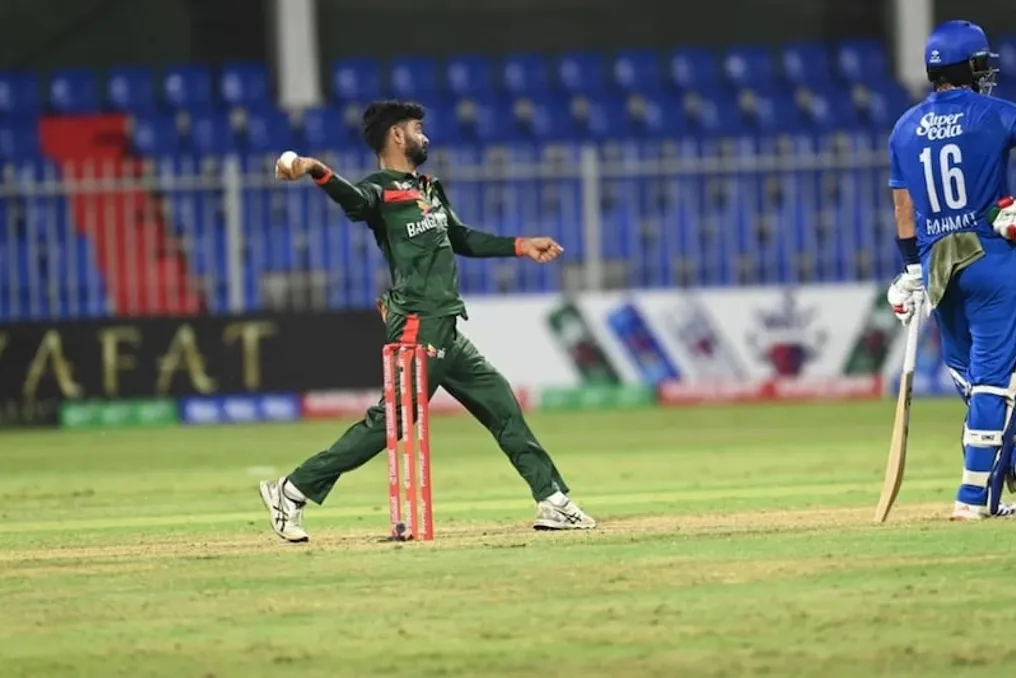
The career of Bangladeshi spinner Alis al-Islam has faced difficulties immediately after his debut in the ODI format. His bowling action was deemed suspicious, and the International Cricket Council (ICC) initiated an independent review of his bowling motion in accordance with ICC standards.

The 29-year-old Alis al-Islam debuted in the ODI on October 21 in Sharjah against Afghanistan. In this match, he bowled 47 runs in 8.3 overs but failed to take a single wicket. Match officials expressed concern regarding the legality of his delivery, which led to an investigation by the ICC.

Alis al-Islam's bowling action will be assessed at an ICC-approved certified testing center. This check will determine whether the angle of his elbow flexion during the delivery is within the established rules. According to ICC regulations, the arm swing when releasing the ball must not exceed 15 degrees.

However, the presence of complaints about suspicious movement does not imply automatic accusation against the player. The final decision will be made based on the results of the independent investigation. Until the assessment is complete, Alis al-Islam may continue to play international cricket.

In domestic cricket, Alis al-Islam is known for his mysterious spin and carrom balls. In the Bangladesh Premier League (BPL), he took 39 wickets in 35 matches, and in List-A cricket, 35 wickets in 20 matches. In the last format, his best performance was 6 wickets for 21 runs conceded.

Adis al-Islam also debuted in a T20 International against Sri Lanka during the 2026 Asian Games in Nagoya. The questions raised regarding his bowling technique after his ODI debut have become critically important for his future international career.

Popular