
In the Europa League, Benfica and Torrense secured victories. Meanwhile, Sporting Braga drew in the Conference League.
Similar stories
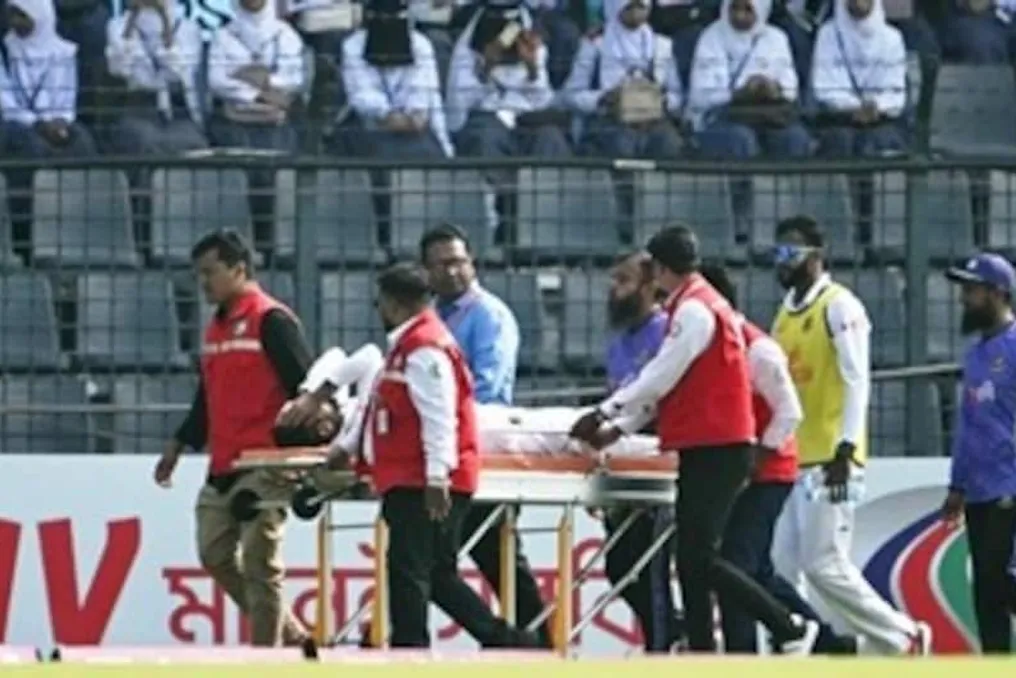
Bangladesh fielder seriously injured during match against West Indies, carried off on stretcher
A serious incident occurred for the host team Bangladesh during the second match of the test series between Bangladesh and West Indies, played at the Sylhet International Cricket Stadium in Sylhet. During the first game of the series, opener Shadman Islam sustained a severe injury while fielding.
The injury happened on the second day of the match, November 6. Islam, who scored a century in the first match of the series, fell on the field experiencing severe pain due to an ankle injury. He then had to be removed from the field on a stretcher.
The incident took place in the 78th over of the first innings of West Indies. Amir Jangoo hit the ball towards the fine leg, which was bowled by Mehdi Hasan Miraz. Shadman Islam ran after the ball into the slip area, but his foot slipped while trying to pick up the ball, injuring his ankle upon falling.
After falling, Shadman Islam suffered a long period of pain. He was taken on a stretcher to the other end of the field, where all Bangladesh players gathered around him, expressing concern about his injury. It was noted in the replay that there was dew on the outfield, which might have caused the slip.
Currently, it is unclear how serious Shadman Islam's injury is or if he will be able to continue participating in the match. He was taken to the hospital for scanning. If he cannot play, Bangladesh may be forced to play the remaining match with only ten players.
Earlier, on the first day of the match, West Indies scored 235 runs losing four wickets. The team played 70 overs, but due to poor lighting, the day's play finished earlier than scheduled. Then the West Indies team continued its first innings on the second day.
Now, Bangladesh's focus is on the medical updates regarding Shadman Islam's injury, as his availability could affect the team's future strategy.

According to the coaching staff, experience and skills allow Kohli and Rohit to succeed in the small boundaries of New Zealand
Although the small boundaries at New Zealand stadiums can be advantageous for batsmen, they present a serious challenge for fielders. The ball quickly crosses the boundary line, leaving fielders very little time to react. Nevertheless, experienced athletes such as Virat Kohli and Rohit Sharma demonstrate outstanding results due to their agility and precise decision-making. Subhish Ghosh, the fielding coach for the Indian team, explained the secret behind these two veterans' brilliant play.
Before the second ODI between India and New Zealand, held in Wellington, Subhish Ghosh elaborated on the game of Kohli and Rohit. He noted that both players have years of experience playing in the same position. This long experience has strengthened their muscle memory, allowing them to anticipate the direction and trajectory of the ball faster than others.
Ghosh emphasized: 'One of the most important aspects in fielding is predicting the ball. Virat has played at cover and point millions of times. He is able to anticipate the direction, path, and movement of the ball after contact with the ground earlier than other players.'
Commenting on Rohit Sharma's play, he mentioned an impressive catch in the first ODI. According to Ghosh, Rohit was able to recognize the situation even before the ball reached him. To become a great fielder, natural talent, experience, and regular repetition of the same action are necessary.
The small boundaries on New Zealand fields create a unique challenge for Indian fielders. Ghosh explained that when the field is compact, the need for fielders on the boundary decreases, and most players are placed in the infield. Under these conditions, the time between the batsman's shot and the fielder's reaction becomes extremely short.
He added: 'If you play on fields with small boundaries, there is no outfielder; everyone is an infielder. Reaction time is reduced because the boundary is very close.'
To increase speed and the ability to correctly judge the ball in fielding, the Indian team uses light balls during training. Ghosh reported that a light ball requires greater stability and better reaction from players. Furthermore, emphasis is placed on understanding the ball's movement and making decisions at the right moment.
He noted that judging the ball in New Zealand is critically important, and the team is constantly working on the stability of its fielders and their ability to judge the ball during training sessions.
Subhish Ghosh expressed satisfaction with the performance of the Indian players in the first ODI. He noted that the team made good catches and demonstrated excellent fielding. The energy and enthusiasm of the players on the field were also positively assessed.
Ghosh admitted that dropping a caught ball is part of the game of cricket, but the team takes this matter seriously, and the players are aware of their responsibility. Ghosh, who took over as fielding coach after T. Dilap, who held the position in August, is now working on improving the team's stability in the field and its ability to judge the ball correctly.
India won the five-match T20 series against New Zealand by a score of 3-2. Following this victory in the first ODI of the ODI series, the Indian team took a 1-0 lead. After this tour, the Indian team is scheduled to play another series of two Test matches. When asked about the physical pressure on the players due to continuous matches, Ghosh replied that it is more of a mental than a physical challenge.
He stated that although continuous matches are physically demanding, the Indian players are so experienced that they know how to cope with such circumstances. Regarding whether Mohammed Siraj will get a spot in the starting eleven for the second ODI, Ghosh declined to make any statements, noting that the decision will be made by the team management.