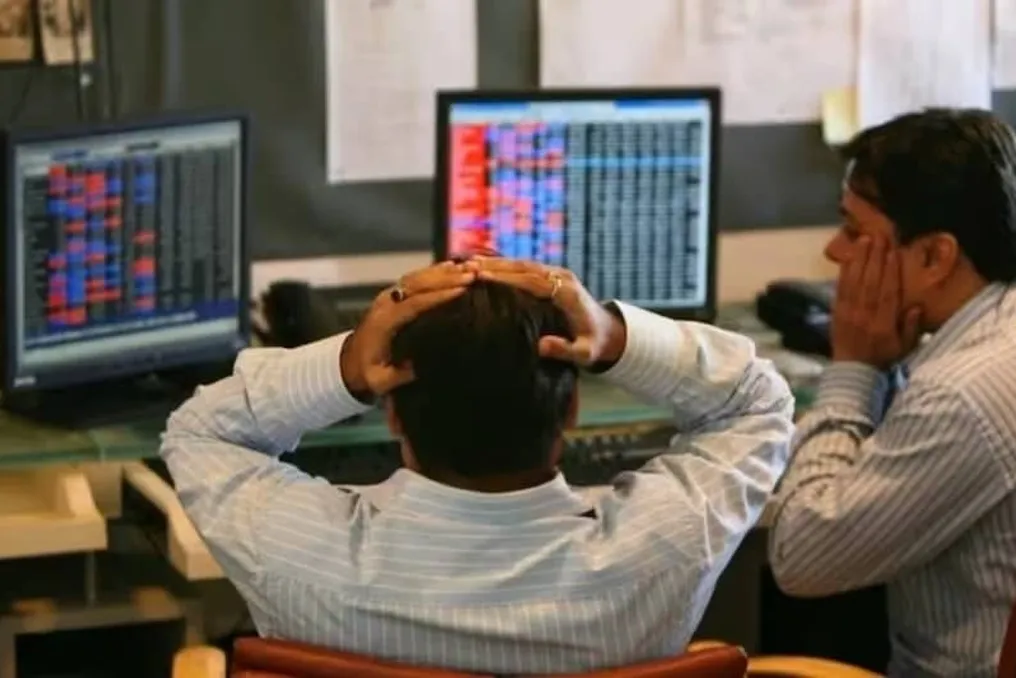
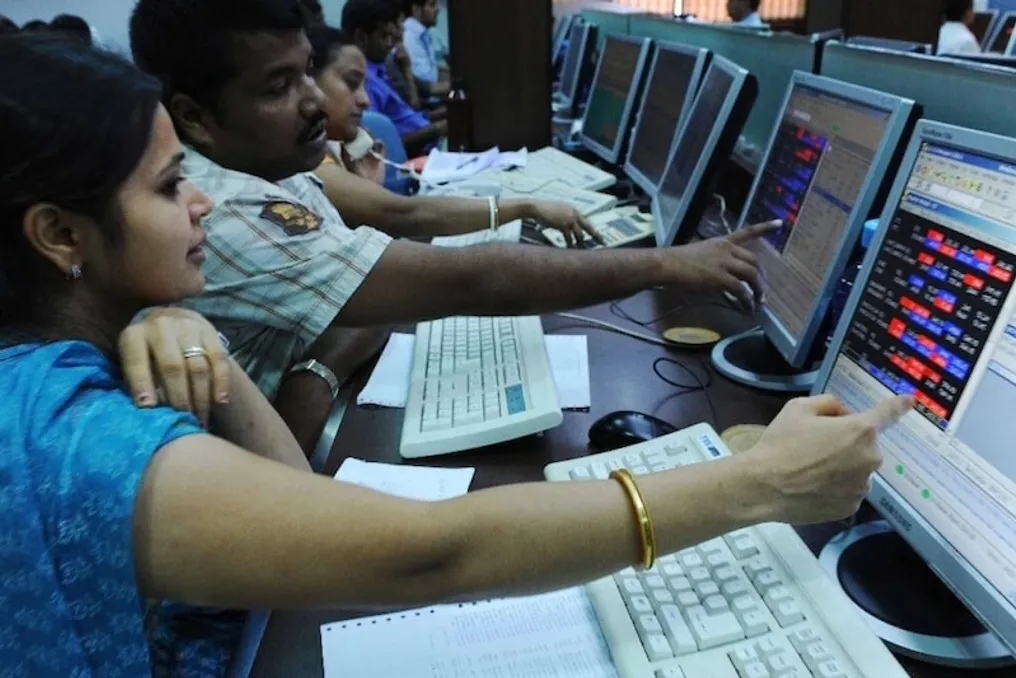
Indian stock market affected due to declines in US and South Korean markets
Read more
Aaj Tak
www.aajtak.in

Indian stock market affected due to declines in US and South Korean markets

The US market registered a sharp decline over AI regulations, resulting in losses exceeding ₹270 lakh crore. Similarly, the South Korean market saw a major drop, where KOSPI hit a lower circuit, forcing a 20-minute trading halt.

However, the impact of these large global fluctuations on the Indian market has been relatively minimal. Nifty fell by 100 points to reach 24,443, while Sensex is trading at 79,020.55, down by 289.46 points or 0.36%. Bank Nifty also witnessed a decrease of 300 points.

Declines were recorded across all sectors except IT and Telecommunications. The Auto and Consumer Durables sectors experienced the steepest drops. Among the top 30 BSE stocks, 10 showed a slight gain, while 20 declined. Shares of Powergrid and BEL registered the highest fall.

A particularly significant decline was observed in the Midcap and Smallcap segments. BSE 250 Smallcap fell by 1.50 percent, and Midcap traded 200 points or 1.20% lower.

On BSE, 1,137 out of a total of 3,515 shares showed gains, while 2,193 shares registered declines. 185 shares remained unchanged. Additionally, 47 shares are at their 52-week highs, while 43 shares are trading at 52-week lows. 79 stocks hit an upper circuit, and 97 stocks hit a lower circuit in the market.

Similar stories

Indian stock market falls by ₹21.79 trillion due to geopolitical tensions and oil prices
Read more
www.aajtak.in

Indian stock market falls by ₹21.79 trillion due to geopolitical tensions and oil prices

Tensions in West Asia are having a serious negative impact on the Indian stock market. Amid rising crude oil prices and inflation concerns, selling pressure is observed. On Friday, the Sensex index closed down for the fourth consecutive working day. Over the last four trading sessions, the total market capitalization of companies listed on the Bombay Stock Exchange (BSE) has decreased by approximately ₹20.79 trillion.

The Sensex on the BSE fell by 125.56 points, or 0.17%, on Friday, closing at 73,123.83. Despite the shortened working week due to holidays, the Sensex overall dropped by 1605.44 points, or 2.15%. This decline was reflected in the market capitalization of companies. If the total market capitalization on the BSE was ₹472,62,167.42 trillion on October 16, it reduced to ₹451,83,393.14 trillion over four working days, corresponding to a loss of about ₹20.79 trillion.

There are five key factors that have led to the sustained fall of the Indian stock market over four days. Firstly, growing tensions in the Middle East, causing investor concern over potential US-Iran tensions and threats of American strikes on Israel. Secondly, the sharp rise in crude oil prices; Brent Crude reached $116.73 per barrel, increasing the risk of inflation in India. Thirdly, inflation fears related to expensive fuel intensified selling in the market. The fourth factor is the downturn in American stock markets, which prompted Indian investors to exercise caution. Finally, the weakening rupee and rising yields on US bonds added anxiety for investors and put pressure on the domestic market.

The primary reason for the stock market decline is the significant jump in crude oil prices. Increasing geopolitical instability in the Middle East raises the probability of oil supply disruptions. On Friday, the price of Brent Crude rose by approximately 3%, reaching $116.73 per barrel, exceeding the $116 mark. The rise in oil prices to a five-month high caused concern among investors. Siddharth Kemka, Head of Wealth Management at Motilal Oswal Financial Services, noted that geopolitical tensions and high crude oil costs could continue to pressure the Indian market.

The risk of increased inflation due to rising oil prices can affect the economy and company costs. Tensions between the US and Iran, setbacks in diplomatic negotiations, and reports of possible new American strikes on Iranian nuclear and military targets have heightened uncertainty. Furthermore, supply concerns intensified after Houthi attacks on Saudi Arabian oil facilities from Yemen.

On Friday, shares of Tata Steel and Adani Ports were among the most affected companies listed in the Sensex, falling by more than 3%. In addition to them, shares of Trent, Tech Mahindra, Bharat Electronics Limited (BEL), Indigo, Bajaj Finserv, Kotak Mahindra Bank, Titan, Bajaj Finance, NTPC, State Bank of India (SBI), and Hindustan Unilever also closed lower. Nevertheless, some stocks showed growth: Eternal, Larsen & Toubro (L&T), Reliance Industries, Tata Consultancy Services (TCS), Ultratech Cement, Asian Paints, Maruti Suzuki India, Infosys, and ICICI Bank closed with positive momentum.

Ankur Punj, Managing Director of Equirus Wealth, stated that the downturn in American stock markets made Indian investors more cautious. This decline, combined with the rise in global crude oil prices and the weakening rupee, intensified selling pressure. He added that although most Asian markets showed improvement, India remained concerned about inflation due to expensive crude oil and rising US bond yields, which impacted the domestic market.

Next week, investors will also be watching the listing of Jio Platforms shares. The company's IPO, valued at ₹30,213 trillion, was subscribed 22.19 times. The shares are planned to be listed on BSE and NSE on October 28. The listing may provide insight into market trends. Additionally, investors will closely monitor the Federal Reserve System meeting scheduled for October 27 and 28. Market sentiment may also be influenced by initial unemployment data in the US, GDP growth figures, and the Bank of Japan's decision on interest rates. Second-quarter results from companies will also be crucial in determining the market direction. Results for companies such as Paytm, Tata Consumer, L&T, Maruti Suzuki, Hindustan Unilever, Adani Ports, Trent, Sun Pharma, Bharat Electronics Limited, and others will be announced next week.

Currently, the market direction is being determined by crude oil prices and events in the Middle East.
Stock Market Decline: Three Main Reasons, Losses of 700 Billion Rupees, and Popular Stocks Dropped by Up to 17%
Read more
www.aajtak.in

Stock Market Decline: Three Main Reasons, Losses of 700 Billion Rupees, and Popular Stocks Dropped by Up to 17%

A decline was observed in the stock market on the last trading day and throughout the fourth consecutive session. The Sensex index fell by 1250 points from its daily high, but after the market closed, it showed a significant recovery. Nevertheless, investors in the Indian market incurred losses amounting to about 700 billion rupees.

The market capitalization of the BSE reached 458 billion rupees on Thursday, and by Friday, it decreased by approximately 700 billion rupees to 451 billion rupees. The main reason for this sharp drop was the massive sell-off of stocks in the small and mid-cap segments.

After the sharp fall on Friday, the BSE Sensex recovered, declining by only 125 points and settling at 73,123.83. The Nifty index dropped by 87 points, reaching the level of 22,600. Previously, Nifty had touched the lower level of 22,372, and Sensex had touched 72,452.37.

On Friday, stocks of mid-cap and small-cap companies experienced a serious decline. At the close of trading, the BSE 150 Midcap index fell by 2.10%, closing at 15,143.47, while the BSE 250 Smallcap declined by 2.68%, ending trading at 6,440.65. Shares of Jammu & Kashmir Bank lost more than 16 percent, while Swiggy shares fell by approximately 17%. These two companies became the stocks of the day in the mid-cap and small-cap sectors.

Most stocks in the small and mid-cap segments were in a decline zone of more than 3 percent on Friday, leading to a significant reduction in investor portfolios. Among the top 30 BSE stocks, the largest drop was recorded by Tata Steel, which fell by 3.21 percent. Twenty stocks closed in the red, and the remaining ten closed in the green. Eternal's shares, conversely, closed with a gain of about 4 percent.

The primary reason cited for the decline is the crude oil situation, whose price reached $115 per barrel. Brent Crude Oil rose by 1.33% on Friday, reaching $114.67 per barrel. This rise is attributed to the Houthi attack on Saudi Arabia. Furthermore, foreign investors continue to increase their selling. On October 22, foreign investors sold Indian stocks worth 16,113.89 crore rupees, while DII supported the market by buying stocks worth 14,519.12 crore rupees.

Large-scale selling was observed among both retail investors and foreign participants in the small and mid-cap segments. The results of some companies' reports also influenced the market.

Indian stock market opens in the black, but then crashes: Reasons for the sluggishness of the Sensex-Nifty index
Read more
www.aajtak.in

Indian stock market opens in the black, but then crashes: Reasons for the sluggishness of the Sensex-Nifty index

The Indian stock market began the trading session with positive momentum after a three-day decline, but soon experienced a sharp drop. The market initially showed growth due to activity in IT stocks. The BSE Sensex opened at 73,665.64 points, showing an increase of 416.25 points, and the NSE Nifty 50 reached 22,742.20 points, increasing by 54.55 points. Bank Nifty also started with a rise of 40.05 points, reaching 54,965.75 points. Specifically, Nifty showed a rise of more than 300 points among IT stocks; TCS shares rose by 2.63%, Infosys by 1.53%, Wipro by 0.85%, and HCL Tech by 1.22%.

However, as trading time increased, the pace of market growth slowed down. Weakness in international stock markets and high crude oil prices negatively affected the market. The rise of Sensex and Nifty gradually weakened, and Nifty, which opened in the green zone, quickly turned red. It lost more than 100 points, and Sensex fell by more than 150 points, also entering the red zone. Bank Nifty remained in the red zone throughout the day, losing more than 500 points.

Brent Crude price holds around $114 per barrel

Brent Crude is trading around $114 per barrel. Since India imports a significant portion of its needs, rising oil prices could put pressure on inflation, companies' production costs, and the country's trade deficit. In the foreign exchange market, the Indian rupee also started moving with slight support. Compared to the closing on Thursday at 94.82 rupees per dollar, the rupee opened at 94.79 per dollar on Friday, strengthening by 3 paisa. Meanwhile, Asian markets saw a decline, and US stock markets also closed mostly negative on Thursday.

Investor concerns related to growing corporate spending on artificial intelligence (AI) and high crude oil prices pressured market sentiment. The domestic market will now watch company results for the third quarter. These reports will show how companies are coping with high energy costs, a weak global environment, and economic uncertainty.

Market support expected next week

There are also positive signals for the stock market. A significant fall in the yield of US 10-year treasury bonds and the strengthening of the rupee could contribute significantly. These factors are capable of helping reduce selling by Foreign Institutional Investors (FIIs), which in turn can support the stock market. Furthermore, the Jio Platforms IPO attracted about 3.73 lakh crore over the last two days. After the share distribution process is complete, it is expected that more than 3 lakh crore of this amount will return to the market, which could increase the availability of funds in the market next week and support stocks.

Expected rally in large-cap stocks

If there is a rise in the stock market on Monday, it may be led by large corporate stocks. There is relative stability in large-cap stocks, and opportunities may arise to invest in stocks of companies with good growth at reasonable prices. Conversely, pressure may persist in the mid-cap and especially small-cap segments. Previously, the growth of these stocks was driven not so much by strong operational performance of the companies as by an additional inflow of cash into the market. Thus, justifying the current prices of some stocks based on their operating results may be difficult.

What signals for investors?

Currently, the market faces two types of signals. On one hand, buying in IT stocks, a slight strengthening of the rupee, and a potential influx of funds next week could support the market. On the other hand, crude oil priced around $114 per barrel, weakness in global markets, and uncertainty regarding quarterly company results increase risks. In such an atmosphere, making decisions based solely on the initial market rise is not the right step. Besides looking for investment opportunities in large and reliable companies, attention must be paid to company profits, its valuation, and risks. Special caution should be exercised when investing in small-cap stocks.

Popular