Geekplus unveiled RoboShuttle Hyper robot for vertical lifting at CeMAT Asia exhibition
Read more
Pandaily
pandaily.com

Geekplus unveiled RoboShuttle Hyper robot for vertical lifting at CeMAT Asia exhibition

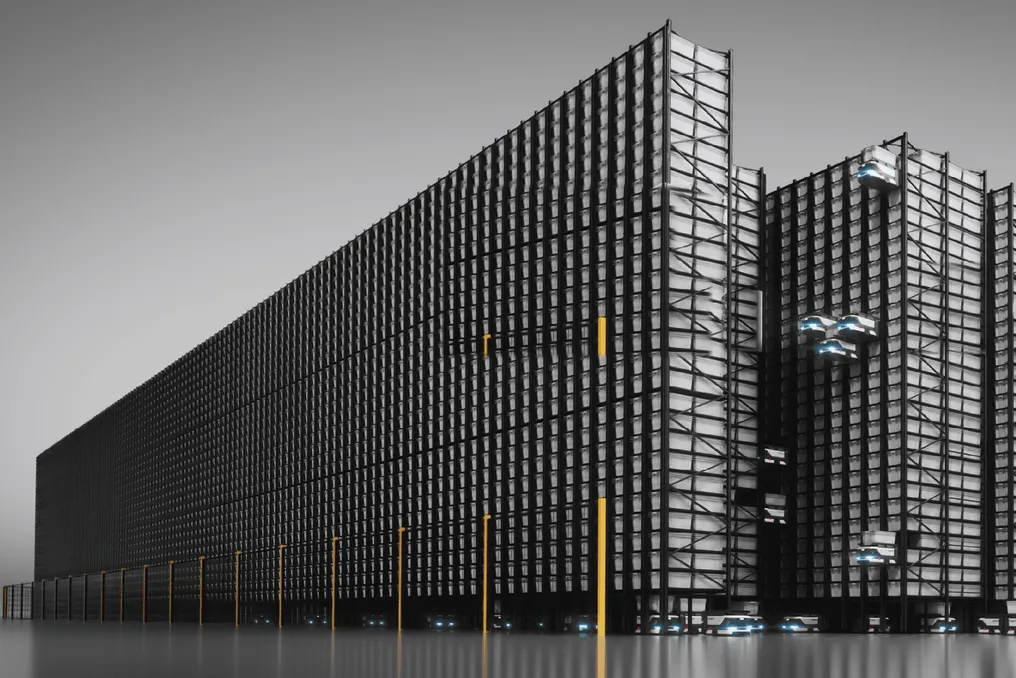
The warehouse robotics company Geekplus, also known as Geek+, demonstrated its RS Hyper robot, capable of hyper-lifting, at the CeMAT Asia 2026 exhibition. This was reported by Sina Tech on November 5. This robot is a central element of the RoboShuttle Hyper system, which the company presented in August. At the exhibition, it was shown alongside the humanoid robot Gino 1 and the SkyCube pallet-to-person system.

The RS Hyper system combines horizontal movement across the warehouse floor with vertical extraction of boxes inside racks, achieving a lifting speed of up to 1.5 meters per second. Geekplus claims that the system increases throughput due to the ability of robots to lift in parallel along adjacent columns, the operation of two robots in one column, and movement along a bidirectional network of high-density roads. The company estimates the system's performance at 6000 boxes per hour per 1000 square meters.

The corresponding Max workstation continuously feeds boxes from two points and processes up to 800 boxes per hour, according to Geekplus data. Target applications for this system include high-throughput, dense operations such as front-end microfulfillment warehouses and fresh produce e-commerce sites.

In the launch materials from August, Geekplus indicated that lifting the robot only requires blocking two rack columns, unlike four or six in standard systems, and that two aisles under one rack increase the robot's trajectory density. Furthermore, the company mentioned a fall protection system limiting box drop to 50 millimeters, and a planning system capable of coordinating up to 5000 robots over an area of 50,000 square meters.

Gino 1 was also operating at the booth, utilizing the company's internal embodied AI model Gravity for picking household goods and bottled beverages, areas where traditional automation faces difficulties. It is also capable of transporting and swapping boxes while working alongside mobile robots and specialized workstations. The automated picking station used a robotic arm for grasping, scanning, and placing items. Geekplus reports that this station initially supports millions of SKUs, deploys in 48 hours, and received the RBR50 innovator award in 2026.

Geekplus noted that the mixed fleet of equipment operating at the exhibition hall served as a live demonstration of the recently announced plan for a 24/7 autonomous warehouse. This plan is based on two technical directions: embodied AI and holistic warehouse intelligence. RoboShuttle Hyper is part of the company's box handling lineup, alongside RoboShuttle Air and RoboShuttle Flex.

Similar stories

AgiBot proposes Worken metric to measure robot work with the goal of reducing the engineer-to-robot ratio to 1:10 by year-end
Read more
pandaily.com

AgiBot proposes Worken metric to measure robot work with the goal of reducing the engineer-to-robot ratio to 1:10 by year-end

At the Innovation Day 2026 event, held on October 29th in Shanghai, AgiBot introduced a new unit of measurement to assess the actual contribution of robots to workflows. Co-founder, President, and CTO Peng Zhihui named this unit Worken, which stands for effective intelligent working hours. He defined Worken as the product of the number of active robots, autonomous working hours, and output efficiency coefficient.

Peng emphasized that simple robot operating time does not equate to value. According to him, a robot being switched on for eight hours does not guarantee the creation of eight hours of value, nor does high success rate in completing one task mean it can operate as stably as a human for a month. The purpose of Worken is to answer the question of what sustainable and useful labor robots provide in real-world conditions, unlike demonstration specifications.

AgiBot shared data from three implementations. Four robots serving visitors in the Quanzhai Alley in Chengdu worked 310 hours and produced 744 Worken. Eight robots involved in loading and unloading on the production line of the Longcheer factory worked 528 hours and yielded 2956.8 Worken. In Guangzhou Metro, 120 robots guiding passengers through the security zone worked 240 hours and provided 14,400 Worken. However, the company has not yet established a universally accepted standard for defining the efficiency coefficient, such as how to account for human intervention, maintenance, or downtime.

An important aspect was the removal of humans from the workflow. In September, AgiBot deployed over 300 robots across more than 100 locations at the Chimelong Spaceship park in Henan to conduct tours, host games like chess and table tennis, and organize other visitor activities. Currently, nearly 500 robots operate there regularly, and the company plans to increase this number to 1,000 by the end of the year.

Partner Wang Chuang noted that initially, almost every robot required its own engineer. Because children interacted with the robots, violating game rules, the robot-to-engineer ratio changed from 1:1 to 3:1. The company's goal is to reach a 10:1 ratio by the end of the current year and 20:1 next year. At such a ratio, he stated, the client would only need about 5 percent more budget for personnel for this function.

The leaders acknowledged existing limitations. Wang reported that the new WITA-OMNI interaction model still requires refinement in terms of stability and consistency when operating with large robot parks. Co-founder Yao Maoqing stated that long-term stable operation of over 10,000 robots in Chinese factories will be a key industry achievement. Peng added that end consumers are interested not so much in the ability to build a robot, but whether they can afford to operate it. Without measurable results and reduced operational costs, he believes every sold robot will still require its supervisor.

AgiBot G2 Max Robot Operates at JD Logistics Warehouse, Processing 80 Boxes Per Hour
Read more
pandaily.com

AgiBot G2 Max Robot Operates at JD Logistics Warehouse, Processing 80 Boxes Per Hour

The AgiBot G2 Max robot has begun its operation at the JD Logistics warehouse. This robot, which was officially unveiled on October 26 as an embodied robot with a safety rating and the ability to handle heavy loads, is responsible for processing incoming boxes at the JD Logistics automated warehouse, known as the Smart Wolf warehouse, according to data from IT Home and Sina Finance.

During the goods receiving stage, the G2 Max removes boxes from arriving pallets and stacks them for the automated system. According to AgiBot, it is capable of removing 80 boxes per hour from pallets and stacking 75 boxes per hour onto pallets, with an overall success rate exceeding 99%. The robot operates around the clock on several production lines.

The Smart Wolf warehouse is a proprietary development by JD Logistics for the goods-to-person system. It utilizes vertical space up to 12 meters high, increasing storage efficiency sixfold compared to traditional warehouses, while simultaneously managing hundreds of robots. Processing the incoming flow is the initial stage of this chain, so its pace and stability affect all subsequent processes, from storage to sorting, especially during the current peak shopping season.

JD Logistics and AgiBot first demonstrated the G2 Max together at the World Artificial Intelligence Conference in July, when they announced its implementation at the Smart Wolf warehouse. The official launch of the AgiBot product took place on October 26.

The G2 Max is designed for handling heavy loads. Each manipulator can carry 20 kilograms, and both manipulators together are rated for 40 kilograms, with a peak load of 50 kilograms. Repositioning accuracy is within 0.5 millimeters. Thanks to a waist joint that allows the robot to bend in the middle, it can integrate into existing industrial lines without requiring 1.5 meters of free space for turning. This is critically important where lines are already set up for personnel.

AgiBot offers this robot for pallet unloading, material handling, and line feeding tasks in factories, stating that it can operate continuously without shifts or night staff. A JD Logistics executive noted that real industrial sites are the best proving ground for embodied AI, and the company is ready to open its facilities, test environments, safety protocols, and service standards to more robot manufacturers.

Bedrock Robotics raises $600 million amid growing demand for autonomous heavy equipment
Read more
ventureburn.com

Bedrock Robotics raises $600 million amid growing demand for autonomous heavy equipment

Bedrock Robotics has raised $600 million in a Series C round, valuing the San Francisco-based company at $4.1 billion. The investment round was co-led by CapitalG and Emergence Capital.

This growth is significant because just eight months ago, the startup was valued at $1.75 billion after raising $270 million. The reason for this jump is that Bedrock's machines have stopped being mere demonstrations and have started generating revenue.

Bedrock does not manufacture fully automated excavators; instead, the company creates an autonomous driving kit that is installed on existing contractor equipment. Since mid-August 2026, excavators equipped with Bedrock hardware have been performing paid work at real commercial sites.

Examples of such projects include a water treatment plant site in Nevada, earthworks conducted by Champion Site Prep in Texas, and a civil project of 1.2 million cubic yards involving Zachry Construction. A new partner, Arizona contractor Haydon, has joined. The company plans to use Bedrock-equipped machinery at data center, medical facility, and water supply sites. Additionally, regional partners in Minnesota, Florida, Georgia, Missouri, and Virginia have also joined the collaboration.

CEO Boris Sofman told The Robot Report that demand from new clients is 'very high.' Sofman previously led the self-driving truck program at Waymo and co-founded Anki, the company behind the Cozmo robot. According to Bedrock, mastering excavator operation takes five years or more, but Associated Builders and Contractors predicts that over 40% of construction workers will retire within five years.

Furthermore, 87% of firms report having open vacancies for skilled workers. Sofman provided a simple example demonstrating the financial benefit: if a project is completed two months earlier due to 24/7 machine operation, a developer paying 9% interest on a $400 million loan will save about $6 million. Applying this logic to thousands of projects explains the interest of players like Bessemer, Temasek, and Nvidia.

The initial use of the raised capital will allow for an increase in the number of machines across various sites. Bedrock aims to reach a three-digit number of autonomous machines across the US by 2027. The second priority is strengthening technical support. Since a breakdown of a robotic excavator costs contractors money every hour, the startup is focused on scaling its operations, equipment, and supply chains. Amy Jones Satrom, formerly of Amazon, Nuro, and Uber, was hired as Vice President of Operations, and Lando Huarez, former head of the legal department of Uber's autonomous division, took the position of General Counsel.

The third point is developing new equipment. Haydon will conduct autonomous trenching tests, after which bulldozers, articulated dump trucks, and wheel loaders will be the focus. In the long term, Bedrock is looking at mining and agriculture sectors. This funding round demonstrates that investors are now interested in artificial intelligence that moves dirt, not just generates text. For contractors, autonomy is becoming a practical tool, not science fiction.

Popular