Throughout the history of Formula 1, there are countless notable drivers, but only one group becomes true celebrities, recognized even by those who do not follow the sport regularly. To achieve this status, a specific combination of talent, charisma, personality, and the luck of driving a car from a top-tier team is required. Names like Ayrton Senna, Michael Schumacher, Nelson Piquet, and Lewis Hamilton are examples of this group—some for being good individuals, others for being eloquent, and others for having a striking presence outside the cockpit.
However, fame and skill are not equivalent, and many drivers, even after winning races and conquering titles, fail to attract public attention. This reality demonstrates that the world is not always fair.
This Thursday, November 5th, Alan Jones passed away. He belonged to this group of undeniable talent and immense importance to one of the most successful teams in Formula 1 history. It can be stated that Jones was crucial in establishing Williams as a dominant force in the subsequent decades, a period when the team achieved nine constructors' titles and seven drivers' titles between 1980 and 1997, with a highlight being the dominance between 1992 and 1997, when they won five of six constructors' championships.
Alan Jones's career trajectory began long before his entry into Formula 1. Born in Melbourne, Australia, in 1946, he was the son of Stan Jones, a prominent name in Australian motorsport, winner of the 1959 Australian Grand Prix. His interest in racing arose naturally: at age 15, Alan had already won the state kart championship and began competing in Cooper Mini and open-wheel cars.
His first attempt at a career in Europe occurred in 1967, but financial problems forced him to abandon his plans. Three years later, he returned to England with only 50 pounds, needing to be creative to finance his dreams. To do this, he rented a boarding house and sublet rooms to travelers, in addition to setting up a small business buying and selling used minivans, focused on Australians residing in England. The modest profits from these activities sustained Jones and his girlfriend, Bev, who would later marry him, leaving enough for his competitions.
The progression was gradual. After a discreet participation in Formula Ford, Jones suffered an accident during testing with a Lotus Formula 3 car at Brands Hatch, resulting in a leg fracture. The turning point in his career came in 1973, when he secured a sponsored spot with Denys Dobbie's DART team, driving the GRD 373. It was in this car that he won his first race at Silverstone and finished second in the British F3 championship.
His results in Formula Atlantic the following year opened the door to the top category. Jones debuted in Formula 1 in 1975, at the Spanish Grand Prix, driving a Hesketh. After a brief time with the team, he replaced Rolf Stommelen in Graham Hill's team, achieving fifth place in the German GP held at the Nürburgring. In 1976, he drove for Surtees, but the complicated relationship with John Surtees and the vehicle's mediocre performance led him not to continue the following year.
However, 1977 brought an unexpected opportunity. Following the tragic death of Tom Pryce at the South African Grand Prix, the Shadow team hired him to replace the Welshman. In the same season, he achieved his first Formula 1 victory at the Austrian Grand Prix, contested under variable track conditions.
This feat attracted the attention of larger teams and put his name on the radar of Frank Williams, who was undergoing a period of transformation. For almost a decade, he had managed Frank Williams Racing Cars, his first team, operating under a typical British garage model: independent, lean, and with limited resources. In 1976, he sold control of the operation to Canadian businessman Walter Wolf, but the partnership deteriorated, leading Frank to leave the team at the end of that year. Instead of giving up Formula 1, he chose to start from scratch, founding Williams Grand Prix Engineering in 1977 alongside engineer Patrick Head.
This change was deeper than just a name: with the new team, Frank Williams abandoned the garage owner model, where he had to personally manage almost every aspect of the team, moving to lead an organization focused on proprietary engineering, technical development, and corporate ambition. This marked the beginning of a new era, and Frank Williams symbolized this transition, being the last garage owner and the first CEO of Formula 1.
Alan Jones arrived exactly at this period. After an unsuccessful negotiation with Ferrari, he signed with Williams for the 1978 season, being hired to lead the new project. The team had launched a purchased March 761 chassis in 1977, but was preparing its first in-house car for the following year, the FW06, designed by Patrick Head.
At that time, Williams was still far from being the powerhouse it would become. Frank Williams' and Patrick Head's team had recently been restructured and was still seeking its first Formula 1 victory. Jones secured the team's first podium at the 1978 United States GP in Watkins Glen, helping to establish a competitive foundation for the project. In 1979, Williams' first victory came, through Clay Regazzoni, at the British GP. However, Jones was the main protagonist of the team's rise: he won four races that season, three of them in the last five stages of the championship, and finished third in the Drivers' World Championship.
The peak came in 1980. With the Williams FW07B, Jones won five Grand Prix and secured his first world title, surpassing Nelson Piquet by 13 points. Williams also secured its first Constructors' Championship, cementing its place among the greats.
The FW07B was a remarkable car. Developed from the previous season's FW07, it was one of the best to exploit ground effect—the design of the floor and the Venturi profile tunnels integrated into the sidepods accelerated the airflow beneath the car, creating an area of low pressure. In practice, it seemed as if the air itself sucked the monocoque against the asphalt, significantly increasing grip in corners, while the side skirts helped seal the space between the floor and the track, preventing external air from compromising this effect. The package was completed by the Ford-Cosworth DFV engine, the legendary three-liter British V8 prepared by John Judd, which reached about 500 hp and exceeded 11,000 rpm.
However, it wasn't just a talented driver finding a winning car. Jones actively participated in the development of the FW07, collaborating with Carlos Reutemann, especially in tuning the suspension for 1980. His ability to extract performance from the equipment and contribute technically to its evolution made him an essential part of Williams. Under the direction of Frank Williams and Patrick Head, Jones helped define the team's competitive identity with his aggressive driving style, low tolerance for errors, and exceptional ability to utilize the car's full potential.
It is relevant to note Alan Jones's position in Formula 1 during that period. Niki Lauda had won two world titles with Ferrari, in 1975 and 1977, before announcing his retirement during the 1979 Canadian GP. Nelson Piquet had had a brief stint with Brabham in 1978 and, for the following season, was hired as the Austrian's support driver. With Lauda's departure, the Brazilian took over the team's leadership and, in 1980, finished the championship just behind Jones. In 1981, Piquet would win his first of two titles with Brabham, repeating the feat in 1983. Lauda, meanwhile, would return to Formula 1 to win his third championship in 1984. Alan Jones was situated between two generations of great champions.
He maintained a strong season in 1981, winning two races—the US West GP in Long Beach and the Las Vegas GP—and finishing third in the championship again, behind Piquet and Reutemann. Williams also secured its second consecutive Constructors' title. Despite not winning the Drivers' World Championship, Jones received the award for best driver of the season for the third consecutive year in the Autocourse yearbook.
Piquet's first conquest involved a particular incident involving Jones. In the 1981 title fight in Las Vegas, the Australian had already announced his retirement and did not intend to help Carlos Reutemann win the title. Still resentful towards the Argentinian for disobeying team orders at the Brazilian Grand Prix, Jones won the race, while Reutemann finished only eighth. Piquet came in fifth and clinched the title by just one point, showing that internal rivalry within Williams played a decisive role in one of the most dramatic outcomes of that season.
Jones ended his participation in Formula 1 at the end of that year, at 34 years old and just a few weeks shy of 35. His decision was not linked to an alleged drop in competitiveness, as he came from a season with two wins and a third place. The Australian simply wished to return to his homeland, live on a farm, and be closer to his family. Additionally, Jones had lost some enthusiasm for the category, mainly due to the ground-effect cars, whose extremely rigid suspension made driving physically exhausting.
It was a premature retirement for someone who was still among the world's best drivers, and with an inconvenient timing: in 1982, Williams would once again win the Drivers' Championship, this time with Keke Rosberg. Jones had left a team in full ascent. Although it cannot be stated that he would have won another title if he had stayed, his departure ended a Formula 1 career before he could enjoy much of the team's peak success period that he helped build.
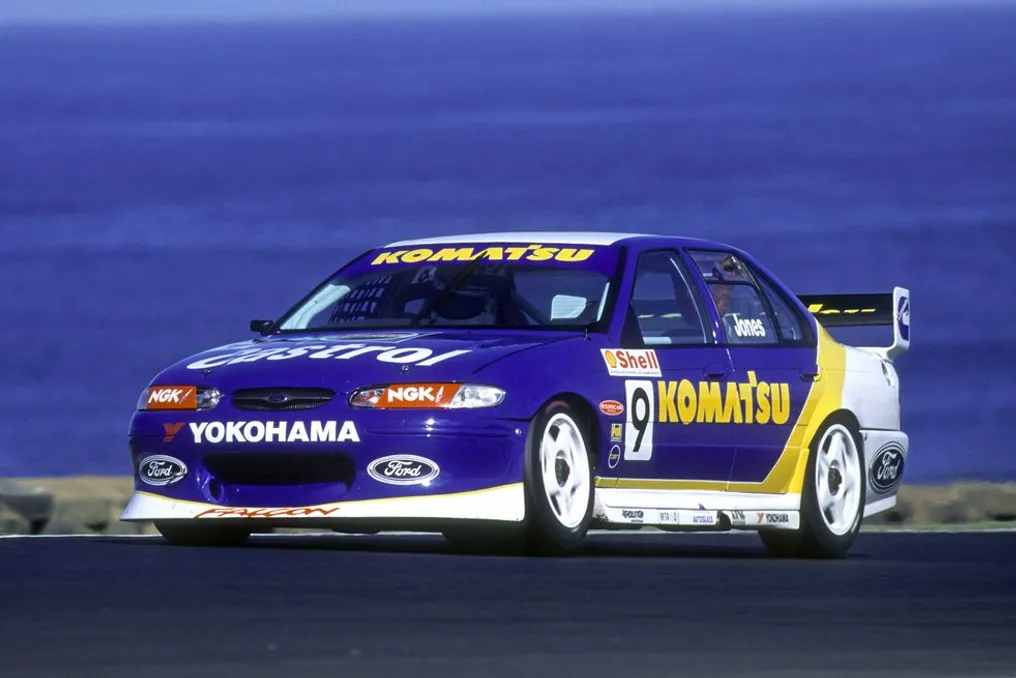
However, his return to the tracks was not long. In 1983, Jones agreed to drive the US West Grand Prix for Arrows, but withdrew from the Long Beach race. In August 1985, he replaced Mario Andretti in a CART round at Road America, finishing third. A few weeks later, he received an offer to lead the Team Haas project, sponsored by Beatrice and developed in technical partnership with Lola. The team debuted in Formula 1 in the second half of 1985 but never managed to present a truly competitive car.
Jones participated in a few races at the end of that year and a full season in 1986, scoring only two points: a fourth place in Austria and a sixth in Italy. At the end of the season, he definitively ended his Formula 1 career, accumulating 12 victories, six pole positions, and 24 podiums in 116 starts.