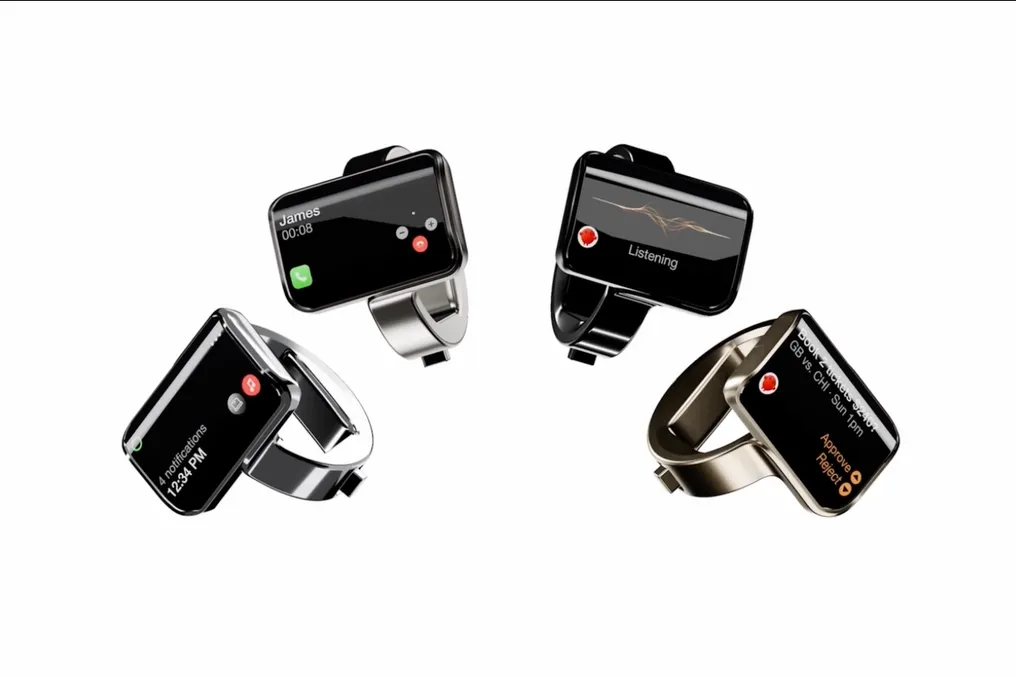
Startup Aina, based in Bangalore and San Francisco, has introduced a new generation of artificial intelligence that, according to the company, will focus less on questions asked to machines and more on the ability of systems to foresee human needs. An intelligent ring model featuring a color display, voice commands, and gesture control was presented at a private event in Bangalore. The ring is priced at $499 (equivalent to 47,000 rupees) and is available for pre-order at a special early bird price starting from $399 (37,700 rupees). Shipments are planned to begin in January 2027.
Unlike traditional smart rings, which are primarily designed for health and fitness monitoring, Aina aims to make its device a daily interface between users and AI agents. The core idea is that while AI agents are becoming smarter, their use still requires unlocking phones, navigating apps, and approving individual actions. Aina intends to eliminate this friction by proposing the concept: what if the AI doesn't wait for a request?
To simplify interaction, Aina has developed three key features: Cues, Voice, and Remote. The Cues feature uses contextual information, including connected applications and daily routines, to predict the user's next desired action. For instance, if a person regularly orders a taxi at the same time in the morning, the ring might suggest booking a ride without a direct prompt. At the presentation, Aina demonstrated ride-ordering interaction, showing how daily operations can be completed with minimal gestures.
The ring can be controlled using a five-position joystick, allowing users to approve or reject suggestions with their thumb without taking out their smartphone. The company claims that its context-aware intelligence can learn user habits and predict corresponding actions within the next fifteen minutes using data from iPhone, Mac, and associated services. Integrations with Uber, Apple Music, Spotify, calls, calendar meetings, smart home control, and email actions were demonstrated.
The second interaction method, Voice, allows users to dictate notes, set reminders, send messages, and issue commands. Aina also showcased use cases with WhatsApp and Telegram, as well as dictation on Mac via Wispr Flow. The third function, Remote, turns the ring into a controller for connected devices. According to the company, users can manage music, phone calls, smart home appliances, and meeting settings without touching another device.
According to the specifications presented at the Bangalore launch, the ring weighs less than 13 grams, features a titanium body, a full-color display, haptic feedback, and directional sound. The company states a potential battery life of up to 18 hours and plans to release the device in four colors: Eclipse Black, Amber Gold, Mercury Silver, and Slate Titanium, in seven sizes. Aina also highlighted the presence of a five-position control mechanism called Shifter, which works in conjunction with the gesture-based interface.
The startup announced that the ring will be accompanied by an open developer platform, enabling third-party developers to create new integrations and interactions. Support for AI agent platforms such as Muse, Grokbot, and Instinct was also demonstrated. Currently, the company supports iOS and Mac, with further integration announcements expected. Whether the open platform will lead to a significant developer ecosystem remains to be seen once the device reaches consumers.
Aina was founded by Apurva Shankar, who previously served as Vice President of Hardware at Ultrahuman, based in Bangalore. Shankar founded Aina in May 2025 as a human-computer interaction lab focused on how people can interact with intelligent software outside of traditional screens and keyboards. The startup secured $5.5 million in seed funding in July 2026, as previously reported by YourStory. The round was led by Redstart Labs and 360 ONE Asset, with participation from MIXI Global Investments, Antler, Blume Founders Fund, and angel investors, including CRED founder Kunal Shah and Razorpay co-founders Harshil Mathura and Shashank Kumar. These funds were allocated for the commercialization of its AI-oriented hardware interface and the expansion of engineering and product teams.
Aina spent about 15 months developing the technology and began testing the ring with a limited group of users in October 2026. Aina's launch comes amid technological companies' experiments with new ways to integrate AI into daily life. Although smartphones remain the dominant interface for digital services, the rise of AI agents is prompting startups to rethink how instructions are given, actions are approved, and information is received. Aina's approach is to make this interface more compact and contextual while maintaining user control over whether suggested actions are executed.
However, at a price of $499, the ring is a premium purchase, especially considering that smartphones and smartwatches already perform many of the stated functions. Its utility will depend on the accuracy of the AI predictions, the reliability of third-party service integration, and how intuitive finger control becomes for daily use. Battery life, voice recognition, and application support will also play a crucial role when the product moves beyond controlled demonstrations. For now, Aina's claims remain unproven at scale, with commercial shipments scheduled for January 2027.