India revised its GDP calculation base, setting it for the period 2022–2023 in February 2026. New data sources were integrated into India's National Accounts, allowing for a reassessment of the size of the informal economy. This process demonstrated that economic indicators are not static, as they change when the statistical system decides to account for certain activities in greater detail.
In the same quarter, India's economy showed growth of 7.8%, enabling the country to maintain its status as the fastest-growing major economy despite the imposition of strict US tariffs and disruptions in the Strait of Hormuz. Although newspaper headlines noted this success, a significant portion of the work remained uncounted in the calculations—this is unpaid domestic and care work, which makes any other employment possible.
GDP has clear boundaries of production, and this is justified: for example, a kindergarten worker who receives pay for childcare is counted as economic activity, whereas a mother or grandmother performing this work for free is not. However, the value of this activity does not disappear; only the form of payment changes.
The volume of activity outside these boundaries is quite significant. According to the India Time Use Survey for 2024, women aged 15 to 59 spend approximately 201 minutes more per day than men on unpaid housework. A deeper analysis of unit-level data shows that women spend 343 minutes daily on unpaid domestic and care work, while men spend 43 minutes. Furthermore, about 93% of women engage in this labor, compared to 44% of men.
A study by the Ministry of Women and Child Development estimates this labor at up to 34.5 lakh crore, which accounts for approximately 15–17% of the GDP at average weighted wages. Even the Ministry of Statistics' time use report acknowledges that excluding unpaid services causes the GDP to 'significantly underestimate the nation's total income.'
The international solution is not to abandon GDP but to add supplementary accounting that measures activities outside production boundaries. India already possesses the necessary elements: two national time use surveys, an adopted valuation method, and a statistical system that has just demonstrated its ability to revise its figures. The only missing piece is the decision to act.
The visibility of this labor is important because governments allocate funds based on the metrics they measure. According to the UNDP, 44.5% of women in India not in the workforce cite childcare and homemaking as the main reason. Meanwhile, female labor force participation has risen from 23.3% in 2017–2018 to approximately 40% in 2025, according to Periodic Labour Force Survey data. However, the volume of unpaid work by women has barely changed over five years.
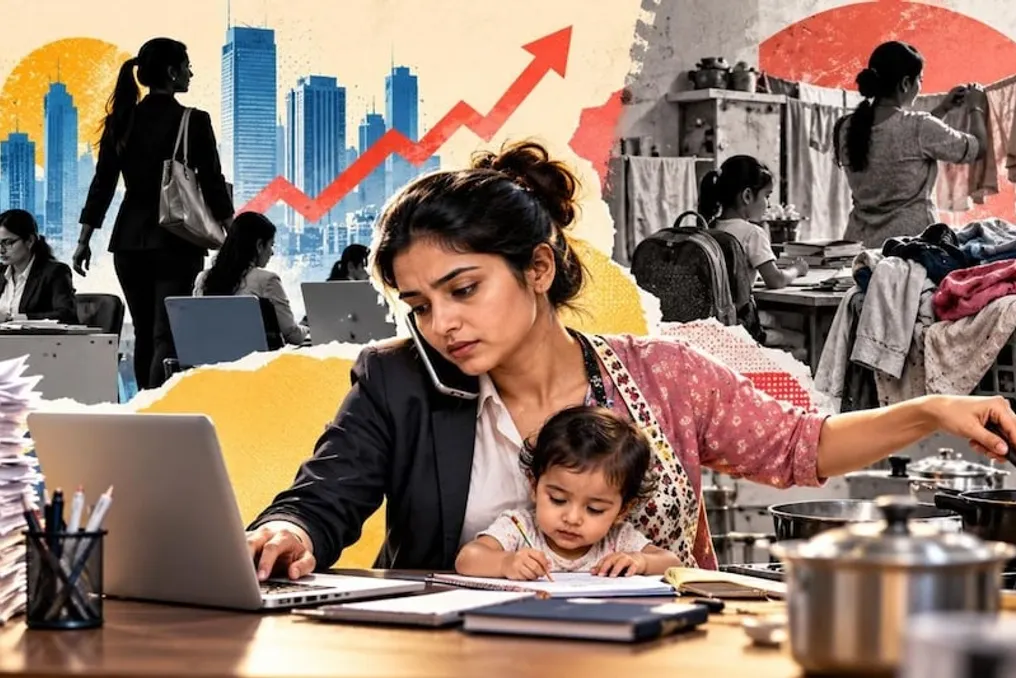
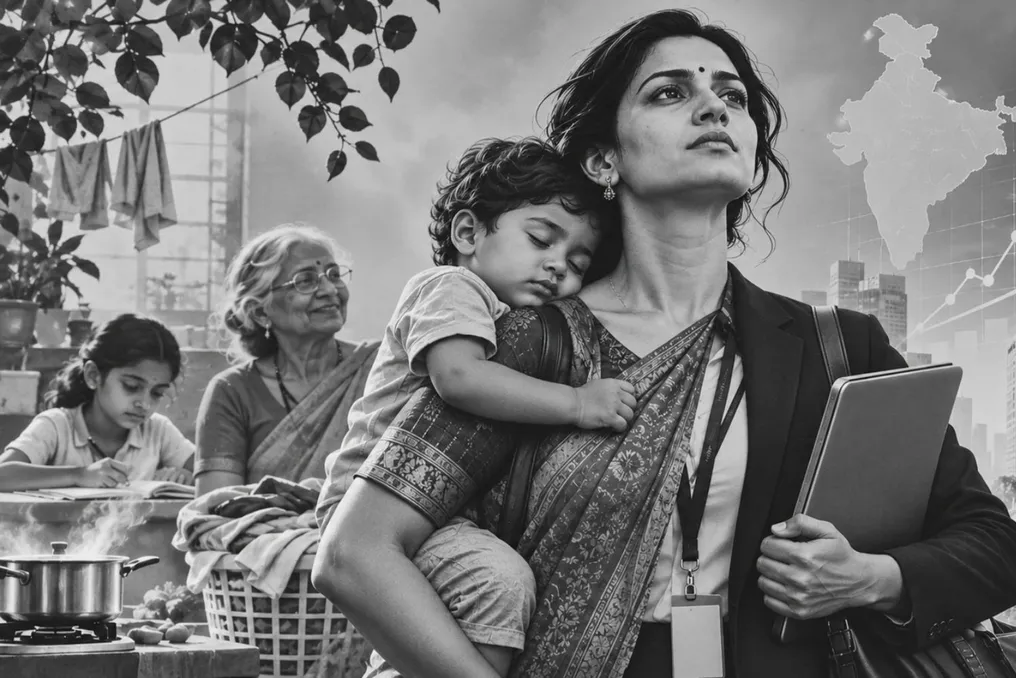
A woman who takes paid work while continuing to perform the same workload at home is not freed up for work; she has taken on a second shift. The real policy question is not how to convince more women to work, but what infrastructure will make paid work compatible with caregiving.
This contradiction is reflected in the government's own documents. The chapter on employment in the Economic Survey calls the care economy a promising source of jobs, and the Economic Survey 2025–2026 aims to achieve 55% female labor force participation. Nevertheless, under the Palna scheme, only 11,395 Anganwadi-Plus kindergartens were approved against a target of 17,000 by March 2025. Less than 10% of Anganwadi centers are located in cities where female participation is lowest.
This shortfall does not mean the scheme has failed. It indicates that care infrastructure is still being built while the country sets ambitious employment goals. If policymakers want to achieve real growth in paid female labor, childcare must stop being a secondary program and become part of labor market policy.
According to harmonized ILO estimates, female labor force participation in India was 32% in 2025. This figure is lower than in the PLFS because the ILO uses a different, internationally comparable definition. Among working-age women, participation reaches 85% in Japan and 78% in the United States.
These differences are the result of policy decisions, not chance. Japan increased the share of fathers taking parental leave from 17.1% to 30.1% in just one year, providing pay for it. Bangladesh, having a small share of India's exports, increased preschool coverage from 19.7% in 2018 to 28.5% in 2023 through targeted efforts to bring women into the workforce. The United States learned the opposite lesson: working-age women reached a record level of participation, after which growth among mothers of young children stalled due to a lack of affordable childcare.
No country has transitioned from developing to developed while leaving half of its working-age women outside the paid economy. The path to Viksit Bharat must account for them, otherwise, it will not be achieved.
There are three key areas of action: 1. Measure. A satellite accounting of unpaid care work linked to the Time Use Survey must be created and regularly published. It should show the value of this work, who performs it, where it is concentrated, and how it changes. The goal is not to artificially inflate GDP but to provide planners with a second panel of data for decision-making. 2. Invest. The UNDP estimates that spending around 2% of GDP on care services could create over 11 million jobs. As India urbanizes, fertility rates decline, and family sizes decrease, the question of who provides care becomes economic, not just domestic.
3. Reclassify. Care expenditures should be assessed not only in terms of social welfare but also in terms of their impact on employment, labor supply, and productivity. If a childcare center allows twenty parents to remain employed, its value cannot be measured solely by the number of children it serves.
This argument extends beyond feminist economics. A working paper by the Economic Advisory Council to the Prime Minister this year calls for moving care 'from private burden to social and economic infrastructure.' The diagnosis has been made, and the evidence supports it. The more complex question is whether measurement, budgeting, and implementation will follow.
The 2026 base revision showed that India's statistical system is capable of questioning long-held assumptions. This same willingness must now extend to work that supports the economy from outside its markets. This means collecting real-time data, publishing satellite accounting of unpaid care linked to the Time Use Survey, and viewing care infrastructure as measurable public investment. Every new kindergarten, elderly care service, and public care program must be evaluated not only by the people it serves but also by the paid work it enables.
If India wants to increase the share of women in the workforce, it must budget for the care that makes their work possible. India has demonstrated that it can re-measure its economy. Now it needs to build the care that will allow more women to participate in it.