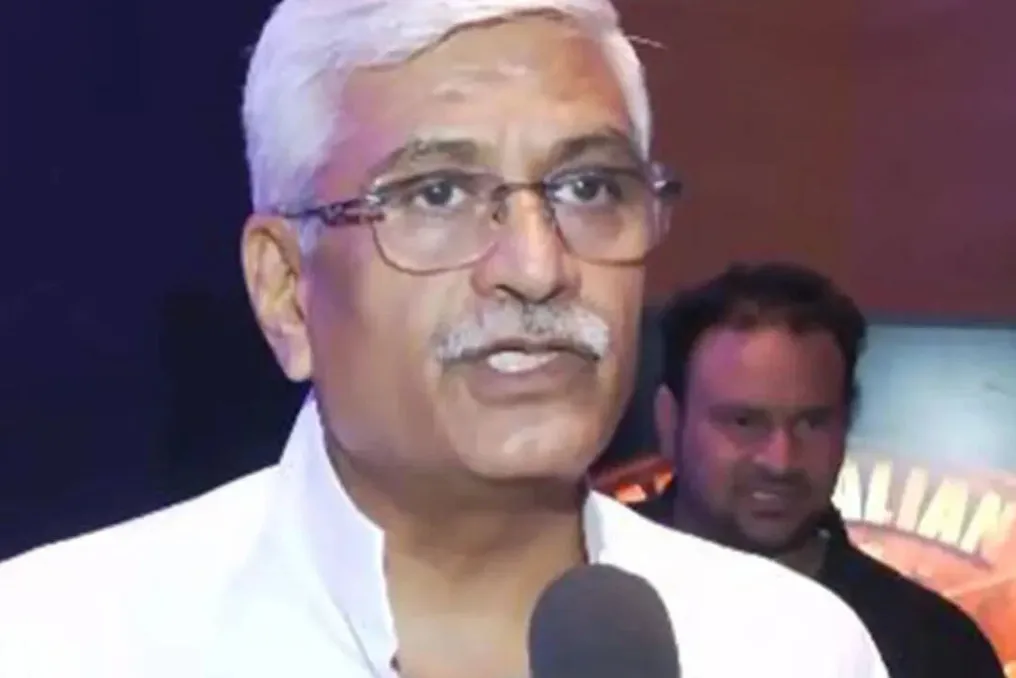
Union Culture Minister Gajendra Singh Shekhawat stated on Wednesday that India is not merely a territory defined by geographical borders, but a cultural nation forged by millennia of continuity, knowledge, struggle, and experience.
Shekhawat's address took place during the presentation of the book 'Timeless India: Protection & Revival of Indian Cultural Identity under the Leadership of Prime Minister Narendra Modi' at Darohar Bhavan, the headquarters of the Archaeological Survey of India (ASI). The event was held in collaboration with the Indira Gandhi National Centre for the Arts (IGNCA).
The book was published by IGNCA and Subhi Publications, and it was edited by former Rajya Sabha member Tarun Vijay. Shekhawat emphasized that 'India is not just an object confined by geographical boundaries, but a cultural nation shaped by millennia of continuity, knowledge, spiritual practice, struggle, and experience. The civilization and cultural consciousness of India flowed uninterrupted through the ages.'
He added that India has established connections with civilizations worldwide through cultural exchange and dialogue. Its heritage in knowledge, architecture, and culture has attracted the attention of many countries.
During the colonial rule period, attempts were made to weaken the sense of pride among Indians regarding their culture, traditions, and civilization. As quoted by the IGNCA statement, the minister noted that this affected how Indians perceived their own traditions of knowledge and cultural ideals.
'A distinguishing feature of Indian civilization is its ability to draw inspiration from the past while moving towards the future. The ideals embodied by Lord Rama and Lord Krishna, along with the traditions of sages, thinkers, and seekers of knowledge, remain vital foundations of India's cultural consciousness,' he stated.
The book explores the role of monuments in preserving and reviving India's cultural identity, as well as discussions surrounding the nation's historical memory. Special attention is given to monument preservation and the concept of 'decolonization of national memory,' stressing the need to understand India's cultural heritage through its 'own historical experience, traditions, and cultural perspective.'
State Minister Jitendra Singh, a former Rajya Sabha member and ex-President of the Indian Council for Cultural Relations (ICCR), as well as Vinay Sahasrabudhe, were also present at the event. In a separate statement, the Ministry of Tourism announced that the Indian Culinary Institute (ICI) signed a memorandum of understanding with Jawaharlal Nehru University (JNU). This agreement allows JNU to recognize BBA and MBA programs from ICI, enabling JNU to award degrees to students who complete their studies at ICI.
The memorandum was signed by JNU Rector Santishri Dulipudi Pandit and ICI Director Gyan Bhushan in the presence of Shekhawat and Tourism Secretary Bhuvnesh Kumar. It is expected that the recognition of ICI programs at JNU, which will begin next academic year, will enhance academic and professional opportunities for students.