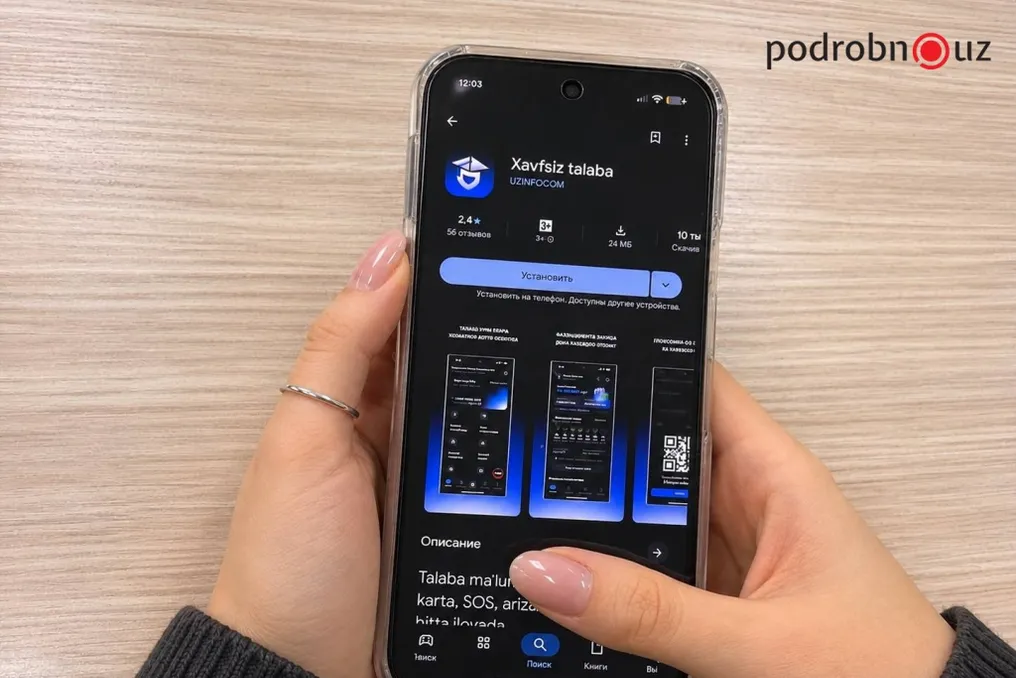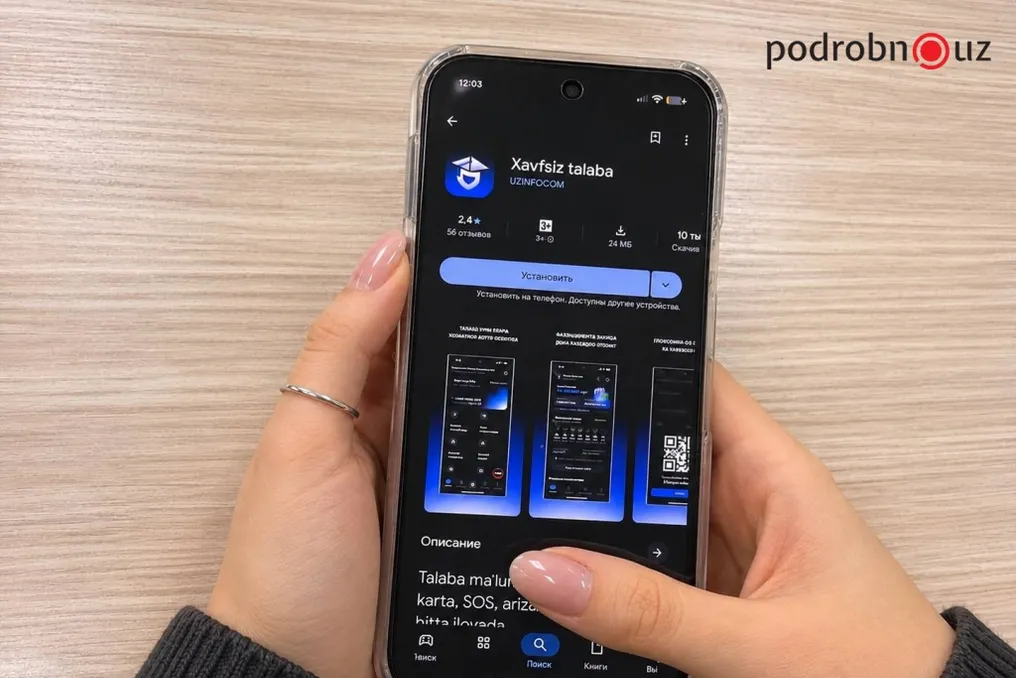
In several higher education institutions in Tashkent, students faced a requirement to install an application called Xavfsiz talaba, which translates to 'Safe Student'. These incidents became known through social media on November 3. A correspondent from 'Gazeta', Mirolim Isajonov, visited the Uzbek State University of World Languages, where students first filed a complaint.
This application collects personal student data, course and contract payment information, and includes an 'SOS button' function. It is also used as a key for campus and dormitory access. Parents can track the contract payment process and record their child's entry and exit times from the dormitory via this program.
Journalist Mukhrim A'zamkhujaev posted messages from students of USGUMYA on his Telegram channel, who claimed they were not allowed into the university building until they installed this application.
Prosecutor's Directive
The Rector of USGUMYA, Ilhomjon Tukhtasinov, told 'Gazeta' that on November 2, representatives of the Uchtepinsky District Prosecutor's Office visited the university and held a meeting with students. The employees explained the procedure for using SOS buttons and issues related to installing the application to enhance student safety.
According to the rector, the prosecutor's office issued a directive to install the Xavfsiz talaba application, and the university is currently working on its implementation. The goal is to increase safety, prevent incidents, and restrict unauthorized access to the university. Tukhtasinov specified that this directive was received after the president's visit to the student town in Tashkent, where issues of monitoring the social situation and security were discussed.
The head of the university noted that alarm buttons are installed in every university to ensure safety. He also announced plans to integrate the application with situational centers, which will allow for accurate tracking of the student's location—whether in class, on the street, or in the dormitory. Ilhomjon Tukhtasinov added that the university would take steps to eliminate misunderstandings, emphasizing that the goal was not to prohibit students from attending classes who had not installed the application. However, due to the small number of students at the meeting on November 2, it was decided to accelerate work in this area.
Installation is Not Mandatory
Valijon Sadiev, the university's first vice-rector for spiritual and educational work and youth affairs, told 'Gazeta' that installing the application is not mandatory, and staff only provide recommendations. He mentioned that about half an hour before classes started, staff explained to students how to install the application. There is no exact data on the number of students covered, but on November 5, the application was downloaded over 50 thousand times on Google Play.
Sadiev advised students to download the application for personal safety, explaining that the SOS button allows sending a signal to the security service and receiving prompt assistance in case of a threat. He stressed that the decision to install remains with the student. Nevertheless, around 12:45, the 'Gazeta' correspondent observed checks for the presence of the installed Xavfsiz talaba application at the entrance to the English language faculty before granting entry. The curator present insisted on the necessity of installing the application for safety. The university employee also recommended installing the APK qo’riqchi application to protect against malware.
Following student complaints on social media on November 3, the dean of the Translation Faculty at USGUMYA, Ulugbek Yuldashev, was dismissed. The university administration informed 'Gazeta' that the reason for the dismissal was the improper organization of the installation of the Xavfsiz talaba application, as well as discussions on social media.
Reaction of the Ministry of Education and Science
Manuchehr Mirzaev, head of the Department of Digital Transformation and Information Policy of the Ministry of Education and Science, commented that the ministry itself does not own this application. He clarified that situational centers exist within internal affairs bodies and the prosecutor's office, but did not name the initiator. The department emphasized that forcing students to install the application is unacceptable, and only explanatory and promotional work is necessary. After reports emerged about students being denied entry to classes at USGUMYA and other universities, the ministry began studying the situation.
Reaction of the General Prosecutor's Office
Hayot Shamsutdinov, head of the Information Service of the General Prosecutor's Office, responded to 'Gazeta''s request, stating that the Xavfsiz talaba platform is not a direct system of the prosecutor's office. It was created as part of cooperation between several agencies to improve the crime situation and ensure a safe environment in student dormitories and universities.
After the Almazar district was transferred under the jurisdiction of the General Prosecutor's Office, a Student Situational Center was established on an experimental basis, covering 6 universities and 41 dormitory in the area. Subsequently, the mobile application Xavfsiz talaba was developed and integrated with this center. Through the platform, students can receive academic information, submit appeals to state bodies, and receive responses. It also provides the option to call an ambulance, a prevention inspector, or emergency rescuers. The platform integrates the HEMIS information system of the Ministry of Education and Science, as well as electronic systems of law enforcement agencies and other state structures.
The digitalization of the process of placing students in dormitories is intended to ensure transparency and prevent corruption. The platform presentation took place for the president during his visit to the Almazar district on September 11, after which a directive was given to first implement the system in all Tashkent universities and then nationwide. University administrations began explaining the system's capabilities, and currently, opinions from students, parents, and university representatives are being studied for its further improvement.
A representative of the General Prosecutor's Office particularly emphasized that connecting students to the platform is not mandatory, and promotion should be aimed solely at informing about the system's benefits. He categorically stated that neither the General Prosecutor's Office nor its subdivisions gave any directives to responsible persons or university representatives regarding the forced connection of students or refusal of admission to classes for those who did not use the platform.