An open exhibition has launched at Umm Al Emarat Park in Abu Dhabi, inviting children not just to look at works of art, but to interact with them, modify them, and contribute, thereby stimulating their imagination.
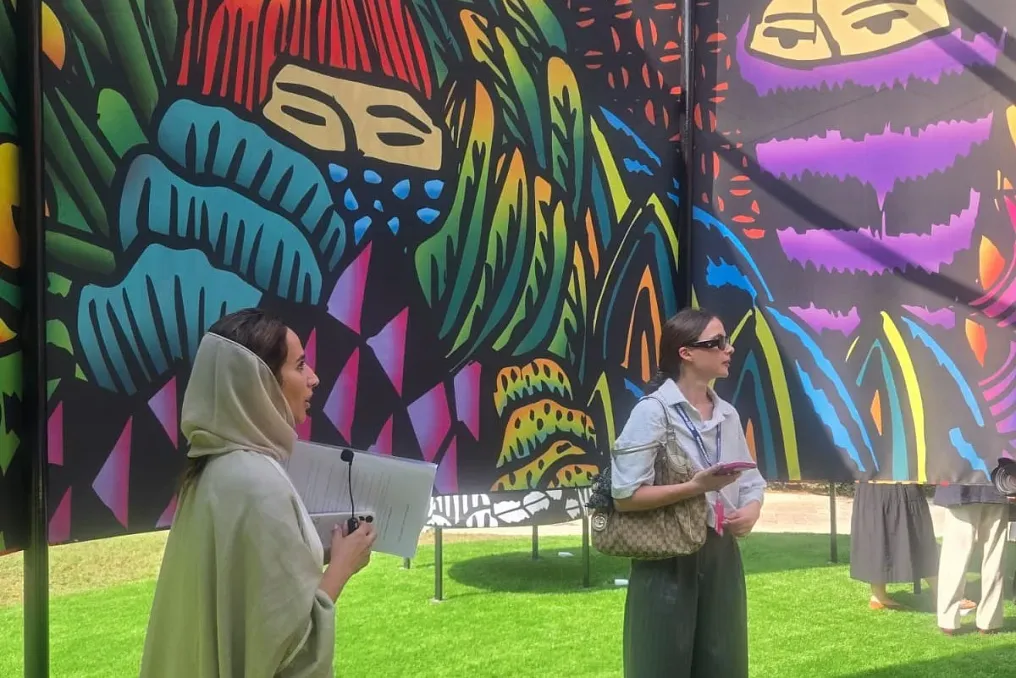
The exhibition, titled 'How the World Feels,' will run from November 6th to December 6th, transforming parts of the park into an interactive display. It features eight installations, seven new pieces created by UAE artists, as well as an immersive installation by Indonesian artist Eko Nugroho.
Curator Dana Al Mazroui emphasized that the core idea was to place children at the center of the artistic experience, rather than viewing them as passive visitors. She noted that the artists were commissioned specifically to consider how to make children part of the work, not merely observers.
One installation, 'Where Wishes Grow,' is a three-part piece by Nada Al Mousa in collaboration with UT-R Studio. It offers visitors a journey through the past, present, and future. In one section, guests are invited to record or draw their favorite memories of public parks and place them among flowers. In another section, a bush-like structure displays works created by children in response to various prompts. The third part is a 'wish tree,' where visitors can attach their hopes for future generations.
Al Mousa explained that the goal of this installation is to evolve over the month through the contributions of children and families. In the section dedicated to the past, visitors are asked to write down their favorite park memories and plant them in a flower, while in the futuristic part, they are encouraged to write wishes and tie them to the tree.
Another installation, 'Common Thread, Common Ground' by Egyptian artist Hana El-Saginy, challenges children by allowing them to decide what they see. It consists of large organic sculptures surrounded by ropes that children can weave and rearrange. Depending on the viewpoint, the shapes can resemble corals, bones, dates, or something entirely different. El-Saginy deliberately avoids explaining what the sculptures represent, aiming to create ambiguous organic forms so that each child can form their own perception.
The ropes play a key role in the concept, as weaving allows the appearance of the sculptures to change during play. The artist added that she wanted children to explore this idea by working together because 'a very fragile element with weaving becomes much stronger.' The sculptures were initially modeled from ceramics and later recreated from fiberglass and resin for outdoor durability, making them usable as a shared family space.
In another area, there is an installation offering a different sensory experience—listening to the park. Created by Mira and Moza Al Mazroui, this interactive sound setup is inspired by a familiar tin can telephone. Different channels provide various ways of perceiving sound: some transmit sound from one end to the other, while others introduce a delay between speaking and receiving a response. Other tubes prompt children to imagine listening to the sky and the earth. The goal of this project is to draw attention to the sounds and surroundings that people often ignore, while allowing children to experiment with communication and listening.
The Pollinators Play Museum, created by Moza Al Matroshi, invites children to approach bees and other pollinators that many instinctively avoid out of fear of being stung. The installation combines pollinator plants found in the park, wild hives, traditional beehives, and other beekeeping items. Children can crawl through large hexagonal structures mimicking bees. The color palette also introduces them to the idea that bees perceive the world differently than humans. Al Matroshi noted that the project partly aims to bridge the gap between humans and pollinators, mentioning that people fear stings, and bees might fear their own stings.
The hives presented at the exhibition were collected after wild bees abandoned them, and the construction materials were chosen to be recyclable or able to return to the earth. Al Matroshi stressed the importance of zero waste in creating the installation.
Nearby, colorful woven structures offer another interpretation of nature. Three textile works by Sara Afaneh—'Patient Earth,' 'Gracious Sun,' and 'Frenzied Sea'—explore natural elements through texture, color, and weaving. Earth symbolizes abundance and nourishment, the sun is presented as a patient giver, and the sea represents boundless unknown. The Palestinian artist noted that the sea is a vast unknown, similar to how we know the surface of the water but not its depth.
Interactive woven nets allow children and adults to add their threads to an installation that will continue to evolve throughout the biennale. For Afaneh, weaving has become a way to reconnect with her childhood and creative instincts, allowing her to follow intuition without detailed planning.
Perhaps the most intriguing installation is the one where the smallest creature is enlarged to giant proportions. Artist Alia Al Shamsi was inspired by the jerboa, a tiny desert rodent with unusually long legs, and transformed it into a large sculptural figure in the park called 'Where Wonder Hides.' This playful figure resembles a mix of a mouse and a kangaroo. Al Shamsi explained that the idea is to alter the animal's real scale to prompt children to think differently. For her, the installation is deeply personal, reminiscent of childhood games in nature, flower picking, and creating imaginary worlds.
Although Al Shamsi never encountered a jerboa in her childhood, she recalled an instance when the animal entered their tent during a desert camping trip. She hopes the artwork will help families reconnect with nature through play, especially in an era when children's attention is often fixed on screens and technology, emphasizing the importance of 'offline' interaction.
Another piece, 'Cosmic Connate' by Palestinian artist Aya Afaneh, draws inspiration from fish and other creatures inhabiting the park's fountains. Her sculptural forms prompt children to contemplate what unusual beings might live in the water, using familiar natural elements to invent something new.
The final stop is spending time under a large illuminated structure resembling a lantern, created by Indonesian artist Eko Nugroho, titled 'Firefly Memories' (Kenangan Kunang-Kunang). Originally commissioned by the National Gallery Singapore for the 2019 Biennale, the installation draws inspiration from traditional East Javanese lanterns and explores ideas of peace, equality, and kindness. Reimagined for the outdoor exhibition in Abu Dhabi, it impresses with its illumination after sunset.
Beyond the installations themselves, the biennale will include workshops and events featuring artists, allowing children and their families to experiment with the ideas behind the works. Public workshops are scheduled for November 6th and 7th, and November 13th and 14th, starting at 6:30 PM, with activities such as drawing, weaving, lantern making, sound exploration, and collective art creation. Morning tours will also be organized for schools.
For Al Mazroui, the park itself is an integral part of the experience. Unlike traditional exhibitions in galleries or museums, the open space provides children with a familiar environment to encounter art. The goal, she says, is to encourage them to pause and notice what they might otherwise walk past.
Some artists explored mythical creatures and imaginary animals emerging from the water, while others focused on the park's sounds that are rarely noticed. Ultimately, the exhibition poses a simple question: what if children were given the freedom to experience the world without being told exactly what to see?
_