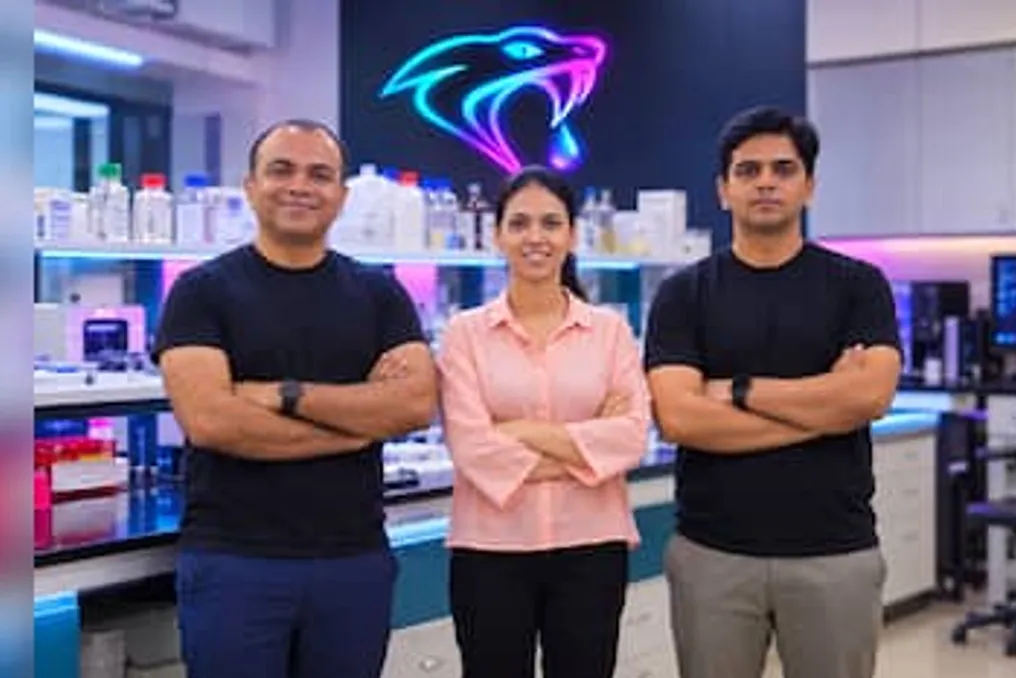
Venomics AI raises $2.7 million to discover drugs from animal venom
Read more
Business Standard
business-standard.com

Venomics AI raises $2.7 million to discover drugs from animal venom

Venomics AI, a biotechnology company spun out of the Indian Institute of Science (IISc), has successfully completed its first round of institutional funding, raising $2.7 million. This seed round was co-led by Speciale Invest and South Park Commons, with participation from Operators Studio.

The company combines venom biology, artificial intelligence, and experimental screening to discover and develop molecules derived from venoms into therapeutic compounds. The funds raised will be used to expand the Venom Atlas molecular database, strengthen the company's capabilities in AI and laboratory testing, and validate potential drugs.

Animal venoms contain diverse molecules shaped by millions of years of evolution to affect biological targets. Understanding the mechanisms of evolution and function of these molecules helps researchers find promising starting points for drug creation. Examples of this potential include existing drugs such as captopril, inspired by snake venom peptides, and ziconotide, derived from a sea snail venom peptide.

Venomics AI aims to study this diversity on a large scale. Their platform uses molecular sequencing and venom biology to build the Venom Atlas, applies AI to prioritize candidates, and then tests these predictions through functional screening in the lab. Experimental results are used for feedback in subsequent predictions and molecular design, linking computational discoveries with actual molecular efficacy.

Kartik Sunagar, founder and director of Venomics AI, and an IISc professor, stated: 'Animal venoms represent one of the richest yet least explored sources of potential medicines in nature, and at Venomics AI we combine cutting-edge experimental science with artificial intelligence to unlock this exceptional potential.' He added that this investment will accelerate their vision of creating a world-class drug discovery platform that leverages India's exceptional biodiversity and scientific talent to develop breakthrough therapeutics in India for the world.

Venomics AI was co-founded by Sunagar and Vinay Prabhu, who combined their expertise in venom biology and artificial intelligence. Sunagar's research at IISc covers venom evolution and antivenom development, providing the scientific foundation for identifying molecules with therapeutic potential. Prabhu, co-founder and CTO, holds a Ph.D. from Carnegie Mellon University and has experience in machine learning and large-scale AI systems.

Arjun Rao, General Partner at Speciale Invest, noted: 'India's venom biodiversity is among the richest in the world, and Kartik is one of the leading global experts in this field. Few people combine his deep understanding of these venoms with the ability to study them. Vinay brings the depth of AI to accelerate this bio-discovery. Together they are creating the Venom Atlas—a unique dataset that will allow AI to find cures for some of the world's most acute diseases. This combination is rare, and we are excited to see the medicines it will produce.'

Pratik Mehta, General Partner at South Park Commons, emphasized that venom is one of the oldest targeting systems in nature, having given rise to captopril and GLP-1. He pointed out that previously, only one molecule could be searched for at a time, but AI is changing this paradigm. Mehta added: 'This is a global opportunity, but India has an advantage as one of the world's richest biodiversity hubs. Kartik has spent two decades in this field, and Vinay is a lifelong builder of AI. They deeply understand this problem and are well-prepared to make discoveries that could forever change medicine.'

By combining India's venom biodiversity with its scientific and computational expertise, Venomics AI aims to create a drug discovery platform in India for global therapeutic development. The company has already established the initial architecture of its platform, joined the NVIDIA Inception program, and was selected as one of the top five finalists for the Indo-Boston Biotech Bridge Award 2026.


Similar stories

Sand.ai raises $200 million in Series A+ round to compete with Kling and Seedance using open AI video
Read more
ventureburn.com

Sand.ai raises $200 million in Series A+ round to compete with Kling and Seedance using open AI video

In ten months, Sand.ai has transformed from an early-stage project into one of the most discussed artificial intelligence startups in China. The company raised $200 million in a Series A+ round, aiming to become a unicorn valued at over $1 billion. Cornerstone Capital and Wangsu Science & Technology led this round. New investors include Times Capital, Panlin Capital, Orient Securities Capital, Pudong Venture Capital, and Shanghai Guofang.

Sand.ai has raised approximately $300 million in funding and is now targeting competition with video generation giants—Kling and Seedance. The company was founded in 2024 by Chao Yue, who previously worked as a senior research scientist at Microsoft Research Asia. His prominence stems from the joint development of the Swin Transformer model, which won the best paper award at the ICCV conference.

This experience shaped the company's strategic decision: Sand.ai chose an autoregressive approach to video, while most of the industry favored diffusion models. Chao later admitted that the team underestimated the complexity of the chosen path.

In May 2025, Sand.ai released the open-source project MAGI-1, which won the Physics-IQ video continuation benchmark. Then, in August 2026, a preliminary version of MAGI-2 was presented—a mixture-of-experts model with 114 billion parameters. Because it is only active about 6 billion times per pass, its cost remains low. The distilled MAGI-2 model can generate a 10-second video in 1080p resolution for approximately 0.5 yuan.

According to BigGo Finance data, the cost per second of video is about one-tenth the cost of mainstream models. Developers also point to the MagiAttention library, used by Tencent's Hunyuan team and supported via NVIDIA's NeMo AutoModel. This is a quiet but significant endorsement. Furthermore, there is a product side: the AI video creation application VidMuse generated $10 million in annual recurring revenue within two months.

It is important to note that many AI labs demonstrate impressive examples but struggle with product sales. Sand.ai demonstrates the ability to do both, which is exactly what investors are currently looking for.

Wangsu is not just providing financial support; 300 million yuan ($45 million) of capital from this company, a giant in CDN and edge computing, is directed toward this project. Wangsu is interested in collaborating with Sand.ai on low-latency edge video inference. Given clients such as ByteDance, Tencent, and JD.com, this partnership could provide Sand.ai's models access to very large customers.

The raised funds will be used for model research, training, inference infrastructure, product improvement, and expansion into overseas markets. In a broader context, the AI video race in China is accelerating as major players already have their own platforms. Kuaishou recently raised about $2.9 billion, valuing the company at $18 billion. ByteDance's Seedance reportedly generates over 1 billion yuan in monthly revenue.

Sand.ai is choosing a different path: it is independent, open-source, and operationally economical. This is attractive to developers and brands that do not want to depend on competitors' platforms. Nevertheless, risks exist: foundational models continuously consume capital, and early successes can quickly fade. However, if MAGI-2 meets expectations, Sand.ai could become a neutral choice in the AI video sphere, which warrants close monitoring.

Simplismart raises $14 million in Series B round to expand AI inference platform
Read more
business-standard.com

Simplismart raises $14 million in Series B round to expand AI inference platform

Simplismart, a company specializing in artificial intelligence inference infrastructure, announced that it has raised $14 million in a Series B funding round. The round was led by Dallas Venture Capital, with participation from NVIDIA, Accel, Shastra VC, and Micromax.

The funds raised will be used for the further development of the Simplismart inference platform. This will enable enterprises to launch AI-based applications more efficiently, and cloud providers to transform their Graphics Processing Unit (GPU) infrastructure into managed AI services. Furthermore, the funding will support the expansion of partnerships with cloud providers and sovereign AI, as well as growth in North American and other global markets.

Simplismart creates a software layer situated between AI models and GPU infrastructure. Its modular inference engine allows companies to customize AI model operation according to their needs for speed, cost, and performance. The company's orchestration platform manages deployment and scaling in both cloud and on-premise infrastructure.

Over the last six months, the company's annual revenue growth rate has increased 14fold. Companies such as HeyGen, Higgsfield, InVideo, Shiprocket, Apna, and Ema run production workloads on the Simplismart platform, covering video, voice, multimodal, and enterprise AI applications.

Amritaanshu Jain, Co-founder and CEO of Simplismart, noted that while the industry has spent many years improving AI model capabilities, the advantage is determined by how these models are utilized: the cost per interaction, application response speed, and reliability under increasing demand. He added that the team spent four years creating the software layer between the model and the GPU, helping clients optimize workload deployment and operation.

An example of usage is the Exotel communications platform. After Exotel found that the economics of closed API models were unsuitable for its voice agents, the company fine-tuned an open model on its own data and migrated the inference to Simplismart. By sharding GPUs, Simplismart reduced the cost per minute for Exotel by 57% compared to closed API models. Additionally, it lowered costs below that of self-hosting the same open model and reduced response time from 1.1 seconds to less than 300 milliseconds.

As part of its offering to cloud providers, Simplismart collaborates with NVIDIA to simplify the deployment and operation of AI infrastructure at scale. Unlike inference providers who buy or reserve GPU capacity and resell it, Simplismart itself does not own computing power. Instead, it provides a software layer that transforms third-party GPU clusters into ready-to-use AI production infrastructure. Cloud providers can use this platform to offer managed AI services under their own brands without building their own software stack from scratch. This approach is already used by Yotta, where the Simplismart platform forms the basis of the Shakti Studio server inference layer.

Dayakar Puskoor, Managing Partner at Dallas Venture Capital, stated that inference is becoming one of the most significant drivers of change in the AI economic model. He emphasized that Simplismart is rapidly becoming a global player, helping enterprises execute AI workloads more efficiently and enabling cloud providers to convert GPU power into scalable services.

Devansh Ghatak, Co-founder and CTO of Simplismart, reported that the company's modular inference engine allows configurations to be adapted to the requirements of individual workloads, and the orchestration platform manages deployment across various infrastructure environments. Ghatak also mentioned that the new funding will support the development of a dynamic GPU scheduling layer, which can align AI workloads with available computing power across different regions and time zones, helping cloud providers better utilize their GPU infrastructure.

WILDE Company Raises $40 Million to Expand Protein Snack Production Business
Read more
ventureburn.com

WILDE Company Raises $40 Million to Expand Protein Snack Production Business

WILDE Company has successfully secured $40 million in investment from S2G Investments. These funds will be allocated to developing the protein snack production business, including product innovations, as well as for the manufacturing and branding of the company's goods. This financing was made possible against the backdrop of growing demand for alternative savory snacks.

WILDE was founded in 2015 based on the experience of CEO Jason Wright in the food industry. Initially, the company used chicken breast, egg whites, and bone broth to create a range of chicken chips and crackers. WILDE's products are characterized by rich flavor and higher protein content.

Currently, the company demonstrates an average sales volume exceeding $100 million and is present in over 35,000 retail locations across the United States. WILDE has begun investing in production infrastructure, and this new funding round will allow it to expand its distribution network and develop new products.

S2G Investments specializes in investing in enterprises in the food industry, agricultural sector, energy, and ocean. Their interest in WILDE stems from changing consumer preferences in nutrition. The combination of high-protein ingredients and WILDE's established retail distribution opens up significant opportunities for further growth.

The company recently opened a 130,000 square foot production facility, which it positions as the only USDA-certified savory snack manufacturing plant in the world. This facility increases production capacity sixfold. With support from S2G, the company plans to scale up production and expand its product line.

The expanded capacity gives WILDE more ability to meet demand for its existing assortment and also provides production support for future launches. The company intends to use the investment to strengthen production alongside distribution growth.

WILDE's current product portfolio includes Protein Chips and Protein Crackers. Both lines provide over 10 grams of protein per serving and are designed to deliver a crunchy pleasure using ingredients other than traditional potato and corn snacks.

The company plans to create additional snack formats beyond the core products. Such novelties may help WILDE reach more consumers and enter various meal times. Investment in production lays the foundation for this product strategy.

The recent release of Protein Crackers was another step in WILDE's product development strategy, as the company expands its protein approach beyond chips. The funding will support improvements to the brand's visual identity, packaging, and marketing capabilities.

New formats are also being developed. These changes aim to increase brand recognition as the company expands its retail presence. WILDE's goal is to occupy a more prominent position in the protein snack category.

S2G sees potential in transforming WILDE into a broader snack platform. The investor noted the firm's growth, its retail presence, and the potential for assortment expansion. The obtained funding will help the brand grow among a wider consumer audience.

Consumers are increasingly paying attention to nutrition alongside taste and convenience. Protein has already become one way the food industry is responding to this demand. WILDE hopes to satisfy this consumer desire without sacrificing taste.

There is currently both capital and production capacity for the company to move to the next stage. Scaling will be achieved by ensuring product quality, increasing distribution, and developing core snack types. WILDE's latest investment marks an important milestone in its growth strategy.

Popular