Although a clean road does not guarantee clean air, three Indian cities are offering unique approaches to solving the problem of road dust. For instance, on November 5th, the Air Quality Index (AQI) in Delhi reached 370, classifying the capital as being in the very poor category. In the Jahangirpuri area, the index rose to 459, falling into the severe category.
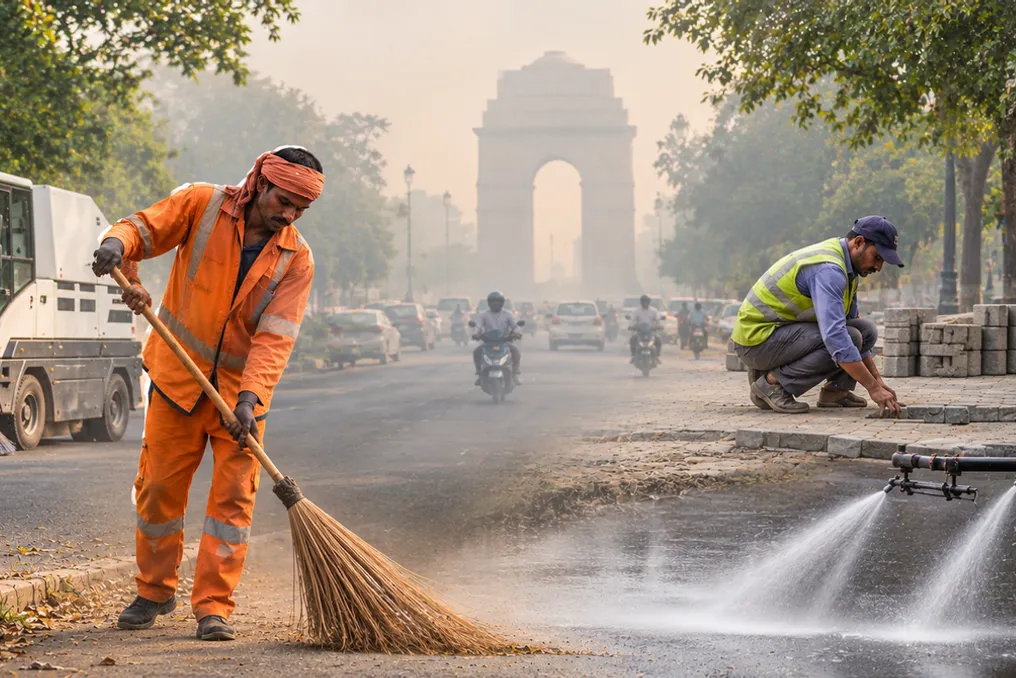
As winter approaches in North India, it is customary to intensify street cleaning, spray water, and inspect construction sites. However, there is an issue with cleaning methods: a street may look immaculate, yet fine particles still rise into the air. Transport can then re-suspend this dust, exposing pedestrians, cyclists, and residents to pollution.
The question is not simply whether municipalities should clean more often, but whether they can remove dust in a way that prevents it from becoming airborne. Three Indian cities are demonstrating different solutions to this problem: Lucknow has expanded mechanized cleaning, Parwanoo has focused on repairing dust-generating surfaces, and Chandigarh is testing a method combining water washing with treatment and mechanical cleaning.
Lucknow goes beyond simple sweeping
In September 2026, Lucknow ranked first in the Swachh Vayu Sarvekshan among cities with a population over 1 million. Its 70th ward in Zone 4 also became the national leader among wards with a population exceeding 30 thousand. This recognition resulted from city-wide efforts to combat various sources of pollution, including road dust, transport emissions, and waste burning.
The Lucknow Municipal Corporation deployed 97 electric mechanized cleaning vehicles. These machines use rotating brushes to collect debris, and suction systems help capture finer material instead of just displacing it. Furthermore, the city paved approximately 559.85 km of roads, reducing the amount of open surfaces that can be disturbed by passing vehicles. Officials noted that the combination of mechanized cleaning and paving contributed to controlling re-suspended road dust.
The ward-level recognition is particularly important because air pollution is felt locally. A city might have an ambitious clean air plan, but residents experience its outcomes right on the street near their homes. The achievement of the 70th ward shows how actions to improve air quality can be assessed at the neighborhood level. Nevertheless, the award does not determine how much the pollution caused by individual measures in that ward has decreased. The task is to turn recognition into sustainable, measurable improvements in the air breathed by residents.
Parwanoo addresses the source of road dust generation
In Parwanoo, a town in Himachal Pradesh, officials started with a different question: what if the road itself is the source of the dust? A study conducted by IIT Kanpur covering an area of 8.5 sq. km in the city identified road dust as a significant source of air pollution. The municipal response was aimed at repairing surfaces and conditions that allowed dust to accumulate.
A 9 km stretch of road was upgraded using paving stones and interlocking blocks, replacing deteriorating surfaces. Drainage systems were improved to prevent erosion, and construction and demolition waste came under closer scrutiny. The city also created 0.27 acres of green buffer zone, intensified afforestation efforts, and restricted illegal dumping.
The results were measurable. The annual average concentration of PM10 in Parwanoo decreased from 66 micrograms per cubic meter in the 2017-18 period to 39 micrograms per cubic meter in the 2023-24 period, representing a reduction of approximately 41%. PM10 refers to particles with a diameter of 10 micrometers or less, and road dust can contain such particles that enter the respiratory system. This reduction cannot be attributed solely to paving; Parwanoo's efforts included a range of measures, and the city's experience demonstrates the value of eliminating dust at its source rather than relying solely on post-accumulation cleanup.
Chandigarh tests the effectiveness of washing
Chandigarh is approaching the problem through a pilot project. In September 2025, the Chandigarh Pollution Control Committee instructed officials to launch a dust control initiative along a dust-prone corridor. The plan combined road washing using treated water, mechanical sweeping, and roadside cleaning.
Roadsides are important because loose soil and litter along the edges can be repeatedly disturbed by vehicle traffic. Cleaning only the central lane might leave a significant dust source untouched. The committee planned to monitor PM10 levels during the pilot project and use the data to decide on potentially expanding the intervention city-wide. The project also fits into broader efforts to control construction and demolition waste. Authorities mandated institutions and agencies to suppress dust at storage sites, cover loose soil with vegetation, and use sprinklers or anti-smog installations where appropriate.
It is important to note that the Chandigarh project was announced as a pilot, not a proven city-wide success. Its value lies in testing whether the combined approach of road washing and mechanical cleaning, along with air quality monitoring, can establish their effectiveness.
What Delhi can learn
Air pollution in Delhi is caused not only by road dust. Transport emissions, industrial activity, construction, waste burning, agricultural fires, and winter weather conditions all contribute to episodes of poor air quality in the city. However, this does not make road dust control insignificant; it only underscores the importance of targeted measures.
Lucknow demonstrates the value of mechanized cleaning and ward-level action. Parwanoo shows why repairing damaged roads and controlling construction waste can prevent dust accumulation. Chandigarh is exploring whether treated water washing and roadside cleaning can improve results. The broader lesson is that road cleaning should not be measured only by the amount of dust collected or the number of machines deployed. Municipalities must measure how much dust remains on the roads, how quickly it returns, and whether the concentration of particulate matter decreases.
For a city like Delhi, where winter pollution can become a public health emergency, clean roads are not a complete solution. But it is a tangible civic intervention that can be planned, monitored, and improved. The true test of a clean road is not how it looks after a cleaning machine passes, but how much dust remains in the air afterward.