ZTE denies rumors of smartphone business sale involving ByteDance
Read more
TechNode
technode.com

ZTE denies rumors of smartphone business sale involving ByteDance

ZTE has officially rejected reports regarding plans to transfer its smartphone manufacturing division into a joint venture with a major internet company and local state investors. These rumors arose amid online speculation pointing to ByteDance as a potential partner.

ZTE informed The Paper on November 3 that such reports seriously diverge from the actual situation and stated its right to file a lawsuit.

According to published data, the alleged proposal involved creating a new enterprise by packaging ZTE's operational activities in the mobile phone sector. Although the media report did not name the internet company, discussions on social networks suggested ByteDance as a likely participant.

It is worth noting that these two companies are already collaborating on the development of AI-powered smartphones. Together they released the Nubia NaviX Ultra model on September 16, which features the Doubao Phone Assistant. This device includes system-level AI agents designed to perform tasks across various applications.

Similar stories

Huawei's application for the OSTA trademark raises reports of a new smartphone brand
Read more
technode.com

Huawei's application for the OSTA trademark raises reports of a new smartphone brand

According to trademark registration data published by IT Home on November 4, Huawei has filed an application to register the trademark OSTA. This mark is intended for various products, including smartphones, tablets, smart glasses, and chips.

This filing coincides with reports that Huawei is preparing a new sub-brand for smartphones called Xingmang in Chinese, with OSTA being used as its English name.

Chinese technology analysts have discovered the OSTA O1 Pro phone model. The presumed image of this model's packaging indicates a configuration with 16 GB of RAM and 1 TB of storage. Furthermore, Huawei has applied to register the Xingmang trademark. Currently, the company has not officially announced either the brand itself or its first devices.

Samsung may develop a 17-inch foldable tablet with flexible screen technology
Read more
tecnoblog.net

Samsung may develop a 17-inch foldable tablet with flexible screen technology

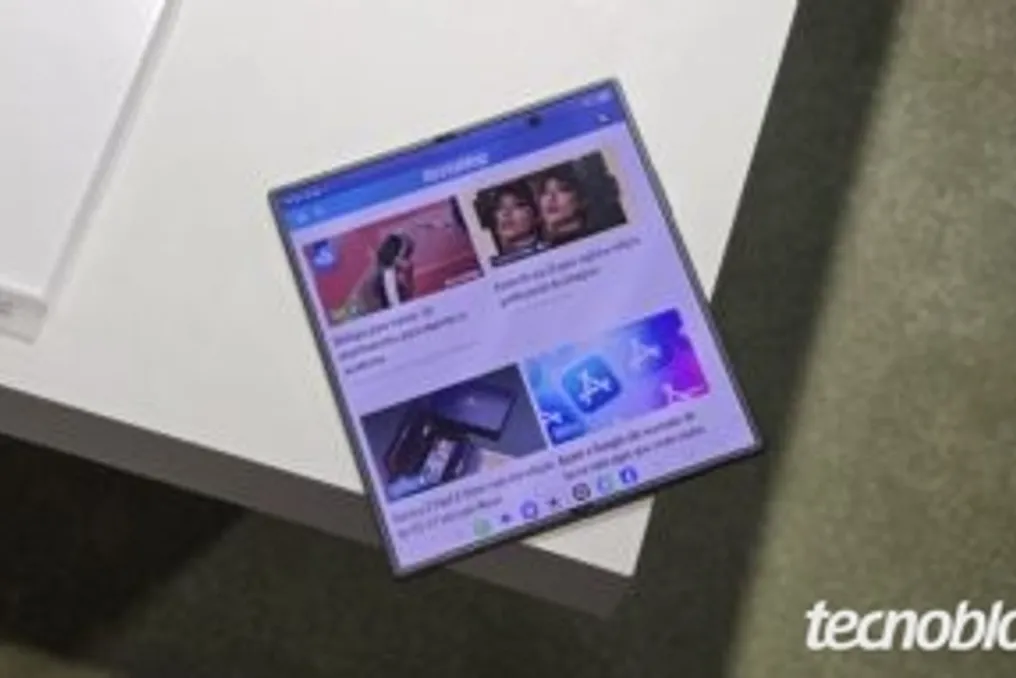
Samsung is showing interest in applying its foldable screen technology to other categories of mobile devices. Current rumors suggest that the South Korean company has advanced in developing a foldable tablet featuring a 17-inch screen.

According to leaked information, when closed, the device would have dimensions close to those of the open Galaxy Z Fold 8, which measures 8 inches. GSMArena reported that the first signs of this project emerged at the end of August, when the source mentioned Samsung's development of a 17-inch foldable.

There are different speculations on how this fold will be implemented. One option would be to use a single 17-inch screen that folds in the opposite direction to what is usual in smartphones, deactivating one side. In this arrangement, the screen would always be visible, which could increase the risk of damage in case of a fall.

Alternatively, the construction could follow the model of phones, featuring a large main screen on the inside and a second external display of about 8 inches. However, no technical details or expected commercial launch date have been disclosed.

This concept is not new to Samsung. In 2021, during SID Display Week, Samsung Display, the corporation's screen unit, exhibited a concept device equipped with a 17-inch foldable OLED panel with a 4:3 aspect ratio.

This prototype was capable of operating fully open or partially folded, in a configuration similar to a notebook. The technology continued to be shown in demonstrations by the division in subsequent years. In 2023, there were speculations about a potential Galaxy Z Tab. Previously, the company had launched the Galaxy View, a 'foldable tablet' that had only one screen.

The probable tablet emerges at a time when Samsung is exploring new formats for its line of foldable devices. The current generation includes the Galaxy Z Fold 8, in passport format, and the Galaxy Z Fold 8 Ultra, which preserves the elongated design of previous versions.

Recent leaks also indicate planning for a broader next generation in 2027. Samsung is expected to launch the Galaxy Z TriFold 2 and a third model of the Galaxy Z Fold 9 family, which could be a wider version or feature simpler configurations.

This expansion occurs parallel to the launch of the iPhone Duo, Apple's first foldable smartphone. Under the direction of John Ternus, the company may also introduce other foldable models in future generations.

Samsung plans to reduce production of Galaxy A line by 20% due to rising memory costs
Read more
tecnoblog.net

Samsung plans to reduce production of Galaxy A line by 20% due to rising memory costs

Samsung is expected to decrease the manufacturing of its Galaxy A line phones by approximately 20% during the fourth quarter of 2026, compared to the initially planned volume. This decision is motivated by the sharp increase in memory chip values, which has raised production costs for both entry-level and mid-range smartphones.

According to reports from the South Korean press, Samsung's suppliers have already been notified about this reduction in component orders. It is estimated that this cut could result in about ten million fewer devices being produced throughout 2026. Furthermore, industry sources indicate that production of the same line in 2027 is also expected to fall by about 10%.

Annually, the company distributes between 230 and 240 million cell phones, according to GSMArena data, with approximately 70% of this total belonging to the A line, which includes models such as Galaxy A17, A37, and A57. The primary cause for this production adjustment remains the increasing cost of components, particularly RAM and storage chips.

Industry information reveals that memory modules can now account for more than half of the manufacturing cost of certain basic phones, which reduces the profit margin obtained from more affordable devices. Other elements, such as PCBs and MLCCs, are also under greater demand pressure due to the expansion of infrastructure focused on Artificial Intelligence. Industry sources also suggest that future cheaper versions may have adjustments to screens and cameras to absorb rising costs, in addition to being launched at higher prices.

Although Samsung manufactures its own memory, the company is reportedly prioritizing components and production capacity allocated to higher-value devices, such as the Galaxy S and Galaxy Z series models, which provide superior profit margins.

The impact of rising costs is already visible in the prices charged by Samsung in Brazil. Models from the Galaxy A line have seen price adjustments in recent months, reaching double their initial price. One example is the Galaxy A07 4G 256, whose value rose from R$ 1,099 in September 2025 to R$ 2,299 at the official Samsung store. Other models, including versions of the Galaxy A07, A17, A27, A37, and A57, have also experienced increases reaching 50% of the original price. Even the premium series has been affected, with the Galaxy S26 family showing increases of up to R$ 1,300.

Despite the adjustments, the mid-range category maintains its position as the brand's sales leader in Brazil, ranking among the top three best-selling devices in the country. This pressure on lower-cost models accompanies a change in consumer behavior. In February, the consultancy Gartner predicted that, with the increase in memory and consequently phone prices, consumers would tend to make fewer device upgrades.

Analyses by other consulting firms, such as Omdia and Counterpoint Research, also show a growth in the market share of higher-priced smartphones and present worrying forecasts for the cheapest models. According to these consultancies, the current scenario may benefit older generation flagship smartphones when sold on promotion or in the used market. The crisis has also influenced recent launches and demand for lines such as the iPhone 18 Pro.


Popular