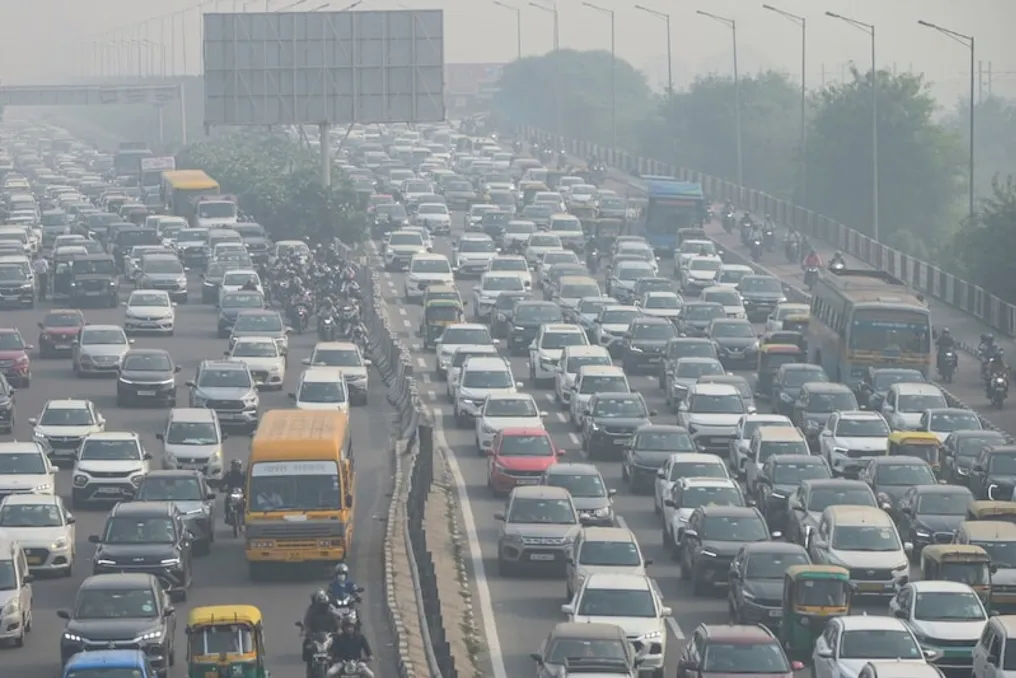
303 fines issued in Delhi in one day for environmental pollution violations
Read more
Aaj Tak
www.aajtak.in

303 fines issued in Delhi in one day for environmental pollution violations

Due to the rising level of air pollution, the municipal corporation (MCD) has intensified measures to prevent violations. On Wednesday, MCD issued 303 fines in the Rohini zone alone. These fines were imposed not on vehicles, but on individuals violating regulations concerning pollution dispersal.

The reasons for these measures include incidents such as open burning of garbage, lack of dust prevention measures at construction sites, and dust accumulation on streets. According to an MCD report, such violations continue to be recorded in various parts of the city.

According to the MCD report from November 4, the highest number of fines was issued in the northwest zone (Rohini). On November 2, 160 fines were issued there, and on November 3, this figure increased to 199. However, on November 4, a record 303 fines were issued in a single day. Ninety-one out of 94 staff assigned to daytime patrols were present in this zone.

Actions were also carried out in other areas. 221 fines were issued in the central-north zone, 210 in the west zone, and 147 in the southeast zone. 155 fines were registered in the south zone, and 105 in the southwest zone.

Various activities contributing to pollution continue in Delhi. Necessary measures are not being taken during construction and demolition work to control dust. Construction waste is stored openly in several places, and cases of garbage burning are also recorded. Dust accumulated on roads also worsens air quality. MCD issues fines to those who violate these established norms.

MCD Commissioner Sanjeev Hirwar reported that the Corporation has identified 48 pollution hotspots in Delhi. Each such area covers about 3–3.5 kilometers. Work is underway in these territories on issues such as road dust, illegal constructions, and traffic jams. He also noted that 66 machines for mechanical road cleaning are currently operating in the city. The shift duration for these machines has been increased from 8 to 12 hours. It is expected that about 12 new machines will arrive by mid-November, and the remaining 55 machines will be delivered from the beginning to the end of December.

125 teams have been created to prevent garbage burning, working in two shifts. Residents are also being informed about the inadmissibility of burning garbage. Furthermore, water spraying, anti-smog cannons, and jet cleaning machines are being used. Garbage collectors have also been placed to pick up waste lying on the roads. MCD is installing Automatic Number Plate Recognition (ANPR) cameras at checkpoints. This will help ensure compliance with emission limits for vehicles below the BS-VI standard. Testing of these cameras is expected to begin next week, after which vehicle data will be transferred to the Delhi Police.

On Wednesday, the average AQI in Delhi was 377, corresponding to the 'very poor' category. On 22 monitoring stations across the city, air quality reached a 'hazardous' level. Despite MCD's actions, polluting activities continue in some areas.

Similar stories

Delhi's 'Winter Action Plan' to Combat Air Pollution Takes Effect on November 1st
Read more
www.aajtak.in

Delhi's 'Winter Action Plan' to Combat Air Pollution Takes Effect on November 1st

To address the air pollution problem in Delhi, the 'Winter Action Plan' will come into effect starting November 1st. This plan introduces strict regulations.

Among the measures to be implemented are the requirement for offices to operate in a remote work (work from home) mode at 50 percent. Restrictions will also be introduced on the use of fuel without a PUC certificate and a ban on the movement of vehicles that do not meet the BS4 standard.

Introduction of the first stage of the Air Pollution Response Plan (GRAP-1) in Delhi-NCR with threat of fines
Read more
www.aajtak.in

Introduction of the first stage of the Air Pollution Response Plan (GRAP-1) in Delhi-NCR with threat of fines

Due to the rising level of air pollution in the Delhi-NCR region, including Noida and Greater Noida, the government has intensified its measures. The Air Quality Index (AQI) in Noida and Greater Noida exceeded the mark of 200, leading to the introduction of the first stage of the Graded Response Action Plan (GRAP-1) in Delhi-NCR.

The Commission for Air Quality Management (CAQM) issued directives for implementing the measures established under GRAP-1 in the NCR areas covering Delhi, Uttar Pradesh, Haryana, and Rajasthan, and instructed relevant officials to continuously monitor the situation.

Following the implementation of GRAP-1, monitoring of polluting activities has been strengthened. Restrictions have been imposed on the use of coal and wood in tandoors at hotels, restaurants, and street food stalls. Furthermore, burning of garbage, plastic, and dry leaves is prohibited.

Methods such as mechanical street sweeping, water spraying, and the use of anti-smog cannons are actively being employed. Ritesh Tiwari, an official from the Uttar Pradesh Pollution Control Board (UPPCB) in the Noida area, reported that department teams are conducting constant on-site checks to control pollution.

Over the period from October to November, about 30 establishments were inspected, 17 of which were found to be in violation. A fine of approximately 75 lakh rupees has been recommended for these cases. According to Tiwari, information about the measures taken by the department is disseminated through the media and social networks to raise public awareness and ensure compliance with established norms in construction work and other activities.

The regional office official also noted that control is being tightened over Ready Mix Concrete (RMC) and hot mix concrete plants operating near Pust Road. A fine of approximately 1.28 crore rupees was imposed for pollution incidents at these facilities. The department emphasizes that regular inspections and actions will continue to curb pollution-increasing activities.

An additional problem is the dust raised from poor roads in the Noida area, which also exacerbates the pollution issue. Ritesh Tiwari stated that he has personally discussed this matter repeatedly with officials from the Board and the Irrigation Department, and has sent official requests for road improvement. He added that information has been received regarding the allocation of funds to the Irrigation Department for road construction, and the department has promised prompt resolution of the issue. UPPCB staff maintain constant contact with the Irrigation Department for quick resolution of road problems.

The Pollution Control Department asserts that field inspections and actions against violators have been enhanced since the introduction of GRAP-1. Department teams conduct continuous surveillance to control the rising level of pollution.

Popular