China's Trade Demonstrates New Development Model at Canton Fair
Read more
CGTN
cgtn.com

China's Trade Demonstrates New Development Model at Canton Fair

Three weeks of deals, demonstrations, and impressive new products are concluding in Guangzhou, China. The 140th Canton Fair, officially known as the China Import and Export Fair, closed on November 4th after gathering 32,000 participants in Guangdong province in southern China.

This year, the large-scale trade exhibition focused on themes of the future: robots capable of walking dogs, artificial intelligence assisting mobility, and ecological technologies that can power the world.

Robots and Wearable Devices

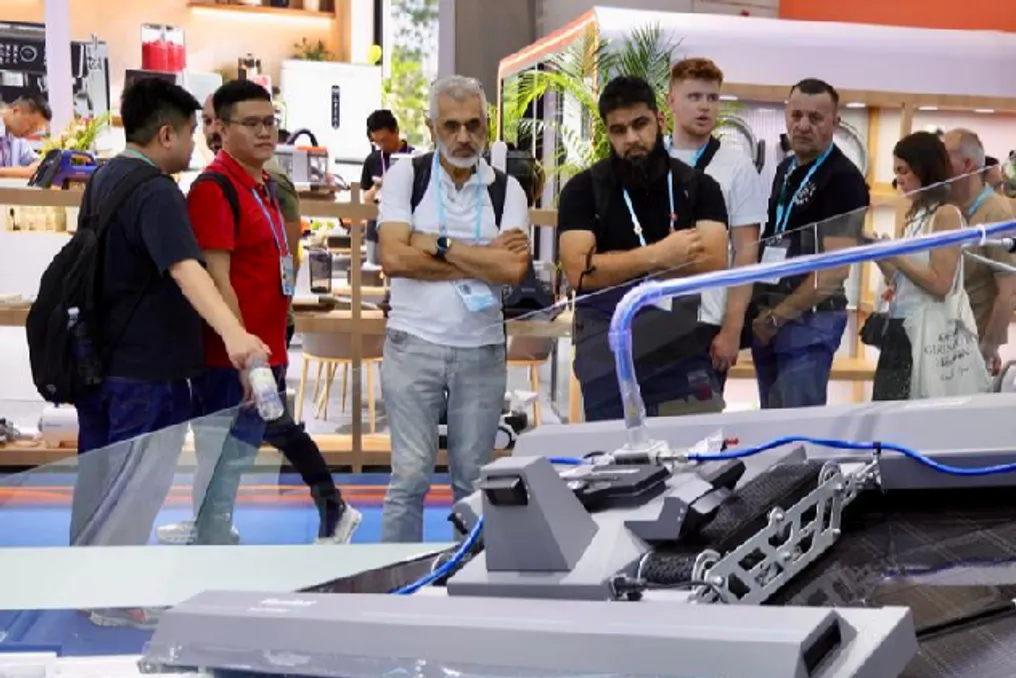
The robotics zone attracted significant attention from visitors. At the booth of Hangzhou Taixi Intelligent Technology, foreign buyers queued up to try out a wearable exoskeleton designed to support the legs and lower back. This device weighs about two kilograms, detects user movements, and assists them in walking.

Founder Lian Linchao stated that this is the company's first flagship product integrating their human-centric physical AI technology. Technological innovations are rapidly developing across all sectors of China. At this fair, 64% of exhibitors integrated industrial internet and AI into their R&D and production processes, and new products accounted for a record 23.2% of all exhibited items.

Customs data confirms this boom: imports and exports of Chinese industrial robots, electronic components, computer parts, and electrical equipment grew by 58.9% compared to the previous year, exceeding 10 trillion yuan ($1.49 trillion USD) in the first quarter of 2026.

Services and Green Technologies

Services are emerging as a new area of growth. For the first time, the fair's services zone covered all ten major categories of service industries, including logistics, industrial design, and cross-border financing. Official data shows that 36.5% of exhibitors have begun incorporating services into their business models.

Eco-friendly products are also in high demand amid countries' transition to clean energy, green technologies, and economic decarbonization. Xiamen HiTHIUM Energy Storage Technology presented its flagship products for long-term energy storage. CEO Wang Pencheng expressed hope that the fair would help present China's long-term energy storage solutions to a wider international audience, giving more countries access to stable and affordable clean energy.

Chongqing SUNDON Prefabricated Construction and Technology attracted buyers from Australia, Brazil, and Saudi Arabia. The company's Director of Planning and Design, Jia Xuehun, reported that preliminary agreements had been reached with over 300 buyers.

China is contributing to the global green transition by supplying a huge share of world renewable technologies. Over the past decade, the country has provided more than 80% of the world's photovoltaic modules and 70% of wind energy equipment, helping to reduce the cost of clean energy everywhere.

The Canton Fair demonstrates that Chinese trade is moving toward an entirely new model focused on higher value-added products and more comprehensive services.
Similar stories

CSIS Analysis: Combating Tariff Evasion Will Not Resolve the US-China Imbalance
Read more
noticiasaominuto.com

CSIS Analysis: Combating Tariff Evasion Will Not Resolve the US-China Imbalance

According to an analysis by the American think tank CSIS, increased US scrutiny over Chinese products exported through third countries will not resolve the trade imbalance between Washington and Beijing.

Researcher Hugh Grant-Chapman from the Center for Strategic and International Studies (CSIS), based in Washington, argues that the administration of US President Donald Trump confuses fraudulent customs duty evasion schemes with the legitimate reorganization of international production chains.

He notes that the White House mistakenly equates entirely legitimate business operations with criminal behavior, referencing the Trump administration's August report titled The Great Transshipment Scam.

In this document, the White House accuses China of using more than 40 intermediate economies to bypass US tariffs by redirecting Chinese goods.

In Grant-Chapman's view, the US administration has expanded the concept of re-export, which traditionally implied goods passing through third countries without substantial transformation, to include products actually manufactured in these markets using Chinese components.

The researcher acknowledges documented cases of customs fraud, particularly those related to batteries, steel products, and solar panel components, but insists that these practices only explain part of the indirect presence of Chinese products in the American market.

He emphasizes that re-export itself is not inherently illegal or undesirable from a governmental policy perspective.

The study mentioned by CSIS shows that in 2024, Mexico and Vietnam accounted for 23% and 15% of China's added value, which indirectly flowed into the US, respectively.

Nevertheless, the research concludes that most of these flows are driven by industrial processing rather than simple goods redirection.

A study by the US Federal Reserve estimates that China's production in Mexico contributed to an increase in Mexican exports by approximately 14 percentage points after the imposition of tariffs on Chinese goods in 2018 and 2019, whereas direct re-export was less than one percentage point.

The CSIS analysis also demonstrates that countries such as Malaysia, Mexico, Thailand, and Vietnam have not recorded a wide increase in the matching of goods imported from China and exported to the US.

Conversely, Cambodia and Laos show more evident signs of growth in these flows, especially concerning steel products and photovoltaic elements.

For Grant-Chapman, the fundamental problem lies in the structural imbalance of the two largest global economies. In China, high trade surpluses are maintained by low domestic consumption, state support for industry, and an export-oriented growth model.

In the United States, import demand is stimulated by low savings rates, budget deficits, and increased investment, particularly in artificial intelligence infrastructure.

The researcher explains that these macroeconomic foundations place the United States in the position of a net importer, and China as a net exporter.

He recalls that in 2025, Chinese exports grew by 5.5%, despite sales in the US declining by approximately 20%, with some products being redirected to other markets, including the European Union.

CSIS also points out that many intermediate countries currently benefit from US tariffs that are 10–20 percentage points lower than those applied to China, which encourages companies to move production operations to these markets.

Grant-Chapman concludes that a sustainable path requires a more thorough analysis of global trade standards, a reassessment of the impact of US tariff differences on the market, and open dialogue with trade partners and business leaders.

Shenzhen Bay MixC Phase II: Project integrates retail, culture, and urban infrastructure
Read more
archdaily.com.br

Shenzhen Bay MixC Phase II: Project integrates retail, culture, and urban infrastructure

The description provided by the project team details how Shenzhen Bay MixC Phase II is redefining the concept of global shopping centers, transforming them from mere consumption points into multifunctional social and cultural ecosystems. This cutting-edge retail development, built by China Resources Land in Shenzhen, prioritizes user experience, connectivity, and urban integration, moving away from traditional commercial planning.

Spanning over a kilometer, the project serves as a new urban backbone for the district, linking Shenzhen's dense commercial center to the parks located on the shores of Shenzhen Bay. This connection is not just physical; it establishes a new experience-focused urban hub operating across various dimensions and levels.

The magnitude and complexity of the project transcend the definition of an ordinary mall. It is integrated with metro systems, adjacent developments, elevated walkways, and underground circulation, becoming a vital component of the urban infrastructure that supports the city's daily life. However, its goal goes beyond mere mobility efficiency; the project converts the act of moving into an experience.

Along the complex, there is a continuous spatial spine connecting retail, leisure, culture, and landscaping into an uninterrupted three-dimensional journey. Visitors move easily between commercial areas, public gathering spaces, dining options, cultural moments, and contact with nature, without rigid boundaries between these elements. This layered integration results in a more engaging and resilient urban environment, stimulating longer stays, repeat visits, and a deeper emotional bond with the location.

The central premise of the project lies in the idea that movement itself can define the identity and lived experience of the space. Inspired by Shenzhen's dynamic rhythm of transformation, the design structures the visitor's journey as a progression through constantly changing spatial atmospheres. Two circulation systems work together to organize this experience.

A straight and direct route functions as a functional urban corridor, facilitating intuitive navigation along the kilometer-long stretch and reinforcing the logic of the city's infrastructure network. Parallel to this, a succession of winding paths offers opportunities for exploration and pauses. These quieter environments house designer boutiques, restaurants, social areas, and informal meetups, allowing visitors to interact with the project on a more personal and experiential scale. The balance between speed and pause gives the development a unique rhythm, catering to both the intensity of metropolitan life and the desire for leisure, discovery, and connection.

To enhance orientation and intensify immersion, the project is divided into three distinct atmospheric zones: Envision, Life, and Memory, representing the future, the present, and the past, respectively. Instead of using literal themes, these identities are communicated through subtle changes in materiality, lighting, scale, and climate.

Near the city limits, the spaces appear vibrant and future-oriented, characterized by reflective surfaces and an expanded sense of movement. Deeper within the project, the atmosphere becomes more stable and social, accommodating daily activities and interaction. Towards the waterfront, the experience softens even further, reconnecting visitors to the landscape, memory, and civic space. These transitions allow people to intuitively perceive their location within the larger trajectory while building a richer emotional connection with the environment.

Various large public spaces punctuate the project's spine, transforming movement into a sequence of memorable urban moments. Large-scale reception areas from the metro, immersive digital environments, civic plazas, and sculptural installations act as visual landmarks throughout the complex. These moments not only aid in orientation through the project's expressive scale but also establish places for meetings, interaction, and shared experiences. Together, they reinforce the notion that the mall transcends the role of a mere commercial destination, configuring itself as a civic environment that supports urban life during the day and caters to various user profiles.

In summary, Shenzhen Bay MixC Phase II proposes a new relationship between commerce and the city. By merging commerce with infrastructure, culture, leisure, and nature, the project moves beyond the conventional shopping center model, heading towards a more flexible and experience-centered urban typology. The final result is not just a place to shop, but a dynamic urban structure that evolves through movement, interaction, and routine, mirroring the continuous metamorphosis of Shenzhen itself.

Intangible Heritage Workshop in Beijing Capital Xiangxi designed by DAGA Architects
Read more
archdaily.com.br

Intangible Heritage Workshop in Beijing Capital Xiangxi designed by DAGA Architects

The ancient city of Qianzhou, located on the banks of the Wanrong River, possesses a rich history and is considered the most prominent of the four ancient cities of Xiangxi. Currently, Qianzhou functions not only as a cultural highlight for the Xiangxi Municipal Government but also as a convergence center for all the intangible cultural heritage of the area, housing 24 nationally registered assets.

Within the ancient city of Qianzhou is the Tiangongju, which originally served as a place for the practice and dissemination of local carpentry, dedicated to Tiangong Luban. Before undergoing renovations, this residence was vacant.

Project Gallery

The project 'Beijing Capital Xiangxi Intangible Heritage Workshop / DAGA Architects' was presented by the design team.

Popular