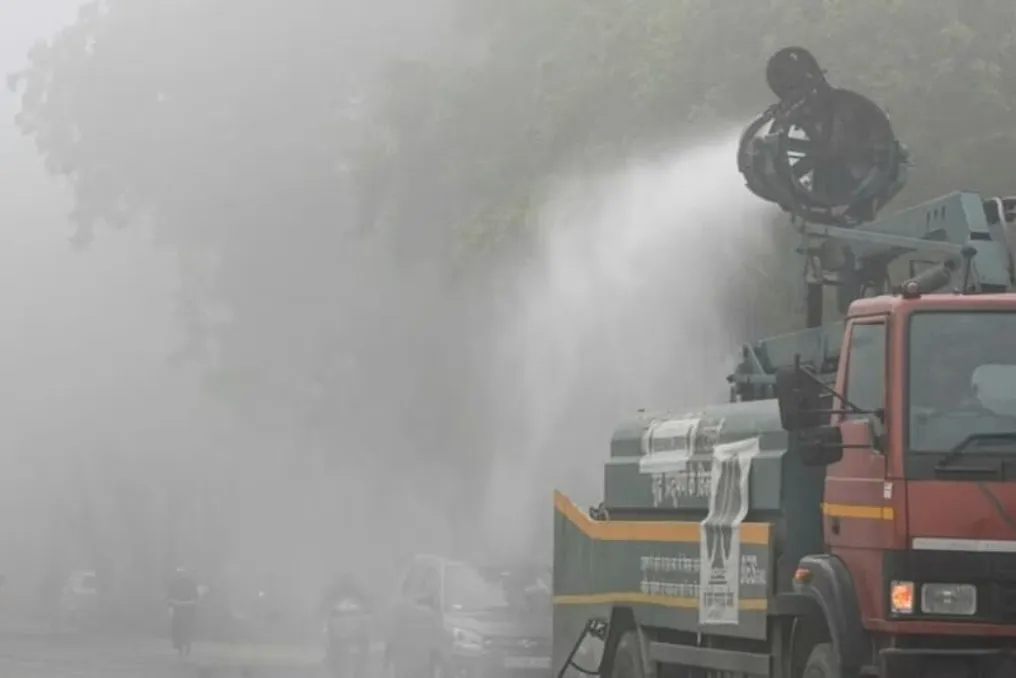
Five districts in Delhi have the highest air pollution levels, AQI is again in the danger zone
Read more
Aaj Tak
www.aajtak.in

Five districts in Delhi have the highest air pollution levels, AQI is again in the danger zone

With the onset of winter, the air quality in Delhi has deteriorated, and the pollution level in the capital city has once again reached a serious level. On the morning of November 5, the average Air Quality Index (AQI) in Delhi was 371, which falls into the 'very poor' category. However, the pollution level is not uniform across all districts of Delhi; in some areas, the air has become even more toxic.

Among the most polluted districts are Jahangirpuri and Punjabi Bagh.

According to data from the Central Pollution Control Board (CPCB), on the morning of November 5, the AQI in Jahangirpuri was recorded at 444, making it the most polluted district in Delhi. The main reason for the high pollution level in this area was the presence of PM2.5 particles. Similarly, in Punjabi Bagh, the AQI was 437, where PM2.5 particles were also the main source of pollution. The air quality in these two areas was significantly worse than the average for Delhi.

The third most significant district in terms of pollution level was the vicinity of IIT Delhi, where the AQI reached 430, with PM10 particles being the primary cause of pollution. Next is DTU, where the morning AQI was 428, with PM2.5 particles also dominating here. The fifth most polluted area identified was Narela, which registered an AQI of 426. Thus, in these five districts of Delhi, the pollution level exceeded the mark of 400.

The situation in other parts of the city is also a cause for concern. According to CPCB, near India Gate, the AQI was 399 on Thursday morning, which also falls into the 'very poor' category. Meanwhile, in Anand Vihar, the AQI was 296, corresponding to the 'poor' category.

In addition to the AQI, the level of pollutant particles is a serious concern. PM2.5 particles are extremely small and can penetrate deep into the body through breathing. PM10 particles are larger and can also cause respiratory problems when their concentration increases.

According to meteorological data at 6:45 AM, the temperature in Delhi was 23 degrees Celsius, and the wind speed was only 1 kilometer per hour. The weak wind hinders the dispersion of pollutants, allowing them to accumulate in adjacent areas.

The rising level of pollution in Delhi has once again become a subject of concern, especially in areas where the AQI exceeded 400. CPCB data indicates that residents of different parts of the capital are facing the consequences of pollution to varying degrees.
Similar stories

Air quality worsens in Lahore and Delhi, reaching dangerous AQI levels
Read more
www.aajtak.in

Air quality worsens in Lahore and Delhi, reaching dangerous AQI levels

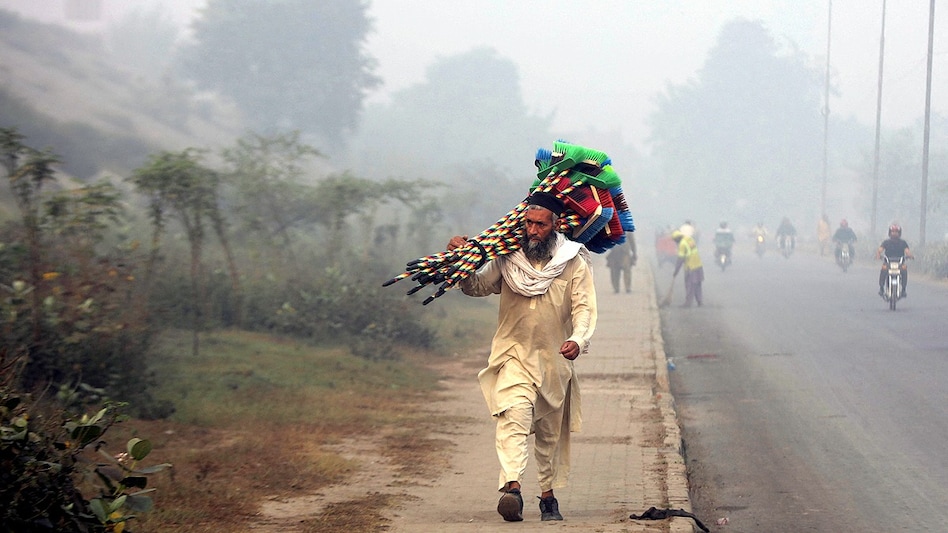
Air quality sharply deteriorated in northern regions of India and Pakistan on Tuesday. Fog preceding winter has turned Lahore into one of the world's most polluted cities. In Delhi, authorities have also introduced several restrictions to combat the toxic smog.

During this season, cold and heavy air traps pollutants generated by transport, construction sites, and crop residue burning close to the ground. This causes pollution levels to reach global highs, posing a serious threat to people's respiratory systems. Furthermore, Diwali fireworks on November 8th may exacerbate this problem.

According to the Swiss group IQAir, the Air Quality Index in Lahore was 447 on Tuesday morning. A level below 50 is considered good, with minimal health risks. The concentration of PM 2.5 in Lahore was 60 times higher than the World Health Organization's annual recommendations. PM 2.5 refers to fine particles that can enter the lungs, increasing the risk of fatal diseases and heart problems.

The drop in temperature and slowing wind contributed to the further deterioration of air quality in Lahore. IQAir recorded a level of 215 in Delhi, while the Central Pollution Control Board of India recorded 332, which falls under the very poor category. The difference between these readings is due to the use of different measurement methods.

The Pakistani government has intensified measures against brick kilns violating environmental standards and appealed to farmers not to burn crop residues. In Delhi, the Graded Response Action Plan has been in effect since Monday, which includes a ban on using coal and wood in vehicles, construction work, and eateries, as well as increasing public transport.

Given concerns about rising pollution due to Diwali, the Supreme Court has permitted fireworks only for three hours on Saturday and Sunday. This issue recurs annually. Cold air prevents pollutants from dispersing, covering cities in a toxic blanket. Children, the elderly, and people with respiratory illnesses are at the highest risk.

Experts emphasize the need for long-term solutions, such as clean energy and improved public transport, alongside stricter control over crop burning, vehicle emissions, and industrial discharges. The problem in this region can only be solved through coordinated efforts by both countries. Currently, people are advised to wear masks, limit time spent outdoors, and follow official recommendations.

Delhi leads in air pollution among major Indian cities with an AQI of 197
Read more
www.aajtak.in

Delhi leads in air pollution among major Indian cities with an AQI of 197

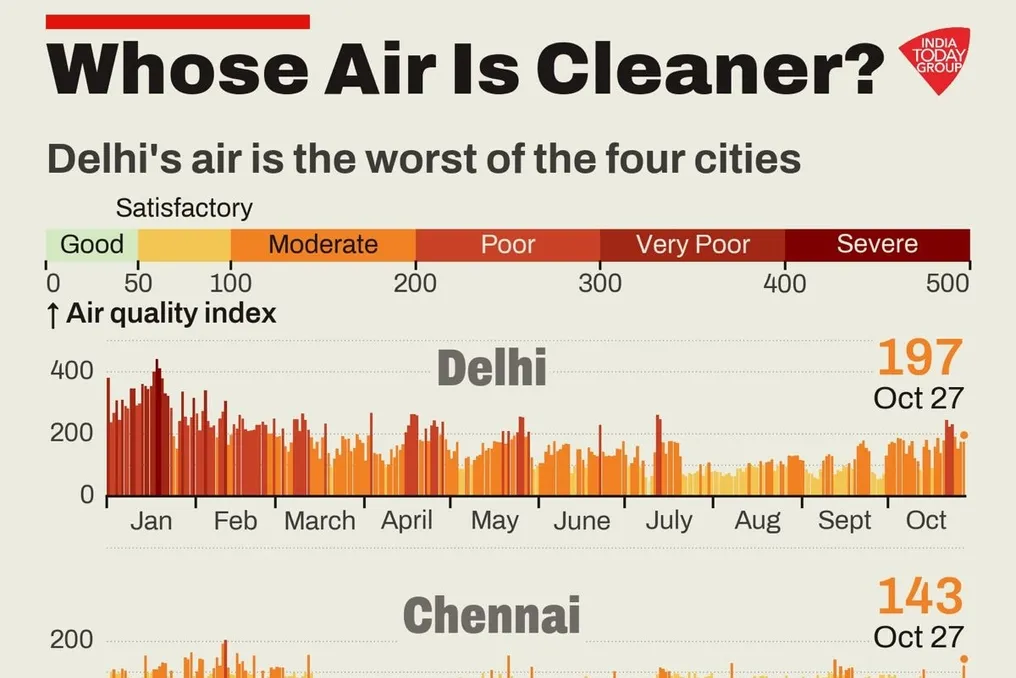
When comparing the air quality in four major cities in the country, the air in Delhi was the most polluted on Tuesday. According to data from the Central Pollution Control Board (CPCB), the Air Quality Index (AQI) in Delhi was 197. In Chennai, this figure reached 143, in Mumbai it was 99, and in Kolkata it was 81. Thus, Delhi ranked first among all four cities, while Kolkata ranked last.

The AQI is a scale that determines the degree of air purity or pollution in a city; the higher the value, the more polluted the air is considered. This is why on October 27, the air in Delhi appeared the most polluted among all four cities.

The specific figures for the four cities were as follows: Delhi — 197, Chennai — 143, Mumbai — 99, and Kolkata — 81. The AQI in Kolkata was the lowest.

Comparing the data for Delhi and Chennai, it is evident that the AQI in Delhi (197) exceeds the figure in Chennai (143) by 54 points. This gap widens even further compared to the figures for Mumbai (99) and Kolkata (81), indicating that the air in Delhi is more polluted than in the other three cities.

In the CPCB graph, AQI levels are divided into different categories. According to this scale, AQI values from 101 to 200 fall into the 'moderate' category. Based on this, the readings for Delhi (197) and Chennai (143) fell into the moderate category. Meanwhile, the figures for Mumbai (99) and Kolkata (81) were below 100, meaning they did not reach the lower boundary of the moderate category.

It is important to note that the CPCB data is based on the 24-hour average value calculated as of around 4:00 PM on Tuesday.

Popular