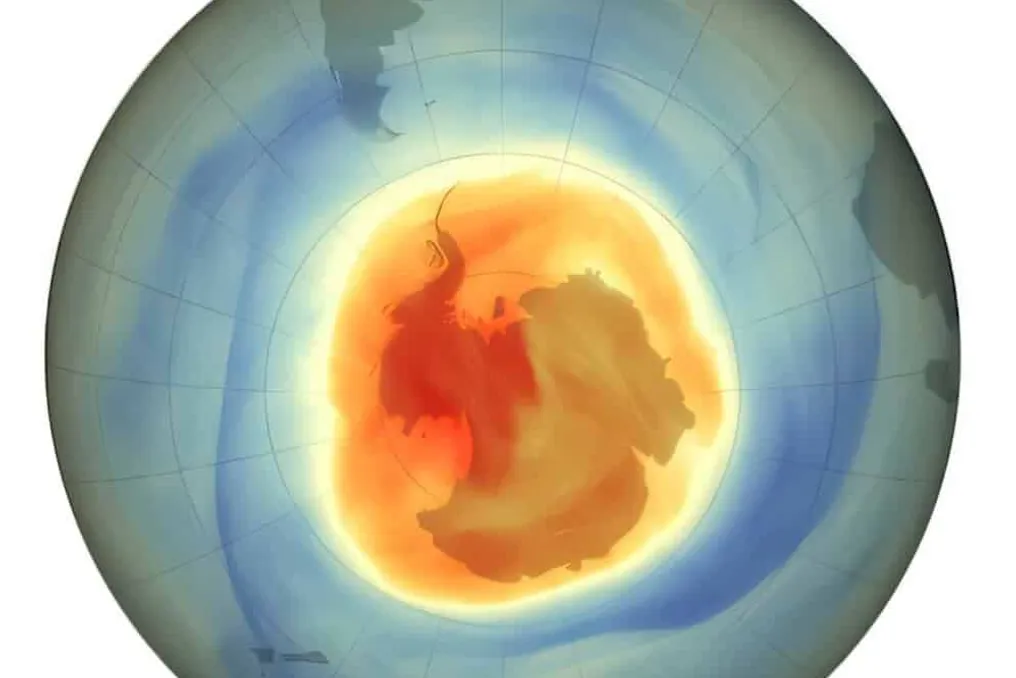
The ozone hole over Antarctica recorded one of the largest extensions in the last 48 years. Data released by the U.S. National Oceanic and Atmospheric Administration (NOAA) and NASA on Wednesday (4) indicates that this phenomenon reached its seventh largest average extent since monitoring began in 1979.
This increase was primarily driven by unusual weather conditions and a particularly intense polar vortex. During the period of greatest ozone degradation, which occurred between September 7 and October 13, the average area of the hole reached about 25 million square kilometers, more than double the territory of the United States.
Despite this significant size, experts state that the ozone layer is still on the path to recovery. The decrease in destructive chemical substances, resulting from international agreements, prevented the hole from reaching even larger dimensions.
The largest size recorded in 2026 was observed on September 18, when the hole reached approximately 27.1 million square kilometers. This dimension is equivalent to about 90% of the largest hole ever documented, which was seen on September 9, 2000.
Paul Newman, a scientist at the University of Maryland (USA) and former leader of the NASA ozone research team, commented to Phys.org that the late emergence of the phenomenon in recent years is a sign that the protective layer is recovering. However, in 2026, an exceptionally strong polar vortex prolonged the ozone destruction in Antarctica, allowing the hole to reach proportions unseen in a decade.
Even with the elevated extent, the 2026 hole did not show a level of destructive intensity comparable to previous record years. Paul Newman calculated that if the concentration of ozone-destroying substances in the atmosphere remained at the peak levels of 2000, the hole could have been between 3.5 and 5.6 million square kilometers larger.
This difference is attributed to global efforts to reduce the use of harmful ozone-depleting compounds. One pillar of this policy is the Montreal Protocol, an agreement signed in 1987 that committed to replacing substances like chlorofluorocarbons (CFCs) with less harmful alternatives.
According to Stephen Montzka, a NOAA researcher, the concentration of chlorine in the Antarctic stratosphere from these substances has dropped by about a third since the maximum levels recorded in the 1980s.
Monitoring the ozone layer involves direct atmospheric measurements and satellite observations. In Antarctica, NOAA researchers use instruments carried by meteorological balloons to measure gas concentration at various altitudes, in addition to employing a Dobson ozone spectrophotometer.
In 2026, measurements over the South Pole indicated that ozone concentration reached its lowest annual level on October 17, recording 105 Dobson units. This unit is used to quantify the amount of ozone in an atmospheric column; one hundred Dobson units correspond to a gas layer with approximately one millimeter of thickness, if all the ozone were compressed under standard temperature and pressure conditions.
The lowest value ever recorded over the South Pole was 92 Dobson units, in October 2006. Satellites are also crucial for tracking changes since 1979, including instruments aboard NASA's Aura, NOAA-20, and NOAA-21 satellites, as well as the Suomi NPP, operated jointly by the two agencies.
Despite the growth in 2026, NOAA and NASA assess that the long-term trend remains positive. The chemicals responsible for ozone destruction can remain in the atmosphere for several decades, and some of them continue to be slowly released by old equipment, landfills, and materials that still contain them. For this reason, complete recovery does not occur immediately after emission reductions, and the agencies estimate that the ozone layer should recover by the 2070s.
The 2026 result demonstrates that natural atmospheric conditions can still cause large annual variations, but it also underscores the relevance of international agreements: without the reduction of destructive substances, this year's hole would have been considerably larger.