A 78-liter diesel engine, originally designed for the world's largest mining trucks, has found a new application: powering artificial intelligence data centers during grid failures.
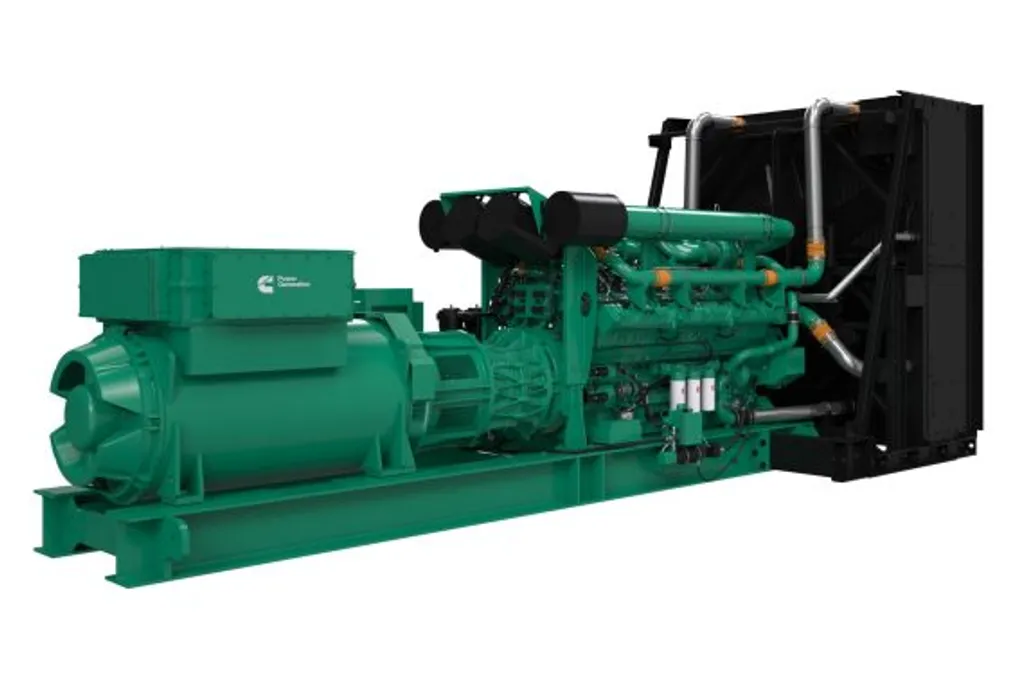
Cummins has increased the power of generators equipped with the 78-liter QSK78 diesel engine to 3 MW. This new offering was unveiled at the DCD Connect Brasil event, dedicated to the data center sector, which took place in São Paulo on Thursday and Friday.
When the QSK78 was launched in 2000, Cummins called it the world's largest engine for the mining industry. It was developed in collaboration with the Japanese company Komatsu for off-road trucks, such as the Komatsu 960E, capable of carrying up to 327 tons of cargo in a single trip.
The engine's specifications are impressive: it features 18 cylinders, each with a displacement of about 4.3 liters, which is larger than the entire 2.8-liter Toyota Hilux engine. The total weight of the unit exceeds 11 tons, and in its mining version, it produces 3,549 hp and a torque of 1,404.3 kgm.
Data centers cannot tolerate power outages, so they maintain backup diesel generators that activate when the main grid fails. With the expansion of artificial intelligence, which demands significantly more computing power and electricity, these generators needed to become more powerful.
In 2024, one of Cummins' executives noted that hospitals, which previously used 1 MW installations, have begun purchasing 2 or 3 MW models. According to the company, data centers can achieve up to a 20% revenue growth over the next five years.
Thanks to the increased power, the QSK78 now covers the range previously served by the 95-liter QSK95 model, which remains in the catalog for generators up to 3.5 MW. Centum series generators, such as the C2750D6E and C3000D6EB, have capacities of 2,750 kW and 3,000 kW, equivalent to approximately 3,739 hp and 4,079 hp. The largest of these reaches over 7 meters in length and 3.5 meters in height.
According to the manufacturer, the unit takes less than ten seconds to take on a load and can run on HVO—renewable diesel made from vegetable oils and fats—without losing power. Leandro Vilhena, Data Center Manager at Cummins Brazil, emphasized that the generator's size must correspond to the load growth and expansion plans of each facility.