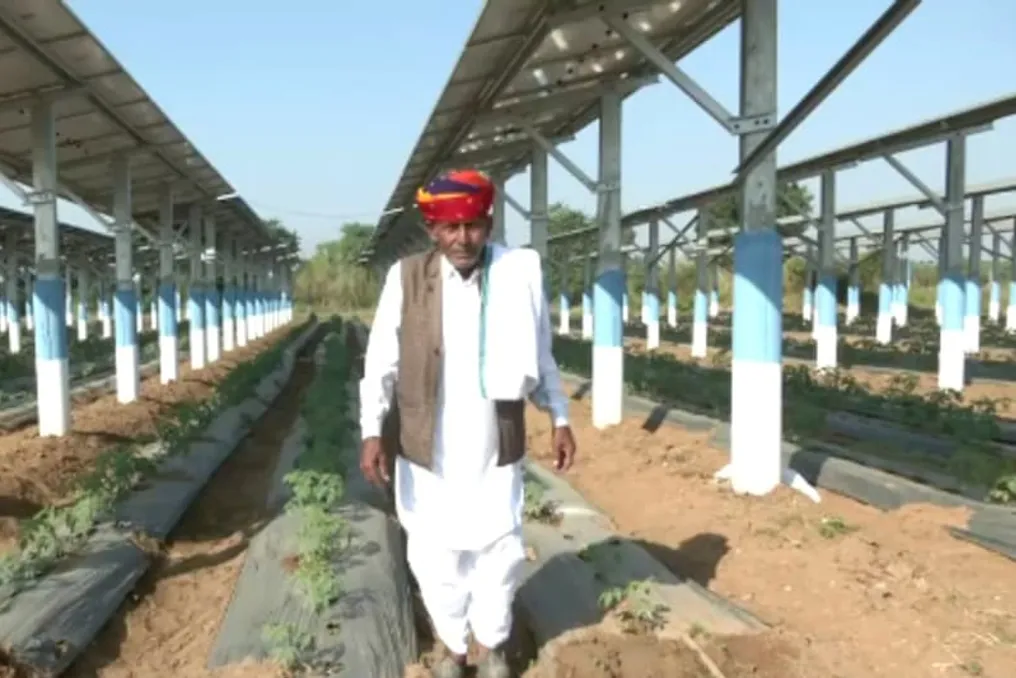
In the context of intense heat, water scarcity, and limited income in Rajasthani agriculture, farmer Kajormal Jhaat from the village of Kundanpura found an innovative way to combine farming and solar energy production. On his field, crops are growing simultaneously with solar panels installed above them, demonstrating that with the right application of technology, one piece of land can be used for both agriculture and electricity generation.
Initially, Kajormal Jhaat was engaged in growing wheat and millet. After installing the solar power plant, he gained a new source of income from electricity generation, but traditional farming on this land became difficult. Nevertheless, as a farmer, he could not give up the land and decided to implement a model that allows him to continue growing crops parallel to solar energy production.
According to this idea, the agro-photovoltaics (agro-PV) technology was applied to his field. According to this technology, solar panels were installed at a height of about 11 feet above the ground to ensure enough space for farming below. Currently, corn, chili peppers, and tomatoes are being grown under these panels, with tomatoes appearing the most abundant. Thanks to the panel height, it is still possible to conduct agricultural activities and care for the crops on the ground.
One of the potential advantages of this technology is the change in the microclimate on the field. Partial shade from the solar panels can help preserve soil moisture and somewhat reduce the impact of intense sun. However, the actual benefit depends on the crop, weather, irrigation systems, and local conditions.
Kajormal Jhaat's solar power plant has a capacity of about 600 kilowatts. The electricity generated by it is fed into the grid, while agricultural production continues on the same land. The feature of this model is that after installing the solar station, the land is not necessarily limited only to energy production; combining agriculture and energy production opens up opportunities to increase the efficiency of using one piece of land.
This experiment showed the potential to increase the farmer's income. If previously the annual income from traditional farming was estimated at about 40 thousand rupees per acre, the total income from combining agriculture and solar energy could exceed four hundred thousand rupees. It is important to clarify whether this amount is the total income or the net profit after deducting expenses. Actual earnings depend on yield, electricity generation, maintenance, and other costs.
Kajormal Jhaat's initiative came at a time when options for increasing farmers' incomes and more efficient use of agricultural land are actively being sought. If this technology is adapted to local needs, costs, and crop types, it could become a path for farmers to connect to solar energy without giving up farming. This combination of crops in the field and electricity from above represents a new prospect for the future of agriculture.