The 2026 edition of the SEMA Show takes place in the first week of November. SEMA is an acronym for Specialty Equipment Market Association, an association of the American automotive accessories and equipment industry, established in 1963 and originally named Speed Equipment Manufacturers Association.
Among the original founders were prominent figures such as Ed Iskenderian, Vic Edelbrock Jr., and Dean Moon, whose surnames are well known among muscle car and hot rod enthusiasts. The idea for organizing the market arose in May of that year when more than twenty manufacturers decided to unite, as the market was growing rapidly but lacked standardization, distribution channels, and representation. Revell, a miniature manufacturer, participated in this initiative seeking ways to negotiate licenses to use these companies' logos on its models.
Initially, the association's mission was quite focused: to represent performance equipment producers, define standards for their products, and structure a segment that operated very independently. Thus, the connection with classic American modification culture constituted the essence of SEMA in its early days. In 1970, the association changed its name from Speed Equipment Manufacturers Association to Specialty Equipment Market Association, in response to political pressures resulting from the tightening of automotive regulations in the United States and increasing government surveillance over safety and emissions. Furthermore, the market had expanded beyond exclusive parts for racing cars, encompassing style accessories, suspensions, replacement components, and a wider range of equipment.
The first official SEMA Show took place in January 1967, in the space under the stands of Dodger Stadium in Los Angeles, under the name High Performance & Custom Trade Show. This event gathered 98 exhibitors and about 3,000 industry professionals. Although the initial booths were improvised with folding tables and chairs, the result was enough to ensure the project's continuity. The following year, the event was relocated to the newly inaugurated Anaheim Convention Center, also in California.
Growth accelerated. By the mid-1970s, the space in Anaheim could no longer accommodate the number of exhibitors, with the 1975 and 1976 editions reaching maximum capacity and excluding manufacturers. The solution found was to move to Las Vegas in 1977, where the first edition hosted over 800 companies. Since then, the Las Vegas Convention Center has become the permanent home of the event, which has evolved along with the automotive accessories and tuning industry itself.
This industry has also undergone major changes. While the focus in the early years was primarily on hot rods and performance equipment, during the 1980s, the market began to integrate imported cars more strongly, notably Japanese and German ones, in addition to the growing segment of pickup trucks and vehicles prepared for off-road use. In the 1990s, the culture of customized cars, lowriders, and hot hatches further expanded the sector's scope. In 1992, the association allied with other industry entities to form the Automotive Aftermarket Industry Week, consolidating the first week of November in Las Vegas as one of the main global gatherings of the automotive aftermarket.
With the passing of decades, another crucial transformation was observed: SEMA ceased to be an environment almost exclusively for independent accessory brands and began to attract the manufacturers themselves. For companies that design and sell automobiles, being in the same place as producers of wheels, tires, suspensions, intake systems, and other items that customize an original vehicle represents a valuable opportunity. Brands such as Ford, Chevrolet, Toyota, Honda, and Nissan began using the event not only to display their models but also to present concepts, original accessory packages, and projects developed in collaboration with tuners and specialized suppliers.
For this reason, although it does not possess the vocation of a traditional auto show, SEMA has also become a stage for notable launches. Honda, for example, used the 2016 event to show the Civic Type R Prototype to the American public. In 2019, Chevrolet unveiled the E-10, an electric restomod based on the classic 1962 C-10 pickup truck, equipped with Bolt EV components. In 2022, Nissan publicly presented the Z GT4, a competition version of the sports car that would continue the tradition of Z models on the track. Such seemingly disparate examples share a common point: they demonstrate how SEMA has come to represent both the original industry and the ecosystem surrounding it.
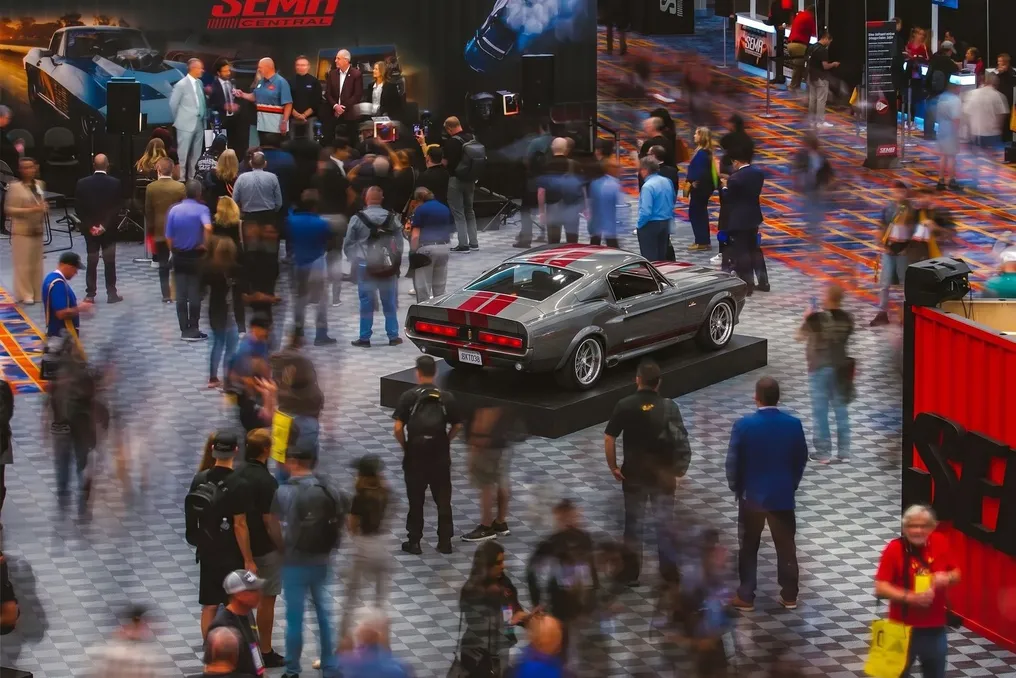
Currently, the event has transcended American market borders. In the 2025 edition, there were over 153 thousand participants, 2,300 exhibiting brands, and representatives from more than 140 countries. The event occupies practically the entire Las Vegas Convention Center complex and functions as a vast showcase of products, technologies, business, and, naturally, vehicles.
It is one of the most relevant events in the global automotive industry, but it has a unique characteristic: for much of its history, the SEMA Show was a strictly professional event, limited to manufacturers, distributors, buyers, press, and other industry agents. Unlike conventional shows, it was not an event solely intended for buying tickets to admire the cars. This tradition began to receive occasional exceptions in recent years, with the implementation of special public access on Friday, which will also occur in the 2026 edition.
Perhaps it is precisely this peculiar relationship with automotive culture that helps explain what is observed in Las Vegas this year. After all, SEMA was born from the desire to modify cars, explore possibilities, and give new interpretations to models already present in the imagination of enthusiasts. More than six decades later, in an industry undergoing one of the greatest transformations in its history, looking back at the past seems to have become an important component for looking toward the future.
This is evident with the greater presence of restomods and classic prepared vehicles brought to the SEMA Show by the manufacturers themselves. Tuners, workshops, and tuning houses, which have always been recurring figures at the event, maintain a strong presence, but there are many projects signed by Dodge, Ford, GM & company that seem to belong to an alternative reality where the world did not migrate to electrification.
The classic Mustang presented by Ford immediately drew attention. Named R125, this car honors Ford's 125 years of racing history, which began in 1901, when Henry Ford won a race against one of the most famous drivers in the United States at the time. It also celebrates the trajectory of the Mustang as a basis for racing cars, both in professional circuits and among amateur enthusiasts.
The conception of the R125 is interesting because it does not seek to reinvent the wheel. It is a restored 1966 Mustang Fastback equipped with Ford Racing components, following a proposal more aligned with a traditional hot rod than modern restomods, which tend to transform any classic into a high-power supercar. Under the hood, there is a 347 cubic inch (5.7 liter) Ford V8 with a Boss block, aluminum heads, and Edelbrock Pro-Flo electronic injection. It generates 360 hp and 54 kgfm, transmitted to the rear wheels by a five-speed Tremec manual transmission.
The design follows the same conceptual line: black body, automotive details in red and gold, gold wheels, and little ostentation. It is a Mustang that evokes an era when tuners simply combined quality parts, a V8 engine, and a great willingness to accelerate. A notable aspect of this project is that almost all the components used are part of Ford's own performance parts catalog, making the R125 a showcase of what owners of classic Mustangs can achieve without relying on completely artisanal solutions.
Jeep also sought inspiration from its past, but with a bolder approach. The Wrangler Scrambler SRT Concept revives the name and concept of the CJ-8 Scrambler, a two-door compact pickup manufactured in the 1980s, blending the brand's traditional off-road vocation with preparation reminiscent of desert racing. Built on the Wrangler platform, the concept features a two-door body, integrated bed, removable roof, and a vibrant orange paint job called 'Punk'n'. However, the main innovation lies under the chassis: for the first time in a Wrangler, Jeep developed an independent front suspension, with input from off-road driver Casey Currie. This solution was designed to optimize high-speed performance on uneven terrain, complemented by a rear axle inspired by Trophy Trucks. The assembly is completed with beadlock wheels, voluminous tires, and a 470 hp and 64 kgfm HEMI V8.
The rear seats also deserve mention: they can be removed or rotated 180 degrees, allowing occupants to travel facing away from the direction of movement, similar to some expedition vehicles. Although not a typical configuration of a production Wrangler, it fits perfectly with the proposal of a concept that seeks to reconcile multiple functions.
Stellantis also brought one of the most attractive novelties for those who build vehicles from scratch. Through Direct Connection, its official performance parts division linked to SRT, the company displayed six new crate engine HEMI V8 packages. This announcement is noteworthy, especially considering the direction that much of the industry, including Dodge, has recently taken.
The new line includes 345 and 392 cubic inch engines, both naturally aspirated, in Street Strip and Super Stock configurations, in addition to the supercharged Hellcrate Redeye and Hellephant C170. Power starts at 385 hp in the smallest V8 and reaches an impressive 1,025 hp in the Hellephant, when fueled with E85. The latter uses a 3.0-liter IHI mechanical compressor and also delivers 128 kgfm of torque. The packages are not limited to selling isolated engines; they contain wiring harnesses, management modules, and pre-configured controllers to operate together, offering compatibility with eight-speed TorqueFlite automatic transmissions or Tre manual transmissions.