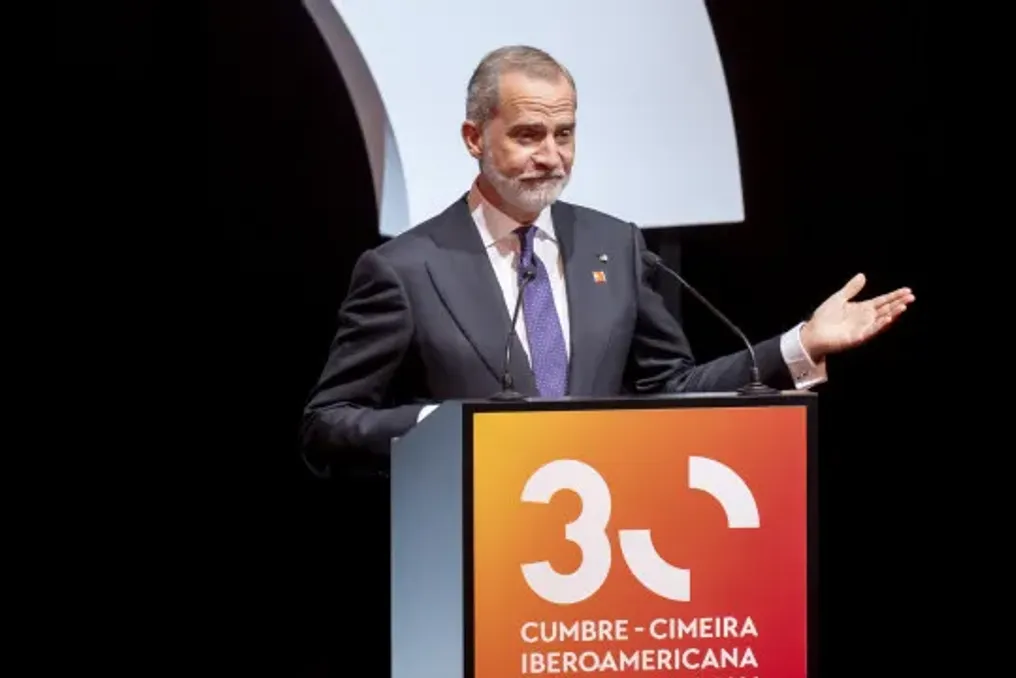
King of Spain mentioned Camões in Madrid during the Ibero-American Summit
Read more
Noticias ao Minuto
noticiasaominuto.com

King of Spain mentioned Camões in Madrid during the Ibero-American Summit

The King of Spain, Felipe VI, opened the thirtieth Ibero-American Summit by using a quote from Camões to call on the community to move along 'seas that have never been traversed before' towards creating a more just society.

Felipe VI stated that they should continue the path that brought them from Guadalajara to Madrid, and which in two years will lead them, 'along seas that have never been traversed before,' to Honduras, which enthusiastically accepts its first temporary secretariat. He emphasized that this path requires working towards building a more just, prosperous, and inclusive society.

The Spanish monarch noted that the summit, taking place in Madrid this day and Thursday, is an opportunity for the 22 member countries to demand 'facts and tangible achievements' from the world.

He also stated that to continue declaring a clear and sustainable commitment to Ibero-Americans before the world—through dialogue, equality, respect for norms, consideration of minority opinions, science, and entrepreneurship—it is necessary that social progress is achieved by all and is accessible to all.

Felipe VI addressed the opening ceremony of the Ibero-American Summit at the Teatro Real in Madrid. Representatives from the 22 member countries were present at the event, as well as invited guests: United Nations Secretary-General António Guterres and President of the Council of Europe António Costa.

Portugal was represented by the President of the Republic, António José Seguro, and Prime Minister Luís Montenegro, who entered the Teatro Real together and were photographed.

In his speech, the King of Spain defended the Ibero-American community and the system of its summits, initiated in Guadalajara, Mexico, in 1991, asserting that it serves as an example of mutual understanding and cooperation that counters tension and rivalry, not only due to its positive impact in various fields.

He stressed that processes of political consensus are not empty rhetoric but lead to real benefits in the daily lives of citizens.

At this Ibero-American Summit, heads of state and government, besides Portugal and Spain, are represented by Andorra, Argentina, Bolivia, Chile, Costa Rica, Guatemala, Honduras, and the Dominican Republic. However, the presidents of Brazil (Luiz Inácio Lula da Silva) and Mexico (Claudia Sheinbaum), the two largest member states by population, are absent.

The Spanish government expects 'five major results' from the meeting, which will be embodied in various agreements. Among these is the creation of an Ibero-American network for disaster risk reduction and civil protection, originally proposed by Portugal in 2024.

The summit also anticipates the adoption of an 'Ibero-American Artificial Intelligence Alliance,' an agreement on 'educational mobility,' another on social assistance and care for the elderly and people with special needs, as well as a new strategy for cooperation between Ibero-American countries aimed at updating the previous one and focusing on 'triangular and south-south cooperation.'

The Ibero-American Summits are held every two years, and Portugal has proposed participating in the 2030 Summit, which will follow the 2028 Summit in Honduras.

The community includes three European countries (Portugal, Spain, and Andorra) and 19 Latin American countries (Argentina, Bolivia, Brazil, Chile, Colombia, Ecuador, Paraguay, Peru, Uruguay, Venezuela, Mexico, Costa Rica, El Salvador, Guatemala, Honduras, Nicaragua, Panama, Cuba, and the Dominican Republic).

Fifteen permanent observers will work in Madrid, including the inclusion of Angola, India, and Turkey in the group, which also includes Germany, Belgium, South Korea, the Philippines, France, Haiti, Hungary, Italy, Japan, Luxembourg, Morocco, and the Netherlands.


Similar stories

Review of the 6 Best TVs for PS5 and Xbox in 2026
Read more
tecnoblog.net

Review of the 6 Best TVs for PS5 and Xbox in 2026

Users looking for the best televisions for gaming on PS5 and Xbox in 2026 can take full advantage of these consoles by choosing premium models with 4K resolution, HDMI 2.1 ports, and a refresh rate of at least 120 Hz.

High-end televisions, such as the LG OLED C6, provide excellent picture quality and refresh rates up to 165 Hz, although they come at a higher price. However, there are also more affordable options that support Dolby Atmos gaming, such as the TCL C6K.

Tecnoblog presents a list of six TV models that can enhance the gaming experience on PlayStation, Xbox, or PC. The review examines the pros and cons of TVs from LG, Samsung, and TCL.

LG OLED C6

The LG OLED C6 is a premium 4K smart TV equipped with advanced features for gamers. The OLED panel delivers brighter colors and lower response times compared to LCD TVs, which improves smoothness and graphic quality during gameplay.

The TV has a native refresh rate of 120 Hz, ensuring smoother motion in games. Furthermore, it supports Variable Refresh Rate (VRR) up to 165 Hz in 4K resolution for compatible titles. The device also includes Auto Low Latency Mode (ALLM) to minimize the delay between command and action on screen, as well as support for low-latency Bluetooth controllers (BT ULL). Nevertheless, the BT ULL mode only supports one connected controller, and the use of other Bluetooth devices may be affected.

Available sizes: 43″, 48″, 55″, 65″, 77″, and 83″.

Samsung S85H

The Samsung S85H is an entry-level OLED line model focused on gaming. This smart TV offers a refresh rate of up to 120 Hz (in 4K) for smooth and responsive gaming. Support for Nvidia G-Sync and AMD FreeSync Premium helps reduce screen tearing by synchronizing the screen's refresh rate with the game's frame rate.

Compatibility with HDR10+ technology allows playing games with individual brightness and contrast adjustments in each scene. However, the device does not support the Dolby Vision format, which is used in some games for Xbox Series X and S. As compensation, the TV is equipped with an AI assistant that analyzes the screen in real time and applies optimal settings for the game genre. Contrast enhancement on specific objects creates a three-dimensional sense of depth for a more immersive gaming experience. Available sizes: 48″, 55″, and 65″.

Samsung QN90F

The Samsung QN90F is an entry model in the Vision AI portfolio (2025) and features Mini-LEDs that are 50 times smaller than traditional LEDs. This ensures better light source distribution across the panel, optimizing contrast, brightness, and color accuracy. The TV is also well-suited for gaming, offering a native refresh rate of 120 Hz and VRR up to 144 Hz (for the 115″ model) or 165 Hz (for the 43″ or 50″ versions). Additionally, the device has automatic sound and picture settings that adapt based on the game genre. Hue Sync support is an interesting advantage, creating dynamics with smart lighting synchronized with game content. However, the lighting is sold separately, and a paid subscription to the Philips Hue Sync app is required for use.

Samsung S85F

The Samsung S85F is another entry-level OLED smart TV from this brand. It shares many characteristics with the S85H, including a 120 Hz refresh rate with VRR for smooth gameplay, adaptive HDR10+ support in games, and a low-latency mode that reduces command lag. However, the TV is equipped with Wi-Fi 5, which achieves lower speeds than Wi-Fi 6, and is limited to 5 GHz frequencies. Furthermore, the Samsung S85F only supports AMD FreeSync Premium Pro to reduce screen tearing but does not support G-Sync for Nvidia graphics cards. Available sizes: 55″ and 65″.

TCL C7K

The TCL C7K is a premium smart TV ideal for both streaming and gaming. It combines QLED technology with Mini-LED backlighting, providing contrast and color gamut comparable to OLED models. The CrystGlow HVA screen offers five times greater contrast than standard IPS screens. The display provides excellent smoothness in games, featuring a refresh rate of up to 144 Hz in 4K. Optionally, an emulated refresh rate of up to 288 Hz can be selected for even more responsive gaming, though the maximum resolution will be limited to Full HD (1,920 x 1080 pixels). Thanks to Dolby Vision support, the device can enjoy compatible content on Xbox Series X or S with enhancements in brightness, contrast, and color. It also features Superwide Gameview, which expands the aspect ratio to 21:9 or 32:9 and increases peripheral vision in compatible games. Available sizes: 65″, 75″, and 115″.

TCL C6K

The TCL C6K is a television with various screen sizes and advanced image and gaming features. Like the C7K, the C6K model combines QLED panel with Mini-LED backlighting to achieve high levels of contrast, brightness, and color reproduction—over a billion shades overall. The device supports AMD FreeSync Premium Pro for synchronizing the TV's refresh rate (144 Hz natively) with the console's or graphics card's frame rate. It also features the Dolby Vision badge, benefiting from scene-by-scene image optimization with dynamic metadata. Other features include Game Master mode, which optimizes picture and sound during games, and Superwide Gameview for expanding the field of view in games with 21:9 and 32:9 aspect ratios. Available sizes: 55″, 65″, 75″, 85″, and 98″.

When choosing the best TV for gaming, focus on models that offer improvements in smoothness, connectivity, and control responsiveness. It is worth noting that the TCL C6K is among the best value-for-money TVs on the list. This TV has a refresh rate of up to 144 Hz for smooth gameplay and supports Dolby Vision for playing compatible titles with enhanced color reproduction, contrast, and brightness, all at more accessible prices compared to the other models presented. It should be noted that Samsung TVs do not have Dolby Vision support.

Honda opens museum space in Manaus celebrating 50 years of national production with 37 classic motorcycles
Read more
autopapo.com.br

Honda opens museum space in Manaus celebrating 50 years of national production with 37 classic motorcycles

Honda inaugurated the Espaço Honda Motos Brasil within its facilities in Manaus this Wednesday (4th). This collection features 37 motorcycles and serves to celebrate the brand's half-century of national manufacturing, transforming the anniversary into a permanent attraction accessible to the public.

Although the initial opening was restricted to the press, including AutoPapo, general visitation is scheduled to begin on Thursday (5th).

Collection and Highlights

The 37 motorcycles on display were manufactured in Brazil over the last five decades. Among the featured models are everything from the most traditional, such as the CG 125, XL 250R, and CBX 750F, to more recent models, like the CRF1100 Africa Twin trail bikes.

Recently, four units of the Honda CG completed a journey from São Paulo to the Manaus factory. This journey, which lasted over 13 days and covered 4,500 km, involved the participation of enthusiasts, journalists, and influencers, echoing a similar adventure undertaken by the brand in 1976 with the first CG.

New Features and Space Structure

In addition to the fixed collection, the space has a section dedicated to temporary exhibitions and launches. The first show features the RC213V, used by Diogo Moreira, belonging to Pro Honda LCR, during the MotoGP. Honda announced that this area will continue to receive new attractions regularly.

The Espaço Honda Motos Brasil also includes interactive areas detailing the company's history and technology, as well as a Honda Store where apparel and accessories can be purchased.

Visiting Information

Entry for the public will be free, operating from Wednesday to Sunday, from 9 am to 7 pm, starting this Thursday (5th). Advance booking is possible through the space's official website; however, those without a reservation can also access it, depending on guide availability.

João Mezari, Head of the Administration and Finance Division of Moto Honda, stated that the motorcycles produced in Manaus over the last 50 years have been crucial for expanding mobility, fostering opportunities, and connecting people in various regions of Brazil. He emphasized that the space aims to celebrate this legacy by presenting iconic models that symbolize Honda's evolution in the country, and he wishes to share this trajectory with the Brazilian community.

DNA study revises history of Germanic languages and the origin of Vikings
Read more
noticiasaominuto.com

DNA study revises history of Germanic languages and the origin of Vikings

A comprehensive study of ancient DNA, combining genetic, archaeological, and linguistic research, is capable of changing the understanding of the history of several Germanic languages, such as English, German, and Scandinavian languages, and also casts doubt on some theories about the origin of Vikings.

The work revealed a previously unknown migration to Scandinavia that occurred about 4,000 years ago. This suggests that the foundations of Germanic languages were laid significantly later than previously thought.

Furthermore, this movement from northern Germany towards Denmark and Sweden predated the Vikings and may explain cultural similarities with the Anglo-Saxons.

The results of this study were published by an international group of scientists in the journal Nature on Thursday. The work was led by scientists from the Universities of Copenhagen (Denmark) and Leiden (Netherlands).

Researchers analyzed the DNA of over 4,500 ancient individuals, including 712 genomes sequenced for the first time. By combining genetics, archaeology, and linguistics, they managed to reconstruct important migration processes that shaped modern European languages.

Eske Willerslev, the lead author of the study and a professor at the University of Copenhagen, noted: 'DNA sequences themselves do not tell us directly what languages people spoke. But by combining ancient DNA with linguistic and archaeological data, we can begin to track how languages spread and changed over millennia.'

Scientists discovered a significant migration to Scandinavia that was previously unknown, which happened approximately 4,000 years ago. According to the researchers, it is most likely that the arrivals came from areas near the Baltic Sea and quickly dispersed throughout Scandinavia.

It was observed that this arrival had a long-term impact on the populations of Northern Europe, suggesting that these groups might carry the most ancient heredity of modern Germanic languages. This refutes the old belief that the roots of Germanic languages came from earlier migrations, around 5,000 years ago.

The new findings indicate that the linguistic foundations of English, German, Dutch, and Scandinavian languages may have spread a thousand years later than assumed.

The research also uncovered an unexpected chapter in Scandinavian history, suggesting that about 1,500 years ago, several centuries before the Viking Age, people from modern northern Germany migrated to Denmark and southern Sweden. This migration coincides with the emergence of Old Norse, the language spoken by the Vikings. This discovery may help explain the long-standing similarities between Viking and Anglo-Saxon cultures, including shared artistic traditions and closely related languages.

An additional study used a similar approach to examine another long-standing debate—the origin of Celtic languages, which are mainly preserved today in regions such as Ireland, Wales, Scotland, and Brittany. However, 2,500 years ago they were spoken across most of Europe, so researchers have been debating for over a century whether their origin lies on the Atlantic coast of Europe or further east, in Central Europe.

Ancient DNA also reveals a migratory movement from Central Europe that occurred about 3,000 years ago and spread westward, reaching France, Great Britain, Ireland, and the Iberian Peninsula. According to the researchers, this provides the simplest explanation for the expansion of Celtic languages and calls into question one of the most influential theories that Celtic languages originated on the Atlantic coast.

Popular