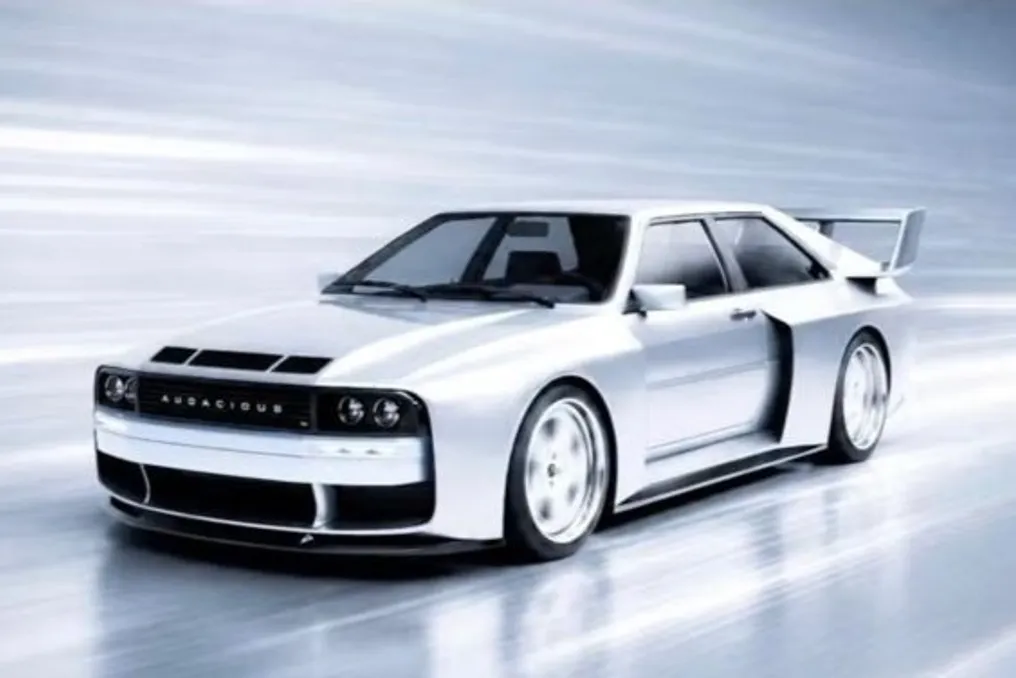
The iconic Audi Quattro, known for popularizing all-wheel drive in both tracks and rally competitions during the 1980s, has been reformulated with a V8 engine capable of generating up to 760 horsepower.
This new project, named Audacious IV, is developed by Audacious Automotive, a Scottish company planning to manufacture a total of 50 units. The estimated initial cost for acquisition is approximately R$ 2.58 million (equivalent to 350 thousand pounds), excluding taxes and accessories.
It is a restomod, a type of classic vehicle that is mechanically modernized while maintaining its original appearance. Although it preserves the square silhouette of the original model, it replaces the five-cylinder engine and the entire mechanical assembly.
The structure of the Audacious IV uses the chassis of the B7 generation Audi RS4, produced between 2006 and 2008. From this base, the car inherits components such as the chassis, suspension, brakes, and part of the electrical system.
Aesthetically, the vehicle features wheel arch flares and large exhaust outlets reminiscent of Group B cars, famous for their extreme models in the 80s World Rally Championship. The customer has the option to choose between a body built from steel and aluminum, incorporating parts from an original Quattro, or a body made entirely of carbon fiber; 40 of the 50 units will be in carbon.
In the interior, the RS4 panels are replaced by analog gauges and physical buttons.
Under the hood, there is the RS4's 4.2L V8 engine, coupled with the Torsen all-wheel-drive system and a six-speed manual gearbox. The entry version comes with a compressor and delivers 608 hp. The second version, which also has a compressor, receives internal reinforcements and an improved cooling system to reach 760 hp.
Two other configurations, still under development with the tuner LAA Performance, a specialist in Audi engines, can spin up to 10,000 revolutions per minute. One of these options is naturally aspirated, and the other is turbocharged.
According to the company, the car can accelerate from 0 to 96 km/h in just 3.4 seconds and reach a top speed close to 320 km/h. The carbon version should weigh 1,200 kg, while the metal version weighs between 1,400 kg and 1,450 kg.
Each unit is assembled manually, and the manufacturing process takes about three years. The first deliveries are scheduled for the end of 2027.