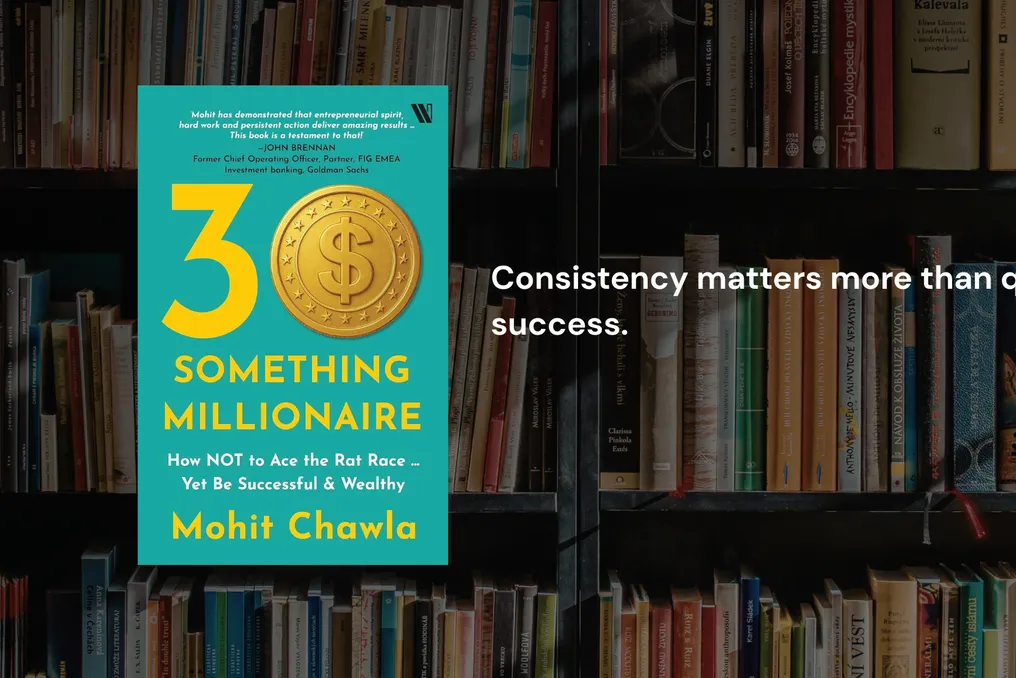
Mohit Chaula shares five lessons from the book '30 Something Millionaire' on achieving financial success
Read more
YourStory [india, en]
yourstory.com

Mohit Chaula shares five lessons from the book '30 Something Millionaire' on achieving financial success

Achieving wealth is a goal that many strive for, but building sustainable capital requires more than just a high salary or finding the right investment opportunity. This process involves developing good habits, making sound financial decisions, and understanding the importance of patience.

In the book '30 Something Millionaire: How NOT to Ace the Rat Race…', author Mohit Chaula describes his journey to financial independence and the principles that helped him become a self-made millionaire in his early thirties.

Drawing on his experience in investment banking, private equity, hedge funds, entrepreneurship, and real estate, Chaula explores how consistency, discipline, and the power of compound interest can shape professional and financial success.

Many people seek quick paths to financial success, desiring instant results, rapid career growth, and fast profits. However, accumulating wealth rarely happens overnight.

One of the key ideas in the book is the importance of consistency. Whether it comes to savings, regular investments, professional skill development, or running a business, small efforts repeated regularly lead to significant results over time.

Chaula's journey demonstrates how disciplined actions and consistent decisions contribute to long-term financial independence. The lesson is this: instead of constantly looking for shortcuts, one should focus on building habits that support your goals. Although consistency may seem slow initially, its impact becomes evident over time.

Compound interest is one of the most important concepts discussed in the book. Most people learn about compound interest in school, but not everyone understands how powerful it can be when applied to daily financial decisions. Compound interest allows money to generate income, which can then generate additional income over time. The longer an investment remains invested, the greater the potential impact of this process.

However, the concept of compound interest is not limited to money. Knowledge, experience, and professional skills can also grow through continuous learning and practical application. For example, regular reading, mastering new skills, and gaining experience in your field gradually open up opportunities that were previously inaccessible.

The lesson is to start early, maintain consistency, and give your investments, knowledge, and efforts enough time to grow.

Financial independence is not just about earning a lot of money; it is also about understanding how to manage what you earn. A higher income does not automatically lead to wealth if expenses rise at the same rate. Developing financial discipline means making balanced decisions regarding spending, saving, and investing.

In '30 Something Millionaire,' Chaula examines the importance of personal financial habits, including saving and investing, as part of the path to building wealth. Instead of spending everything you earn, it is important to develop a financial plan that prioritizes your long-term goals. The lesson is that wealth is built not only through income but also by how effectively you manage and invest your money.

Professional success is another important aspect of the book. Career advancement is often measured by immediate achievements, such as promotions, salary increases, or prestigious positions. However, building a successful career requires a deeper understanding of your industry, improving decision-making abilities, and learning how businesses operate.

Chaula's professional experience in investment banking, private equity, hedge funds, real estate, and entrepreneurship provides insight into the importance of understanding different business environments. The book encourages readers to look beyond short-term career milestones and focus on developing skills, gaining experience, and identifying opportunities that can create long-term value. The lesson is to view your career as a long-term investment. Every new skill, professional relationship, and experience can contribute to your future growth.

You don't always have to learn from your own mistakes. Sometimes understanding the experiences of people who have already succeeded can help make better decisions. One of the three broad categories of knowledge in '30 Something Millionaire' focuses on timeless wisdom gained from successful people from various fields. Their experience can offer valuable insights into leadership, decision-making, business strategies, financial management, and personal development. However, learning from others' experiences does not mean copying their path. Everyone has their own circumstances, opportunities, and challenges. It is important to understand the principles underlying their decisions and apply relevant lessons to your own life.

'30 Something Millionaire: How NOT to Ace the Rat Race… Yet Be Successful and Wealthy' by Mohit Chaula offers a practical perspective on building wealth, developing professional skills, and making better life decisions. One of the main takeaways is that success is not necessarily tied to earning the most money or following a traditional career path. It lies in making consistent decisions, understanding the power of compound interest, maintaining financial discipline, and investing in personal growth. This book offers lessons that can help approach money, work, and life with a long-term perspective, whether you are a budding entrepreneur, a young professional, or someone striving for financial independence.

Similar stories

Five Key Lessons from Bonnie Harmus' Novel 'The Chemistry of Life'
Read more
yourstory.com

Five Key Lessons from Bonnie Harmus' Novel 'The Chemistry of Life'

Bonnie Harmus' novel 'The Chemistry of Life' is a profound work that touches upon themes of ambition, gender inequality, motherhood, and the courage to challenge societal expectations.

The novel is set in the 1960s and tells the story of Elizabeth Zott, a brilliant chemist whose professional aspirations constantly clash with a society that believes women belong in the kitchen, not the laboratory.

When Elizabeth unexpectedly becomes the host of a culinary television show, she uses this opportunity to teach more than just recipes. Through science, she encourages women to think independently, question established beliefs, and recognize their own abilities.

The novel offers several significant lessons about self-worth, equality, and the importance of refusing to let society dictate who we can become.

One of the most important lessons of 'The Chemistry of Life' is that your potential should never be defined by societal expectations. Elizabeth Zott is an exceptionally talented scientist, yet she faces discrimination simply because she is a woman working in a male-dominated field. Instead of judging her solely on her knowledge and abilities, she repeatedly encounters people who underestimate her based on her gender.

Her experiences highlight how social stereotypes can prevent talented individuals from realizing their full potential. Elizabeth refuses to accept these limitations as truth about herself and continues to pursue her interests, challenging the assumptions that try to hold her back.

The lesson is simple: your abilities are not limited by what others think you are capable of achieving. Regardless of career, education, or personal life, you deserve the opportunity to explore your potential without being constrained by outdated notions.

Elizabeth approaches life with the curiosity of a scientist. She believes in analyzing evidence, asking questions, and understanding the causes of events, rather than accepting common wisdom without reflection. This way of thinking becomes particularly important when she starts hosting her cooking show, 'Supper at Six.' Although the program is about cooking, Elizabeth incorporates scientific explanations and urges her audience to understand the processes behind everyday tasks.

Her method transforms an ordinary television show into an opportunity for women to learn, think critically, and gain confidence in their own intellect. The novel reminds readers that questioning established ideas is not necessarily an act of rebellion; sometimes it is the first step toward progress.

In daily life, this means examining ingrained beliefs, questioning unfair traditions, and making decisions based on reason rather than fear of judgment. Independent thinking allows one to recognize when something needs to change.

Gender inequality is a central theme throughout 'The Chemistry of Life.' Elizabeth faces professional discrimination, unequal treatment, and assumptions about what women should do in life. Her experience reflects a broader social issue: women's achievements are often ignored simply because they do not conform to traditional expectations.

Through Elizabeth's journey, Bonnie Harmus illustrates how exhausting it can be to prove one's competence in an environment where others are unwilling to provide equal opportunities. She has to work harder for her knowledge to be recognized, even when her qualifications speak for themselves.

However, the novel also demonstrates the importance of mutual support among women and the recognition of their collective potential. The lesson extends beyond the workplace: equality implies respect for women's choices, acknowledgment of their contributions, and permission for them to build careers and realize ambitions without being forced into predefined roles. A person's abilities should determine their opportunities, not their gender.

Elizabeth's transformation into a TV host shows that knowledge can be a powerful tool for challenging social norms. Instead of abandoning her scientific background to fit the expectations of a cooking show, she integrates science into the kitchen. She explains cooking through chemistry and treats her viewers as intellectually developed individuals capable of understanding complex ideas.

Her approach challenges the assumption that domestic duties and intellectual pursuits must exist separately. It also provides women with a platform to engage with science in a way that traditional institutions often deny them. Elizabeth's confidence does not stem from proving she is better than everyone else; it arises from knowing the value of her knowledge and refusing to diminish herself to satisfy others' expectations.

This lesson encourages readers to embrace their knowledge, articulate their ideas clearly, and trust their ability to make a difference. Sometimes changing people's minds begins with one person willing to question the familiar and present a different way of thinking.

Another important lesson from 'The Chemistry of Life' is that people should have the right to define their family and identity on their own terms. Elizabeth's life calls into question conventional views on motherhood, relationships, and women's responsibilities. Her experience shows that being a mother does not mean giving up ambition, just as striving for a career does not make one less capable of caring for a family.

The novel explores how people cope with grief, parenthood, relationships, and the expectations placed upon them. It presents a more nuanced understanding of what it means to build a fulfilling life. Elizabeth refuses to accept the idea that she has to choose between intellectual ambition and dedication to motherhood. Instead, she creates a life that reflects her circumstances, values, and priorities.

The takeaway for readers is that there is no single formula for a meaningful life. People have different ambitions, responsibilities, and definitions of happiness. Instead of measuring oneself against conventional benchmarks, one can focus on building a life that aligns with one's own values and allows for growth.

'The Chemistry of Life' by Bonnie Harmus is more than just a novel about a scientist overcoming a world that underestimates her. It is a story about fighting inequality, embracing curiosity, and refusing to let others' assumptions define your future. Through Elizabeth Zott's experience, readers are reminded that intelligence deserves recognition, women deserve equal opportunities, and personal ambitions should not be sacrificed to meet societal expectations. The five lessons from the book urge us to question outdated beliefs, trust our abilities, and create a life that reflects who we truly are. Whether you are pursuing a career, questioning social norms, or discovering your identity, Elizabeth's journey serves as a powerful reminder that you do not have to conform to anyone's definition of success.

Five Lessons from Claire Keegan's Story 'Late in the Day'
Read more
yourstory.com

Five Lessons from Claire Keegan's Story 'Late in the Day'

Claire Keegan's story 'Late in the Day' is a short yet profound piece of literature that explores themes of relationships, regret, gender expectations, and the quiet ways people reveal their true nature.

The story focuses on the character Catalé, who reflects on his relationship with Sabine and the events that shaped their bond. Through the depiction of an ordinary day and memories of failed relationships, Keegan analyzes how everyday assumptions, small decisions, and unspoken presumptions can have long-term consequences. The story achieves its purpose not through dramatic plot twists.

Instead, it prompts readers to closely examine the details of human behavior and contemplate what they say about love, responsibility, and emotional maturity. Despite its conciseness, 'Late in the Day' raises important questions about how we treat those closest to us and whether we acknowledge our own flaws.

One of the key lessons drawn from the work is that character often manifests through mundane behavior rather than grand gestures. Catalé's interaction with Sabine demonstrates attitudes that might seem insignificant at first glance. His habits, assumptions, and reactions to everyday situations reveal his views on relationships and the role of women within them.

The piece urges readers to look deeper than what people say about themselves. A person may describe themselves as caring, fair, or attentive, but their daily actions often provide a clearer picture of their values. This principle applies to friendships, romantic, and professional relationships. How a person listens, shares responsibilities, reacts to disagreements, or treats others when nothing is expected in return says a great deal about their character. Actions often transmit what words try to conceal.

Romantic relationships cannot exist solely on attraction or attachment; they also require attention, compromise, and a willingness to recognize the needs of the other person. In 'Late in the Day,' the relationship between Catalé and Sabine highlights the distance that can arise when one partner does not fully value the other. His perspective shows how someone can believe they are acting reasonably while ignoring the impact of their actions.

The story challenges the idea that being in a relationship automatically makes someone a good partner. Love requires active participation: the ability to listen, share duties, respect boundaries, and make room for the other person's preferences. It also requires questioning one's own assumptions instead of expecting the partner to constantly accommodate.

The lesson is that healthy relationships are built on daily choices. Small acts of kindness can strengthen a bond, whereas constant neglect of another's needs gradually weakens it. Love is not just about feelings, but about how we choose to treat a person.

Claire Keegan explores how deeply traditional gender expectations can influence relationships, even if people do not openly admit it. Catalé's behavior reflects notions about women, domestic duties, and how relationships ought to look. These expectations shape his interaction with Sabine and expose the imbalance that can occur when one person's comfort is prioritized over the other's independence.

The work emphasizes that gender inequality does not always manifest through overt hostility. It can arise from everyday expectations, unequal distribution of chores, and the belief that one partner should naturally yield to the other. These patterns are hard to notice because they are often perceived as normal. However, if they are not questioned, they can prevent both partners from building a relationship based on genuine equality.

The lesson is the necessity of critically evaluating the expectations we bring into our relationships. Household chores, emotional labor, and personal choices should not automatically follow gender lines. Healthy relationships allow both individuals to feel valued, respected, and free to make decisions about their own lives.

One of the most thought-provoking aspects of 'Late in the Day' is how it examines regret through the lens of memory and reflection. Catalé's memories prompt readers to consider how people interpret their own past behavior. We might deem certain events trivial, overlooking how those moments affected another person. Sometimes the consequences of our choices only become clear after the relationship has changed or the opportunity has passed. By then, understanding what went wrong may be insufficient to repair the damage.

Keegan's story reminds us that self-awareness requires more than simply recalling what happened. It demands an honest analysis of our own role in those events. This lesson applies to all types of relationships. Instead of immediately defending our intentions, we can ask ourselves whether our behavior was attentive and how it might have affected others. Regret can cause pain, but it can also reveal areas where we need to grow. It is important to learn from mistakes while we still have a chance to make a better choice.

Another important takeaway from the story is that emotional maturity involves acknowledging one's limitations and taking responsibility for one's behavior. It is easy to assume that relationship problems are caused solely by the other person. We might focus on their reactions, expectations, or ways of disappointment without examining our own contribution to the situation. Catalé's perspective invites readers to move beyond self-perception and consider the gap between how they see themselves and how their actions affect those around them.

True self-awareness requires questioning our own assumptions, listening to challenging viewpoints, and admitting when our behavior has been unfair. This does not mean blaming oneself for all problems or taking responsibility for things outside our control. It means recognizing those aspects of our behavior that we are capable of changing. The lesson is simple: personal growth begins when we are willing to honestly analyze ourselves. Understanding our behavioral patterns helps build healthier relationships and avoid repeating the same mistakes.

Five lessons from Yuval Noah Harari's book 'Nexus' on the influence of information networks
Read more
yourstory.com

Five lessons from Yuval Noah Harari's book 'Nexus' on the influence of information networks

Information has always played a key role in shaping human civilization. The ways information is disseminated—whether ancient tales, religious texts, newspapers, television, or social media—determine people's beliefs, decision-making methods, and trust in others.

In his book 'Nexus,' historian and author Yuval Noah Harari analyzes how information networks have influenced the course of human history and how they might affect the future. Published in 2024, the book explores the relationship between information, power, truth, and the development of artificial intelligence.

Harari challenges the assumption that having a greater volume of information automatically makes societies wiser or more informed. More important is how the information is organized, who controls it, and whether the dissemination systems facilitate the correction of errors by people.

Below are five important lessons that can be drawn from 'Nexus' and applied to the modern world.

One of the book's most crucial conclusions is that the mere availability of information does not guarantee that people will become better informed. We often assume that receiving more facts, news, and opinions will help us understand the world more accurately. However, information can be misleading, incomplete, or deliberately distorted.

Throughout history, information networks have helped societies organize, preserve knowledge, and cooperate on a large scale. Nevertheless, these same networks have been used to spread myths, propaganda, and disinformation. Harari examines this contradiction with examples from history, ranging from religious institutions to modern political systems. Today, this issue remains relevant: social media allows us to receive information in seconds, but it can also expose us to false headlines, unverified claims, and content designed to provoke emotional reactions.

The lesson is to approach consumed information more thoughtfully. Instead of accepting something simply because it appears frequently online, one must verify the source, seek corroborating evidence, and consider alternative explanations.

Popular