The question of how to survive in theater was often posed to people like Lalit, whose father worked as an auto-rickshaw driver and whose mother was a homemaker. Despite his family's concerns about income, Lalit maintained his passion for theater, continuing to train in Delhi theater groups, often paying for the classes out of his own pocket.
The situation changed when he saw an advertisement near Mandi House, the city's arts district, for the Bargad program. This program offered free training and a monthly stipend. Lalit happily recalls deciding to try it and joining the first cohort of 14 participants in January 2025.
In the first class, co-founder Amba asked the participants to write down their expectations from the program and return to them after six months. Initially, Lalit hoped that participation would lead him to a 'renowned drama school' and provide qualifications for his family, but the problem his family faced was precisely the issue that Bargad aimed to solve.
Who has the right to tell their stories?
The program addressed a broader question: who can pursue theater if training requires money, time, and a stable income? For Amba, co-founder of Bargad and academic director of the program, this question arose from her personal experience in performing arts. After studying at the London Academy of Music and Dramatic Art and working in London for five years, she returned to India with a desire to create her own theater practice.
She was concerned not only about access to training and professional opportunities but also about whose stories, imaginations, and artistic voices are valued first. Amba notes that there is a strong system of gatekeeping in the performing arts, shaped by caste and privileges that are matters of birth. Bargad aims to challenge this system of control.
For Anirudh, another co-founder of Bargad and course director, this question became personal about ten years ago when he was working on a play about the Criminal Tribes Act. Before that, his privileged background had hidden many inequalities from him. He admits that he lived in a 'small bubble,' unaware of the outside world until the play became his first honest confrontation with the reality of caste and Ambedkarite labor.
In 2025, Bargad was founded by Amba Sukhasini K Jala and Anirudh Nair with the participation of Sanyukta Saha, who directs the Agaaz Theatre Fund, and Shambhavi Singh, founder of Oddbird Theatre. The first cohort began in January 2025. For Amba, expanding access meant not just inviting new people into existing institutions, but changing the conditions that determine who can enter the field at all.
Paying students to enable the creation of theater
Bargad's first practical response was to make the training free and pay the participants. The first two cohorts received 10,000 rupees per month, and the third, starting in January 2027, will receive 15,000 rupees. Classes run from 4:00 PM to 8:30 PM, six days a week, allowing participants to earn during the day. Many applicants are financial breadwinners in their families, and attending classes might mean giving up hours they could spend working.
Anirudh emphasizes that 'for participants, the high opportunity cost of spending time learning the art is significant.' The guarantee of a stipend also helps convince their families. Lalit, before joining, paid for his own theater training and sometimes depended on siblings for money. The stipend gave him a sense of financial independence.
He shares that 'for the first time, I was paid for theater.' Initially, he couldn't believe it, but he understood it was a great opportunity to afford what he loved most. Thanks to the stipend, he didn't have to ask his brother or sister for money, and he spent it on travel, books, and personal needs. He didn't tell his parents about his selection; only his brother knew. The question of what theater could give him remained unresolved, but for the first time, he had space to find out.
Bargad also challenges the assumption that a lack of formal education means a lack of talent. The number of applications grew from about 75 in the first year to 200 in the second. Candidates can apply in English or Hindi through written or video submissions. An independent online jury selects about 30 candidates for three rigorous in-person auditions, followed by a group audition testing listening skills, collaboration, responsiveness to direction, and ensemble skills. A second jury selects the final group of 14.
Amba explains that 'we intentionally keep the group small so that each participant receives constant individual attention, close mentorship, and space for risk-taking, experimentation, and growth within a tight ensemble.' The six-month curriculum covers voice, movement, acting, improvisation, writing, and creation, involving guest practitioners from Delhi, Mumbai, Bengaluru, and Chennai. The focus is not only on learning techniques but also on finding ways to use these techniques to create original work.
The stage never truly ends
Neil Chaudhuri, a creation instructor who has taught at Bargad since its inception, works with participants on developing productions based on assignments within the 'Creation' discipline, or as he calls it, 'learning to learn how to look inward and invent what story one wants to tell oneself.' In the 'Creation Labs,' held every two weeks, participants create short scenes and revisit them over time, observing how the idea changes with further work.
He says: 'The idea is not that they must create a perfect scene in two weeks, but to follow the process, to learn how a story is conceptualized and everything required to bring it to life.' This distinction is important. Instead of viewing the first version of a scene as a finished product, the process encourages participants to reconsider their choices, test different approaches, and discover what the work can become. The focus is on developing the idea, not just quickly producing something.
This approach also expands the definition of what can be considered theatrical material. Neil explains: 'A scene doesn't necessarily have to start with an extraordinary event or a fully formed story. An ordinary object, a remembered incident, or a personal discomfort can be the starting point. The essence lies in exploring experience and finding a way to convey it to the audience.'
Classes are conducted primarily in Hindi, and instructors are asked to teach bilingually. He notes: 'Participants can ask questions and experiment without feeling like they should already know theatrical conventions. And language plays a big role in that.'
When life becomes a story
For Pirna Bisht, who joined the program in 2026 after an unsuccessful application attempt the previous year, this process began with food. During a workshop led by Vamsi, an interdisciplinary theatre artist exploring the multifaceted link between caste and food, participants were asked to tell stories through what they ate. This assignment took Pirna back to her childhood in Haryana, where her family's vegetarian diet was something they felt they needed to hide.
She recalls: 'My father locked all doors and windows while cooking so no one would know what we were eating.' One day, a neighbor's child came over, and they quickly hid the plates. 'For a long time, I was ashamed of my food and often ate school lunch, hiding from everyone,' Pirna recalls with a hint of sadness in her voice.
This memory was more than just a meal. It reflected how the fear of judgment can haunt a person beyond the home, turning an ordinary part of life into a source of embarrassment. The workshop gave Pirna the opportunity to re-examine this experience and explore what it meant to her. 'In Bargad, food became a way to enter a story about social pressure, secrecy, and shame that I carried to school. I felt liberated,' she says.
This is one of the creative possibilities: experiences that would otherwise remain private can be shaped into material for performance. The process does not erase what happened. It gives the storyteller a way to look at it differently and decide what they want to share.
Bringing the story to the stage
After any program, students often ask themselves: 'What next?' In theater, this anxiety can be multifaceted due to lack of opportunities, rising costs, and inaccessibility. To address this problem, the founders launched the Bargad ka Chautry program, an additional six-month program that graduates can apply to. It includes masterclasses on workshop facilitation, fundraising, and staging, among other supportive training. Students can also apply for one of two production grants of 100,000 rupees each.
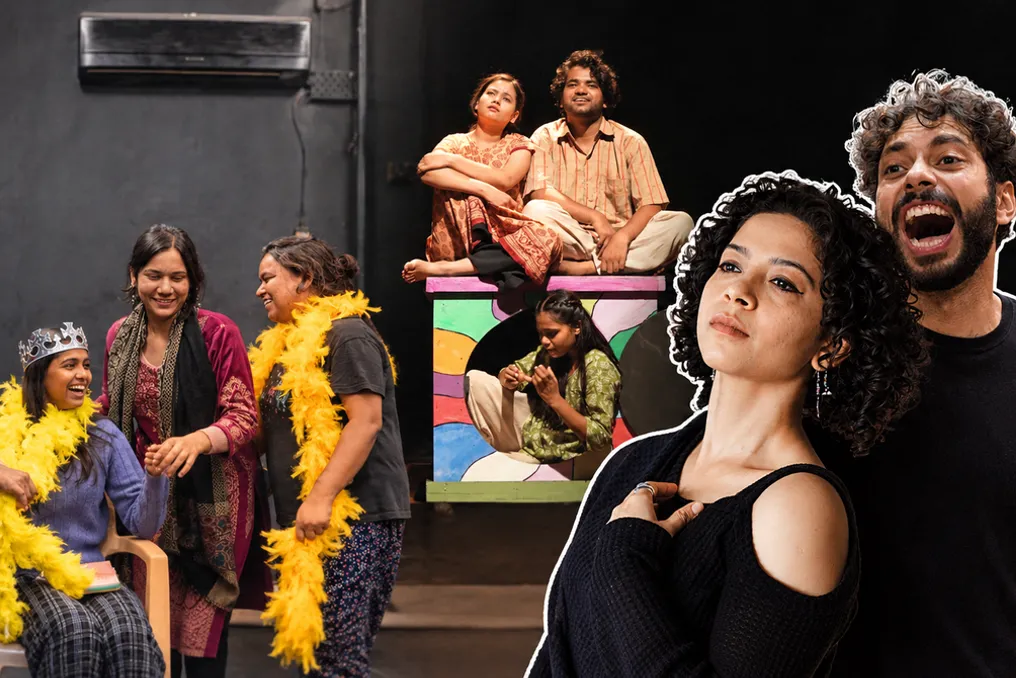
Lalit's cohort used one of the grants to transform a 15-minute scene about manual waste collection into the full-scale play 'Hawa Mahal.' The group interviewed people involved in manual waste collection, whose experiences formed the basis of the production. Then, Lalit became part of a larger production team and designed sets made of pipes and windows that also served as hatches. Over seven months, the students developed the production, studying not only how to shape a story but also how to organize the work necessary to present it to the public. For Lalit, this meant taking on responsibilities beyond acting and helping to turn the group's research into a staged performance.
Finding a place for the story
Bringing a play to the stage presented another problem. Audiences around Mandi House could cost between 80,000 and 100,000 rupees per day, while available independent venues are limited and often booked in advance. 'Hawa Mahal' ran six performances, one of which took place at Ashoka University. For Lalit, the reaction after one performance made the work worthwhile. 'After three shows, at the post-show meeting, the audience thanked us for telling this story,' he says.
However, moving a story from the classroom to the audience requires funding, rehearsal time, and space. The ability to develop a production is little useful if there is no accessible venue to show it. Neil asserts: 'It is impossible to work in theater without space, both for creating the work and for showing it to its audience.'
Bargad attempts to solve this problem by creating a network of spaces, people, and resources that can help participants bridge this gap. Nihil Mehta from Black Box Okhla participated in the program and the alumni program. Other participants continued their work in various ways: a graduate from a village in Bihar received a 100,000 rupee grant to write a play, a second-cohort participant enrolled in the National Drama School, and another won a full scholarship to the Mumbai Drama School.
Keeping the door open
The future of Bargad depends on ensuring the sustainability of these opportunities. Over two years, the program relied on about 20–25 private donors who contributed between 5,000 and 500,000 rupees. Their support helped maintain its operation, but dependence on the generosity of individuals makes long-term planning difficult.
Amba states: 'Sustainability is not about finding more well-wishers every year. It is about finding long-term partners who understand that access cannot depend on annual generosity so that we can plan three, four, five years ahead.' With more stable funding, she hopes to establish annual courses in every metropolis, tour with productions, and offer larger scholarships. These ambitions will expand opportunities.