The Architecture Drawing Prize, established in 2017, annually hosts events to value and highlight the art of architectural drawing across various techniques and formats. The ninth edition of this prize announced its 11 winners after selecting from 168 proposals received globally. The event's curation was conducted in collaboration with Make Architects, Sir John Soane's Museum, and the World Architecture Festival (WAF), with support from Iris Ceramica Group and ArchDaily as media partners.
The submissions to the World Architecture Festival covered a vast range of styles, including conceptual, technical, or construction drawings, perspectival sections, perspective views, speculative scenarios, and innovative formats. The call was open to architects, designers, and students, and was judged by a professional jury that considered technical skill, originality of approach, and the ability to communicate an architectural idea. Due to the growing influence of artificial intelligence tools and the evolution of drawing practice, the awards are judged globally, rather than by separate categories.
The special award dedicated to hand drawing, created to preserve the original spirit of the award, was given to Ross Cameron. He received the award for his pencil sketch of the scaffolding surrounding the Glasgow School of Art, dated from the 2014 and 2018 fires, as it captured 'the tension between permanence and impermanence in a structure designed to be temporary.'
The drawings recognized this year addressed varied themes such as memory, housing, chemical dependency, climate, myth, fiction, perception, and public participation. Among the notable works are The People's Palace by Ioana Enache, which functions as an archive of oral testimonies at the base of the unfinished Romanian Opera; Urban Scenography by Bojana Sićović, which investigates social housing in New Belgrade; and In the Eye of the Storm by Javier García Goicoechea, which uses six floor plans to map the progression of addiction in casino spaces, offering a psychological analysis.
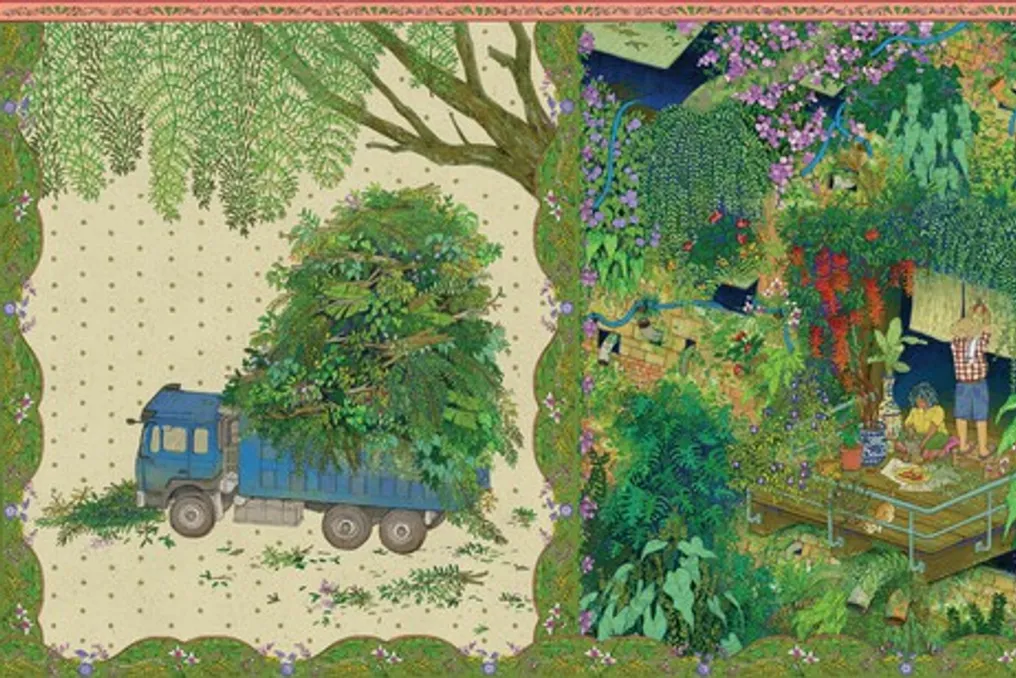
Contemporary environmental and climatic issues were represented in Post-Tropical Landscapes by Annabelle Tan, which shows concrete structures covered in vines in Singapore, and in Re-enchanted City by Laurie Chetwood, which imagines the reestablishment of a deserted metropolis. Other speculative and fantastic examples include Floating Feast by Alexandra Kazandzhyan, a floating ziggurat built with a single table, and Gilgamesh by Gary Polk, a mixture of architectural fragments similar to a kaiju.
The selection also included artistic research and practices, such as Michael Chapman's 49-panel map of the fictional Fox River prison, and Ben Johnson's exploration in drawing and painting of a zero-gravity corridor. Additionally, Jarrell Goh presented an illustrative masterplan for the Cambridge Business Park, developed for public consultation.
The selection of works was led by Ken Shuttleworth, founder of Make Architects; artists Ben Langlands and Nikki Bell; Lily Jencks, Executive Director of the Jencks Foundation at The Cosmic House; Federica Minozzi, Global CEO of Iris Ceramica Group; Narinder Singh Sagoo MBE, Design Communications Director at Foster + Partners; Erin McKellar, Assistant Exhibition Curator at Sir John Soane's Museum; and Paul Finch, WAF Program Director and Jury President. The selected drawings will also be exhibited at the World Architecture Festival, which will take place at the Broward County Convention Center in Fort Lauderdale, Florida, from November 18 to 20, 2026.
In other industry news, Anne Lacaton and Jean-Philippe Vassal were announced as winners of the Le Prix Charlotte Perriand 2027, organized by the Créateurs Design Awards. In October, the Royal Institute of British Architects (RIBA) released two major prizes: the alternative factory model in Bangladesh, developed by Nakshabid Architects, won the RIBA International Prize 2026, and the Lion Green Road housing complex in London, designed by Mary Duggan Architects and RUFFARCHITECTS, won the RIBA Stirling Prize 2026. Furthermore, the second edition of the ArchDaily Student Project Awards has already accepted entries, inviting global students to answer the question: what can architecture provide to the city?