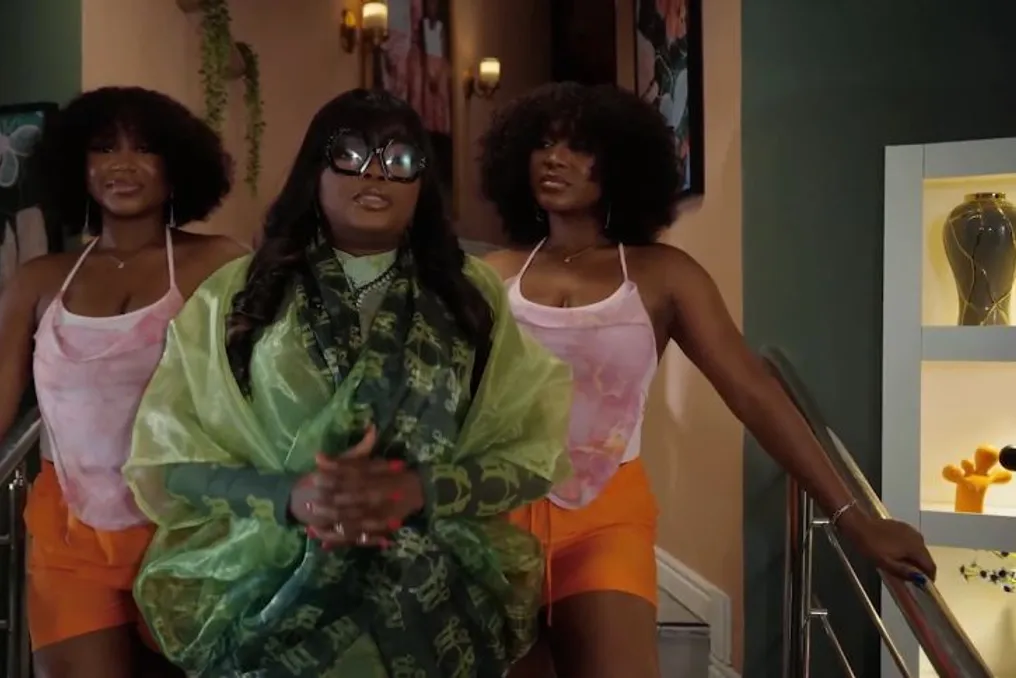
Funke Akindele, a Nigerian director, producer, screenwriter, and actress considered Africa's most commercially successful filmmaker, is preparing to release a new potentially major film titled 'The Four: No One Fights Alone' on December 11th. This film is her eighth major theatrical project and tells the story of four strong women who fiercely fight for the future of a young man they love.
Akindele emphasizes that her creative approach is to tell African and Nigerian stories that can resonate with audiences while adhering to global standards to ensure understanding and attract a wider audience. She shared this view with Larry Madowo from CNN in Lagos earlier this year.
Following the success of the film 'Behind the Scenes,' which was released in 2025 and earned over 2 billion Naira, equivalent to approximately $1.6 million, Akindele has been recognized as Africa's most commercially successful filmmaker. This film, dedicated to a real estate magnate experiencing a crisis and reevaluating his generosity, became the first Nollywood picture to surpass this financial threshold. It gained a global audience through its screening on Netflix.
Nigeria's film industry ranks second globally in production volume after India, according to UNESCO data. More than 2,500 films are produced annually in the country, exceeding Hollywood's annual output. Film production is the second-largest employment sector in the country, providing jobs for over a million people.
Akindele became the first African filmmaker whose films topped the box office in Nigeria for three consecutive years. Her 2023 film 'A Tribe Called Judah' was the first Nollywood picture to gross 1 billion Naira at the box office, surpassing $745,000. This comedy-drama tells the story of five brothers with different fathers who rob a shop to save a sick parent, in which Akindele herself stars. She explained that she wrote the script wanting to 'tell the truth, without embellishment,' inspired by real life, specifically the story of a woman who had seven children by seven men, whom society condemned and labeled a 'prostitute.'
Akindele notes that her writing style is based on authenticity, as one must be purposeful in their actions in life. She believes ambition is important, but she sells the film on quality and authenticity. Before the successes of 'Behind the Scenes' and 'A Tribe Called Judah,' her first major financially successful film was 'Jenifa,' released in 2008. It told the story of a village girl who moves to the city to study and desperately tries to fit into the environment.
This film helped Akindele gain recognition. She wrote the script because she wanted to reach out to the youth, seeing storytelling as a tool to demonstrate social problems, correct vices, and help young people build self-confidence, as she is very devoted to the youth. The sequel, 'The Return of Jenifa,' was released in 2011 and became Akindele's first film shown in Nigerian cinemas. In 2024, she released the second sequel, 'Everybody Loves Jenifa,' calling it her most expensive film to date.
Akindele revealed that the filming took place in Ghana, including the entire cast and crew, at the Safari Valley Resorts. She noted that she created the sets herself rather than renting premises, which made 'Everybody Loves Jenifa' very costly; however, she managed to recoup the expenses since the film proved successful both in theaters and on streaming platforms.
Despite the commercial success, Akindele, who first appeared on screen in 1998 in the sitcom 'I Need to Know,' sponsored by the UN Population Fund (UNFPA), and has acted in over 100 films, believes that African filmmakers still face obstacles. 'Our main barrier is distribution,' she stated. She is confident that this barrier will be overcome through greater partnership and global collaboration, as working with world filmmakers allows for the exchange of experience, ideas, perspectives, and the study of production standards, technologies, and distribution methods.
Akindele calls on filmmakers to collaborate with other creatives and create stories that resonate worldwide. She advises writing authentic yet cross-border stories, focusing on emotions, because 'Rome wasn't built in a day.' Regarding legacy, she hopes her work will help other women by breaking barriers for them and continuing to create platforms for their voices.