
Mitchell Santner discusses reasons for New Zealand's defeat in Auckland match due to ball speed and bounce
Read more
Aaj Tak
www.aajtak.in

Mitchell Santner discusses reasons for New Zealand's defeat in Auckland match due to ball speed and bounce

New Zealand captain Mitchell Santner shared his opinion on the team's loss to India in the Auckland match, noting that the speed and bounce of the ball on the field were decisive factors. He suggested that the ball at Eden Park bounced more than expected and was quite fast. Because of this, the New Zealand batsmen could not adapt to the playing conditions quickly enough, although Santner also highly praised the Indian bowlers.

Santner emphasized that countering such bounce at Eden Park is very difficult, and the Indian bowlers utilized this advantage better. He also mentioned that Shrees Iyer tried to play more often against short balls. Furthermore, after the rain, the ball skidded well on the pitch, leading to many short deliveries.

Despite India getting a good start, Santner expressed satisfaction with his batsmen's performance, who did not give up. According to him, returning to such a situation was not easy, but the quick bowlers continued to put in effort. Now the team will focus on the upcoming match in Wellington.

In the first ODI played in Auckland on Wednesday, India defeated New Zealand by five wickets in a match affected by rain. New Zealand, batting first, scored 185 runs in 40.2 overs. In response, India reached the revised target of 143 runs, losing only 5 batsmen in 22.4 overs.

Virat Kohli played a key role in India's victory, scoring 74 runs off 51 balls, including 13 fours and one six. This innings marked his 80th half-century in ODI format. Rohit Sharma was dismissed without scoring after 6 balls. After this, Kohli and captain Shubman Gill built a partnership of 113 runs for the second wicket. Gill scored 37 runs and provided excellent support to Kohli, who entertained the spectators with his cover drive, flick off mid-wicket, and pull shot, as well as his cover drive against Blair Tickner's ball.

The young Indian bowlers changed the course of the game. Since India's main fast bowlers, Jasprit Bumrah, Mohammed Siraj, and Prasidh Krishna, did not participate in the match, Arshdeep Singh and Guruonur Barnar took responsibility. Arshdeep took 4 wickets, conceding 70 runs in 10 overs, while Guruonur took 3 wickets, conceding 44 runs in 9.2 overs. The tall Guruonur, standing about 6 feet 5 inches, troubled the New Zealand batsmen with his pace and the height of the ball. Arshdeep provided a good start for India, taking two wickets in the powerplay. New Zealand managed to score only 45 runs in the first 10 overs, losing 2 wickets.

Anshul Kamboj also showed excellent bowling performance, taking 2 wickets, conceding only 22 runs in 10 overs, while bowling 46 dot balls. Coach Gautam Gambhir's decision to field three young bowlers proved successful. These four young Indian pacers had a combined total of only 29 ODI matches experience.

Sifert and Mitchell also could not cope with the innings. New Zealand's start was poor: Will Young was dismissed for 9 runs attempting a pull shot against Arshdeep's ball, caught by Shrees Iyer. Henry Nicholls also returned to the dressing room for 9 runs trying a pull shot, caught by Naman Dihr. In the previous T20 match, Tim Sifert, scoring 38 runs off 43 balls, hit a six, playing a ramp shot against the keeper off Akib Nabi's ball. He also responded well to Guruonur's longer ball, but later made a timing error on a short delivery, caught by reserve Rituraj Gaikwad at mid-on.

After this, Guruonur sent Tom Latham back to the dressing room, who himself caught the ball trying to stop it. When New Zealand had 5 wickets and 109 runs, hope rested on Daryl Mitchell (28) and Glenn Phillips (30) to build a big partnership, but they could not do so. Mitchell and Phillips tried to score quickly, but Rohit Sharma's alertness and the quick bowling of KL Rahul led to Mitchell being dismissed. Anshul Kamboj maintained pressure in the middle overs, constantly bowling dot balls, and took two wickets. Captain Mitchell Santner was dismissed, and Virat Kohli caught a magnificent catch by Nathan Smith in the second slip.

Similar stories

Ishan Kishan ruled out of India squad due to injury, missing third T20 match
Read more
www.aajtak.in

Ishan Kishan ruled out of India squad due to injury, missing third T20 match

Due to a muscle injury sustained during a game, vice-captain and batsman Ishan Kishan has been dropped from the Indian squad for not only the second but also the third T20 match against New Zealand.

The third match of this five-match series between India and New Zealand is scheduled for Tuesday, October 27, at Sky Stadium in Wellington. Fans were expecting Kishan's return as he was in excellent form.

The injury, which is a low-grade adductor strain in his right lower leg, was sustained by Ishan Kishan on October 22 during the first match of the series in Christchurch. The 28-year-old was advised to take a break to prevent further damage. Kumar Kushagra has been included in his place in the team.

Meanwhile, the players are ready for the second match of the series at Hagley Oval in Christchurch. India captain Shreyas Iyer decided to start the game with a coin toss and opt for bowling first. The Indian team aims to maintain its winning streak, having achieved an impressive target of 226 runs in the first T20 match.

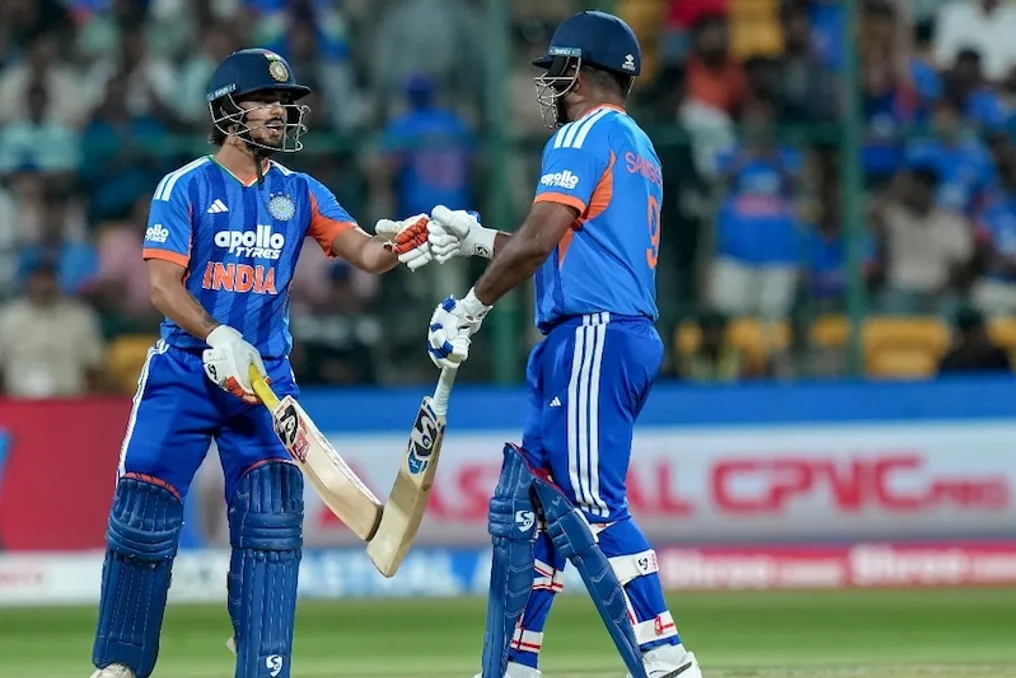
In the first match, Sandeep Samson delivered an impressive performance, scoring 67 runs off just 33 balls, while captain Shreyas Iyer added 42 runs. Following this, young Naman Dheer secured a brilliant victory for the team, scoring 42 runs off only 15 balls without getting out.

Despite Kishan's absence, the Indian team, which currently leads the series 1-0, is fully prepared to continue its winning run. At the same time, the host side, New Zealand, will make every effort to return to the game.

India's New Philosophy in T20: Team Ready to Attack Despite Bowling Issues
Read more
www.aajtak.in

India's New Philosophy in T20: Team Ready to Attack Despite Bowling Issues

India won the first T20 match against New Zealand, achieving a target of 226 runs in 19.4 overs.

This victory was achieved not only through strong batting but also demonstrates the Indian team's aggressive approach to chasing targets, unafraid to take risks. Despite shortcomings in the bowling game, the batsmen managed to compensate for these weaknesses with their power.

India's strategy became clear: instead of restricting the opponent to a low score, the team found it more advantageous to surpass their total. However, such a tactic will only be effective if there are consistent high performances in the attack, as chasing a target of 225 runs every day will not be easy.

The target of 226 runs indicates that serious questions face the Indian bowling unit. Allowing over 200 runs in T20 itself is a signal that the strategy, length, and line of the delivery need improvement, especially towards the end of the match. Nevertheless, India's batting completely changed the course of the game.

By reaching 230/6, India proved that its batting does not depend solely on stars. The squad includes players capable of increasing aggression under the pressure of a difficult task.

This victory is more of a statement about batting strength than a success of bowling.

Sanjju Samson laid a solid foundation for the chase, scoring 67 runs off 33 balls, including eight fours and four sixes. His key contribution was preventing the pressure of a large score from overwhelming the Indian batting.

Samson showed from the beginning that simply preserving wickets is insufficient to achieve a target of 226 runs; maintaining tempo and putting pressure on the bowlers is necessary. His play allowed subsequent batsmen to play in a more open manner.

The performances of Shreyas Iyer with 42 runs and Naman Dira without getting out for 42 runs (off 15 balls) were important elements of this victory. Axar Patel also made a useful contribution of 24 runs.

The significance of these innings is not limited to the runs scored. When chasing a big score, the quick start of one batsman must be supported by others. This is where Shreyas and Naman played their role.

Naman's unbeaten knock was particularly crucial, as the match needed to be concluded even after approaching the target. India demonstrated that it has options to score runs at different stages of the match, winning in 19.4 overs.

Despite the brilliant victory, it is crucial to understand the other side of the coin. Reaching a target of 226 runs shows India's strength, but this does not allow for ignoring the bowling deficiencies.

India's aggressive strategy is its strength, but a truly strong team is one that can control the game with both batting and bowling. India has shown that a large score is an opportunity to attack, not a cause for fear.

However, to maintain this dominance in the series, the bowlers will have to raise their level. India's new T20 declaration is this: if you make 225, we will make 226. But true dominance will come when the ball rules over the opponent alongside the bat.

Popular