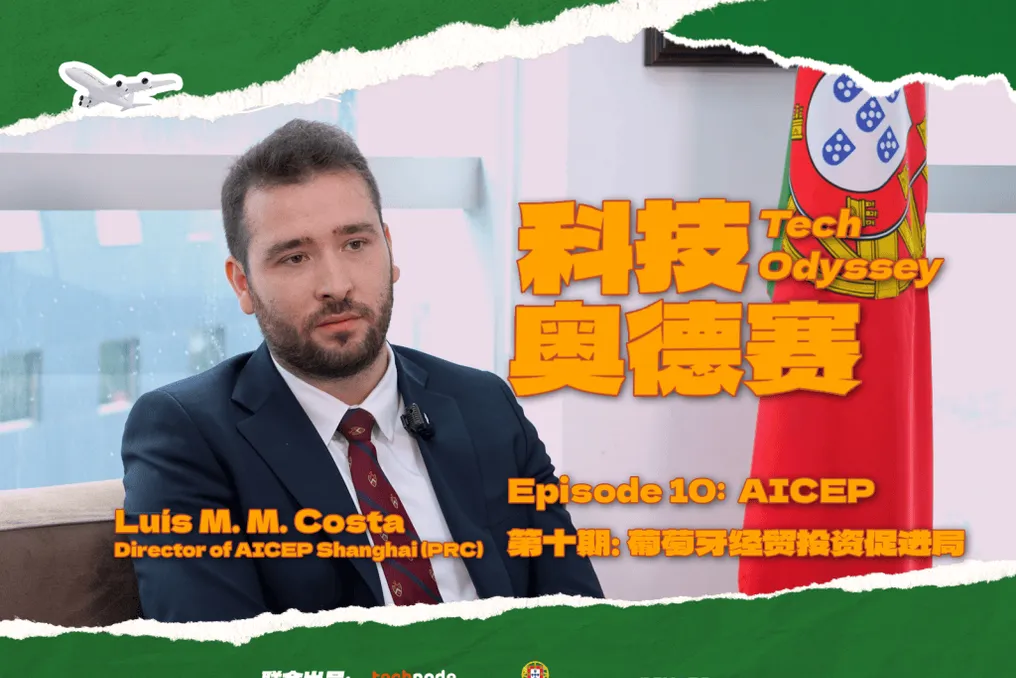
The concluding episode of the Tech Odyssey series discussed the future of technological interaction between Portugal and China. The discussion took place with the participation of AICEP, the Portuguese agency for trade and investment, as well as the series co-creator.
During a chance meeting in Thailand, two weeks before recording the final episode, a friend from Singapore asked Dr. Ganggu Lu, founder and CEO of TechNode Group and co-founder of BEYOND, about Portugal. He had already watched the series and was seriously considering expanding his business into Portugal.
This was an unexpected outcome: a program highlighting Portugal's technology sector reached someone in Asia and prompted him to pay attention to a market he might have otherwise ignored. This was precisely what AICEP aimed for. For Luis Costa, AICEP Director in Shanghai and Portugal's economic and commercial advisor in China, the exchange of information worked in reverse as well. Portuguese founders featured in the program gained the opportunity to learn more about China.
Costa noted: 'We bring China to them, and hopefully, they will eventually consider China when traveling abroad.'
AICEP is the state agency of Portugal for trade and investment, operating under the aegis of the Ministry of Economy. Its activities are focused on two areas: assisting Portuguese companies with international expansion and attracting foreign investment to Portugal.
For Costa's team in China, this means supporting Portuguese enterprises studying the Chinese market, as well as interacting with Chinese companies interested in investing or manufacturing in Portugal. There is also a broader objective—strengthening trust. Costa strives for potential investors and buyers to perceive Portugal as a reliable country for doing business. Achieving this requires more than just a national presentation; companies need people who understand the market they are entering.
Francisco Catalão, a former member of the AICEP board, described an international network covering over 50 markets, with teams of varying sizes depending on local needs and existing business relationships. These representatives act as local contacts for Portuguese companies. For instance, a business looking at Shanghai can approach Costa and his team for insights into the commercial environment and assistance in networking. Catalão believes this local expertise is the key value of the network. A company may have a ready product for export, but finding suitable partners and understanding how a new market operates requires different preparation.
While Portuguese wine, food products, and traditional industries are well-known to international audiences, Portuguese technology companies often remain less visible. Costa saw in Tech Odyssey an opportunity to broaden this picture: to showcase founders developing new products, universities supporting emerging businesses, and institutions helping ideas reach the market. One consistent theme throughout the series was that Portuguese startups tend to think globally early in their development. Costa described how founders consider international clients, partners, and sources of capital almost from the beginning. International expansion becomes part of the company-building process, not a deferred solution.
Catalão placed these enterprises within a broader economic context that unites established export industries with new areas of research and development. Beyond agriculture, wine, and food, he highlighted pharmaceuticals, biotechnology, and the blue economy, including ocean-related technologies. Throughout the season, this spectrum became tangible through visits to companies working on spatial audio, smart urban infrastructure, rehabilitation equipment, and environmental monitoring. Together, they presented a more detailed view of what Portuguese tech enterprises are creating and where they hope to sell it.
When asked which sectors Chinese companies should look into more closely, Costa primarily pointed to medical and health technologies. In his view, the potential for partnership and investment in these areas warrants more attention. He emphasized the presence of Portuguese engineers, the university network, and research capabilities, as well as incentives for companies willing to invest and manufacture in the country. 'Personally, I believe MedTech is a huge opportunity' for Chinese companies, he stated.
The conversation also touched upon hardware. Lu was familiar with China's capabilities in equipment design and manufacturing. What surprised him during his trip was the number of Portuguese companies working on physical products and related technologies. Costa agreed that there is potential for exploring partnerships. The pace of business in Portugal may differ from the pace in cities like Shenzhen, but companies can still find common commercial interests. This is where AICEP's practical role comes into play: helping businesses identify potential partners and develop initial dialogues.
For a Chinese company considering manufacturing in Europe, the decision involves many simultaneous questions: access to talent, location, logistics, energy, operating conditions, and investment economics. Costa pointed to Portugal's connections with other European markets and its Atlantic position relative to America and Africa. He also highlighted the high percentage of renewable electricity generation in the country. Portugal's openness to foreign investment was another part of his presentation. 'We want more Chinese companies to continue investing in Portugal and partnering with Portuguese companies,' he said.
In discussions with Chinese investors, Costa found that many factors presented by AICEP align with what businesses are seeking: a seamless process, ease of doing business, and a viable cost-benefit balance. These considerations give companies grounds for further investigation. Whether a specific project is feasible will ultimately depend on its own requirements, partners, and commercial justification.
The idea for this season started on a much smaller scale. Costa recalled the first meeting three years ago, when the discussion concerned a single article representing Portugal. AICEP provided material, and TechNode selected the stories most relevant to its audience. This proposal eventually evolved into a web series built around four-day visits to Portuguese cities, universities, incubators, investors, and technology companies. For Costa, the resulting programs hold value beyond their initial release. Available on platforms such as Bilibili, YouTube, and LinkedIn, they create an archive that future audiences can refer back to when seeking an introduction to Portugal's innovation ecosystem. The meeting in Thailand offered only a small glimpse of how these stories could spread. The viewer in Singapore watched the program and began viewing Portugal as a place to expand their business. Costa hopes that Portuguese founders will make a similar discovery in reverse—that getting to know China will prompt them to consider markets outside their current plans. The season concludes with this possibility remaining open. The visits are finished, but the companies, technologies, and people met along the way provide viewers with a concrete starting point for the next conversation.