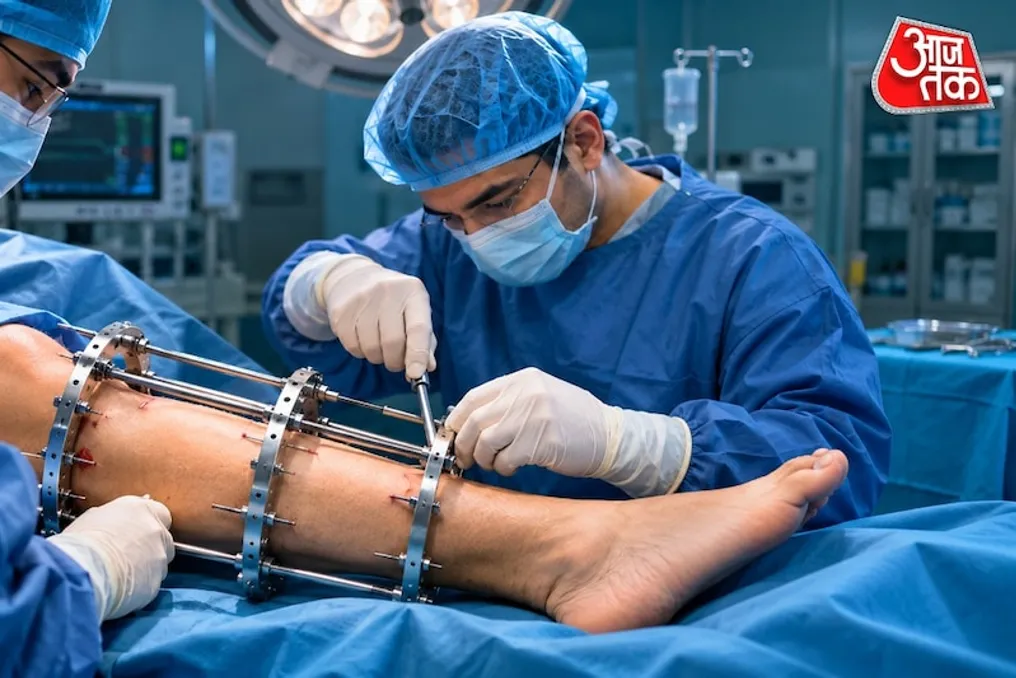
Currently, there is a growing interest in surgical height increase, thanks to advancements in medical science. However, experts emphasize that height-increasing operations are not a standard procedure and involve several risks that require prolonged caution from the patient. Nevertheless, the desire to look taller motivates people to undergo such operations, which include bone amputation.
In this regard, it is important to understand the level of safety of such procedures. Professor (Doctor) Rajesh Bhalla, a specialist in bone diseases from JMC Hospital in Delhi, provided detailed information on this issue.
According to Dr. Bhalla, height-increasing surgery involves lengthening bones using the Ilizarov technique. Initially, this method was used to treat patients whose bones did not heal properly after fractures or who had leg length discrepancies. Now, people seeking to increase their height also undergo this operation.
Dr. Bhalla explains that during this operation, the bone is first cut into two segments, and then a special apparatus is installed. This device gradually increases the distance between the two bone parts, with an increase of about one millimeter daily. As the bone segments separate, the body naturally begins to form new bone tissue in the created gap. Simultaneously, surrounding nerves, muscles, and other tissues have time to adapt to the increasing length.
For example, if a 5-centimeter increase in leg bone length is required, the gradual buildup process may take about 50 days, but this does not complete the treatment. After that, the newly formed bone needs about 100 days or even more to strengthen. Thus, the entire procedure for a 5-centimeter increase can take approximately five months or more, although this period depends on the patient's age, bone condition, and the body's recovery rate.
According to Dr. Bhalla's opinion, in some cases, the femur is planned to be lengthened by about 7.5–8 centimeters, and the tibia by 5–6 centimeters. When performing operations on both bones at different stages, there is potential to increase the total length by 12–15 centimeters. However, such a procedure is not considered safe for every patient. Possible complications include joint stiffness, muscle spasms, delayed bone healing, and the need for repeat surgeries.
Dr. Bhalla also notes that before starting the operation, it is crucial to understand the reason why the patient wishes to increase their height. It must be determined whether this is their own decision or if they are under pressure from someone else. Furthermore, the patient's bone strength should be tested, and their mental state assessed. If necessary, involving a psychologist is recommended.