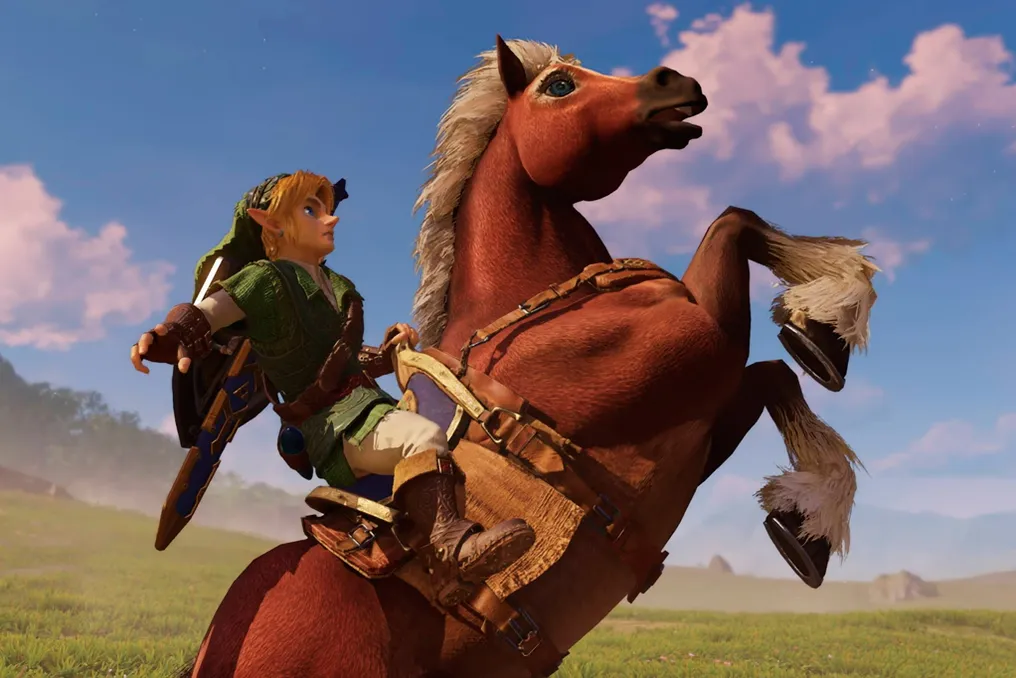
The Legend of Zelda: Ocarina of Time Remake arrives on Switch 2 with modernized graphics
Read more
Super Abril
super.abril.com.br

The Legend of Zelda: Ocarina of Time Remake arrives on Switch 2 with modernized graphics

The game The Legend of Zelda: Ocarina of Time, originally released in November 1998, had its initial review recorded by the Metacritic website, which was only created three years after its release. Although the site did not exist at the time, the team included the title's score, based on 22 journalist reviews, resulting in a notable rating of 99 out of 100.

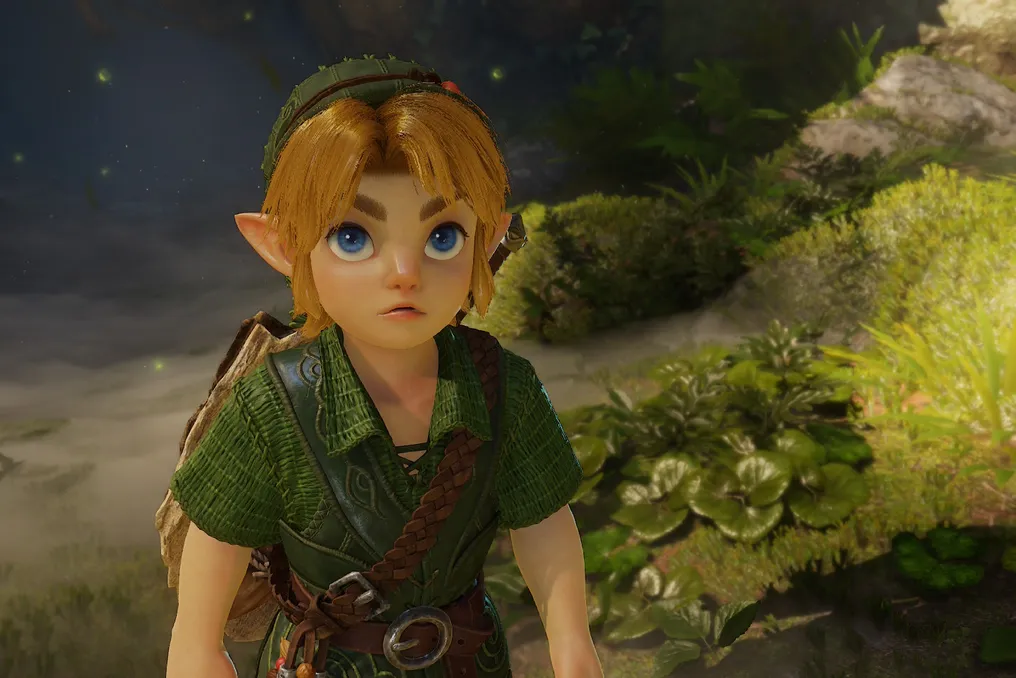
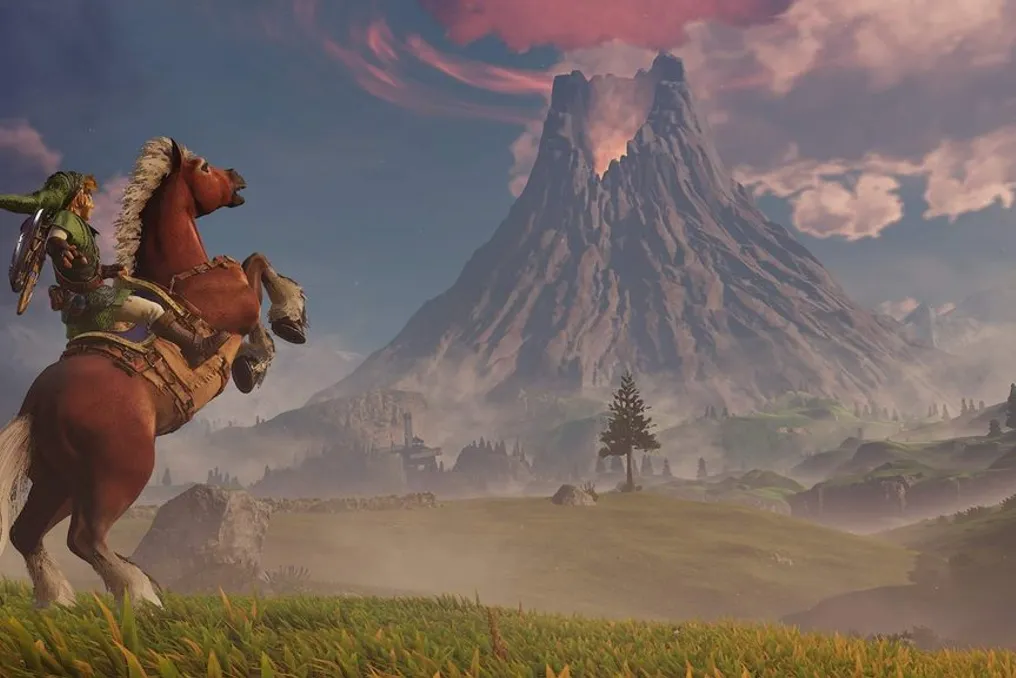
Nearly a quarter of a century later, the game's relevance remains evident. Nintendo has released a remake of Ocarina of Time, featuring updated graphics, which will be available this Thursday, the 5th, for the Switch 2 console. Even with the modernization, the game continues to make a strong impression.

Players can explore extensive and complex caves, collect various items, confront adversaries, as well as solve puzzles and disarm traps. The game maintains a difficulty progression that develops almost perfectly, managing to be simultaneously challenging and relaxing, characteristic of the Zelda series.

This title pioneered the presentation of three-dimensional environments, utilizing the processing power of the Nintendo 64, which was considerable for the time. The remake inherits this visual quality, although it presents some peculiarities. When playing on the Switch 2 connected to a TV, the graininess and flickering of details are noticeable, unlike in handheld mode, where this is less apparent. For example, the characters' hair may appear to vibrate when viewed up close.

These effects are consequences of the upscaling process, where the console runs the game in a lower resolution and uses artificial intelligence to increase image quality. This contrasts with Nvidia's DLSS technology, present in the Switch 2, which generally produces near-perfect results. However, these small flaws are quickly forgotten as the player becomes immersed in the narrative and gameplay.

Ocarina of Time is considered a fundamental element in the Zelda franchise timeline, offering important discoveries about its mythology. However, the story is accessible and well-told, allowing anyone to appreciate it without prior knowledge of the saga.

The remake also incorporates the motion sensors of the Switch 2, allowing the player to aim at enemies using projectile weapons just by tilting the controller. This functionality works well but offers the option to disable it to use the traditional aiming method with the analog stick.

It is important to note that Ocarina of Time does not possess the same depth or vast scale as more recent titles, such as Breath of the Wild (2017) and Tears of the Kingdom (2023). This limitation is inherent to 1990s technology. Despite this, the game remains excellent, being appealing both to those who follow video game evolution and to those who are simply looking for entertainment.

The release of The Legend of Zelda: Ocarina of Time is scheduled for this Thursday, the 5th, priced at R$ 329.90 for the Switch 2 console. It will also be available in physical format, costing R$ 439.90 on Amazon.

Similar stories

Nintendo explains that the remake of Zelda: Ocarina of Time aims for team evolution and franchise design diversity
Read more
olhardigital.com.br

Nintendo explains that the remake of Zelda: Ocarina of Time aims for team evolution and franchise design diversity

Nintendo detailed the reasons behind the creation of the remake of The Legend of Zelda: Ocarina of Time for the Nintendo Switch 2. According to Eiji Aonuma, the franchise producer, this project transcends the celebrations of The Legend of Zelda's 40th anniversary, which will occur in 2026.

In an interview published on Nintendo's official portal, Aonuma clarified that the decision is also linked to the development of the creative team itself. He mentioned that many professionals currently working on the franchise only participated in the most recent releases, such as Breath of the Wild and Tears of the Kingdom.

The initiative seeks to give developers the chance to analyze the architecture of Ocarina of Time, which was originally released in 1998 for the Nintendo 64, allowing them to understand its relevance to the overall identity of the series.

According to the producer, recreating Ocarina of Time provides the team with a moment to examine the design choices that were crucial in shaping the franchise. It is believed that revisiting the creation process of this classic can inspire new ideas for future The Legend of Zelda games.

The intention is not to discard the autonomy of the most current titles, but rather to understand how traditional components, such as narrative progression, exploration, and gradual player ability advancement, can enrich new gaming experiences.

Another purpose of the remake is to facilitate the connection between players who know the saga through Breath of the Wild and the classic structure of Zelda. While the most recent games offer complete freedom to explore and follow various paths from the beginning, Ocarina of Time presents a more focused journey, where new scenarios, abilities, and events are presented sequentially.

For Aonuma, this distinction represents an opportunity to present an alternative design approach that is also part of the franchise's trajectory. The remake of The Legend of Zelda: Ocarina of Time will be released on November 5, 2026, exclusively for the Nintendo Switch 2, as part of the series' 40th-anniversary festivities. Nintendo's statement regarding the reason for the remake was initially published on Olhar Digital.

Zelda Chronology: The Game Order Defined by Nintendo 25 Years After Franchise Launch
Read more
olhardigital.com.br

Zelda Chronology: The Game Order Defined by Nintendo 25 Years After Franchise Launch

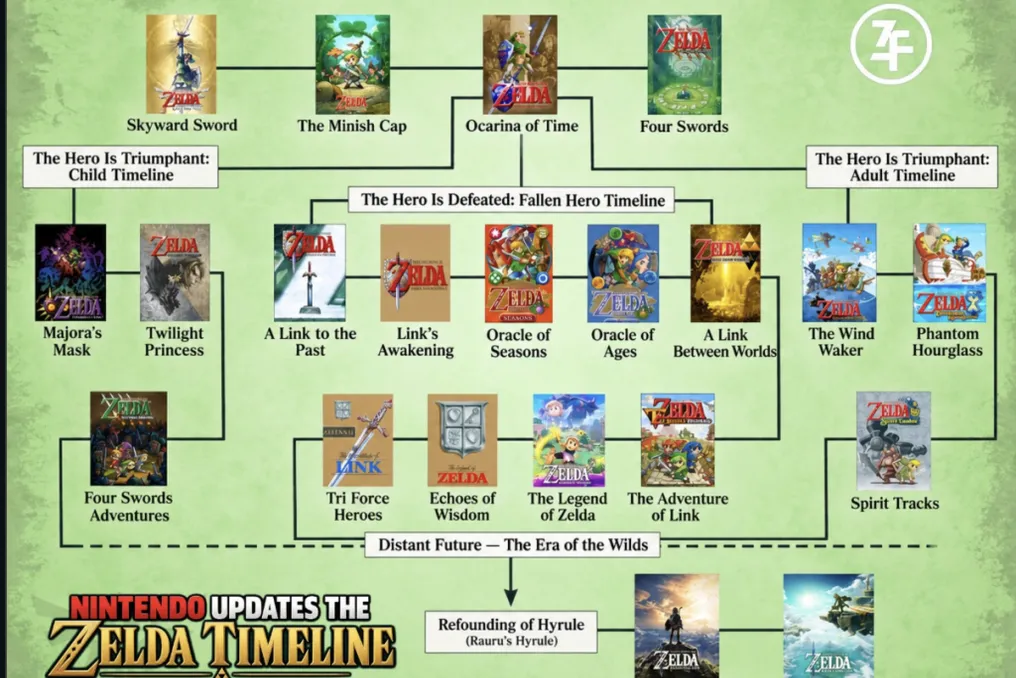
The chronological organization of The Legend of Zelda divides the games into three parallel timelines, all originating from Ocarina of Time. An important fact is that this sequence did not exist during the game development; it was formally released in 2011 through the book Hyrule Historia, when the franchise was already over 25 years old and had nearly twenty titles released.

This indicates that Nintendo did not conceive a complete saga and then segment it into games. On the contrary, the company produced the games over 25 years and subsequently organized everything into a coherent line, or not.

The game Skyward Sword, released in 2011, serves as the starting point for the narrative. The original 1986 title is found at the end of this timeline. Some games underwent minor script changes, known as retcons, to better fit the new structure. This chronological framework remains constantly updated, with its last modification occurring in September 2026, along with the announcement of the Ocarina of Time remake.

With the franchise reaching 40 years and the remake scheduled for November 5, 2026, it becomes relevant to understand how this complex structure is organized. However, this apparent confusion can be seen as a positive characteristic of the series.

Each Zelda title has its own complete story, with a defined beginning, middle, and end. This allows the player to start with Breath of the Wild, Ocarina of Time, or the most recent remake without needing to have played anything before, as the game itself provides the necessary information. There are few clear exceptions: Majora's Mask continues Ocarina of Time with the same Link, Tears of the Kingdom is a direct sequel to Breath of the Wild, and Phantom Hourglass succeeds The Wind Waker. Even in these cases, the subsequent game manages to stand on its own.

Although knowing the connections enriches the experience, there is a strong argument for those who play in release order, as this sequence allows players to experience revelations as they were planned. Imagining playing The Wind Waker in 2002, treating it as an ordinary cartoonish Zelda, and later discovering that ocean covers the Hyrule of Ocarina of Time, or finding a warrior skeleton in Twilight Princess that turns out to be the Link of Ocarina, dead unrecognized, are moments that lose impact when the player already knows the chronology.

In practical summary, it is recommended to play in whichever order is most enjoyable, using the chronology only as supplementary reading material, and not as an obligatory prerequisite.

The entire saga begins with a curse established in Skyward Sword: the Demon King Demise is defeated, but before dying, he pronounces that an incarnation of his hatred will eternally pursue those who carry the goddess's blood and the hero's spirit. This fundamental phrase sustains the entire franchise, explaining why the princess is always called Zelda, the hero is Link, and the villain always returns. It is not the same individuals, but rather the same three souls continuously reincarnating.

Four games occur before the narrative split: a young person raised in the forest discovers they are chosen by the goddess. Ganondorf, king of the Gerudo and incarnation of Demise's hatred, stages a coup to obtain the Triforce. Link extracts the Master Sword from the pedestal, but at only ten years old, his body cannot withstand the power, resulting in a seven-year sealing. Taking advantage of this opening, Ganondorf obtains the Triforce and divides it into three parts. Seven years later, Link awakens as an adult and becomes the Hero of Time, winning the conflict.

It is at this point that the story branches into three paths. Zelda sends Link back to the past so he can recover the lost seven years. Upon returning with his memories, he alerts the royal family, and Ganondorf is stopped before the initial coup. This is the world Link leaves when traveling through time: a world without a hero.

The third branch is the most peculiar, as it starts from a hypothetical scenario: what if Link had failed in the final battle of Ocarina? In this alternate universe, Ganondorf manages to gather the three parts of the Triforce. The Seven Sages manage to imprison him in the Sacred Realm, triggering the War of Sealing, which in turn corrupts into the Dark World.

A notable detail for collectors is the change in the order between Link's Awakening and the Oracle games. While Hyrule Historia (2011) placed them in a different order, the Zelda Encyclopedia (2018) inverted this sequence; the current updated order is the one in effect.

For years, it remained unanswered where Breath of the Wild and Tears of the Kingdom fit in. Neither was ever integrated into any of the three main branches. Tears of the Kingdom added complexity by revealing that Hyrule was founded by Rauru and Sonia of the Zonai race, which would imply the existence of two Ganondorfs: the Gerudo of Ocarina of Time on the surface and the original Ganondorf sealed underground. This question was never fully resolved.

In September 2026, after the 40th Anniversary Direct that presented the remake, the Japanese page of the game included a revised chart with a subtle yet crucial change: a second founding of the Kingdom of Hyrule, positioned immediately before the War of Sealing in Tears of the Kingdom, keeping the first founding at the beginning of the chronology, as always occurred.

The community's interpretation of this is that the Hyrule of Rauru represents a re-founding, occurring long before the classic chronology. The location simply resumed the name Hyrule, just as the hero always returns to the name Link.

In the source code of the same page, content creators identified the two games as a shared epilogue: the convergence point of the three branches. This idea was already defended by the series developers, suggesting that Breath of the Wild and Tears of the Kingdom occur so far advanced that the three lines have become legends, making it impossible to distinguish legend from history within the universe itself.

It should be noted that the expression

Zelda Remake: How revisiting the game can lead to the reunion of personal versions
Read more
super.abril.com.br

Zelda Remake: How revisiting the game can lead to the reunion of personal versions

The gaming industry uses nostalgia to create great anticipation around new releases. Among remakes and remasters, revisiting an adventure can be an opportunity to recover old memories.

The game The Legend of Zelda: Ocarina of Time will receive a new version for the Nintendo Switch 2 on November 5th. For those who experienced Hyrule in childhood, this return raises the question: what is expected to be found in that world after all the changes that have occurred in our lives?

In Ocarina of Time, this inquiry connects with a narrative that addresses themes of growth and return. Originally released in 1998 for the Nintendo 64, the title follows Link on a mission to protect the kingdom of Hyrule against the threat of Ganondorf. The protagonist must explore forests, villages, and temples, solving challenges to advance.

At a crucial point, by removing the Master Sword from its pedestal, Link advances seven years and awakens older, allowing him to travel between the two eras. While the character in the game travels through time, the player perceives the time passed outside of it, although the ability to return to the game's initial state is considerably more difficult.

Growing up and finding the transformed world

Upon waking up seven years later, Link discovers that Hyrule has been altered by Ganondorf's dominion. Familiar locations present new conditions of existence, and this familiarity intensifies the perception of change. The player can make comparisons, which is possible due to environmental recognition. If everything were completely unknown, it would just be discovery; but since part remains, there is a chance to notice a loss.

The game's manual emphasizes the metamorphosis of Hyrule during this period and the consequences of childhood actions in adulthood. This can be interpreted as a metaphor for the experience of maturing. A childhood setting still exists, but its physical presence does not guarantee that it can be inhabited as before. People evolve, relationships change shape, and the visitor themselves develops unprecedented concerns.

In the game, this alteration is presented drastically. In real life, this often becomes evident upon returning: the comparison reveals the transformations accumulated over the years. The option to switch between ages generates a philosophical tension. Link returns to a previous moment, retaining, for the player, the knowledge acquired later. Although the action may restore a configuration of the world, the player's experience already incorporates what happened in the other era. Furthermore, when replaying, we discover paths that previously required exploration, and this knowledge alters the nature of the journey. A known route may bring comfort, but loses the original surprise; the return gains meaning in this difference.

The uniqueness of a first time

Remembering how a game works differs from evoking the moments lived during gameplay. When resuming Ocarina of Time, one can identify commands, predict solutions to puzzles, or traverse paths easily. However, one can also recall a specific occasion in that setting, who was present, or how one felt upon discovering something after a playthrough. Familiarity with the game and the memory of its presence in our lives may approach each other, but one does not necessarily imply the other.

This distinction helps in understanding why repeating a playthrough can generate unexpected feelings. We know the path, but we miss the person who walked it with us. We recognize the music and remember a time with different concerns. The setting remains accessible, but the circumstances that gave the first experience its special character have changed. Even reproducing every movement, the encounter occurs at a different moment in our history.

The years passed also alter what we can grasp from the work. A scene once seen as a mere stage of the adventure can gain new weight after experiences of separation or major changes. By following Link in a modified world, someone returning to the game in adulthood may recognize issues ignored in childhood. Prior experience influences this reading, along with everything lived after it.

From this point arises a paradox of return: the more we recognize a passage, the greater we perceive the distance separating us from the first time. Nostalgia can emerge from this closeness to something dear and the awareness that its original conditions remain in the past. Returning to the game allows us to revisit a valued experience and observe how our relationship with it has transformed. Hyrule remains available, and the reunion with its landscapes can aid in understanding the course of our own lives.

What science shows

A meta-analysis study, published in 2026 by Evan Weingarten of the University of Southern California, USA, analyzing over 400 experiments on the triggers and benefits of nostalgia, indicated that psychological threat situations can provoke nostalgia, and that this emotion can contribute to well-being.

The explanation presented in the article is that recalling personally significant events provides resources to cope with current challenges. In scenarios of loneliness or loss of purpose, for example, memories of shared experiences can restore feelings of connection and belonging to one's own story. The individual finds again, in memory, bonds and experiences that remain valuable to them. This process helps understand why a difficult situation in the present can evoke longing for past moments. However, the benefits vary according to individual characteristics and the way nostalgia is evoked.

Also in 2026, Michael Mask of the University of British Columbia, Canada, released two experiments demonstrating that remembering a nostalgic experience can increase the perception of the psychological richness of one's own life. The results indicate that people who write about a nostalgic memory tend to evaluate their trajectory as richer in interesting and diverse experiences capable of changing their worldview, compared to those who wrote about an everyday event.

The main factor highlighted in the findings was the atypical nature of the recalled episodes: nostalgic memories drew attention to events that differed from routine. By recovering them, participants evoked experiences that made their story more varied and meaningful, favoring a new appreciation of what has already been lived, including its emotional complexity.

Returning with the life that continued

These results suggest that the value of a memory can encompass the complexity of what it makes us perceive. In the context of Ocarina of Time, the satisfaction of recognizing a setting can coexist with the awareness of time passed. The memory of playing with someone can be both affectionate and painful. The same game allows these nuances to coexist, without requiring the past to be portrayed as an entirely happy period.

By navigating the eras, Ocarina of Time allows us to experience the nostalgia of a fiction about transformation, where knowing a place implies perceiving what happened to it. Upon encountering the game again after years, this perception can be applied to one's own life trajectory. The distance between play sessions becomes part of the work's experience.
Popular