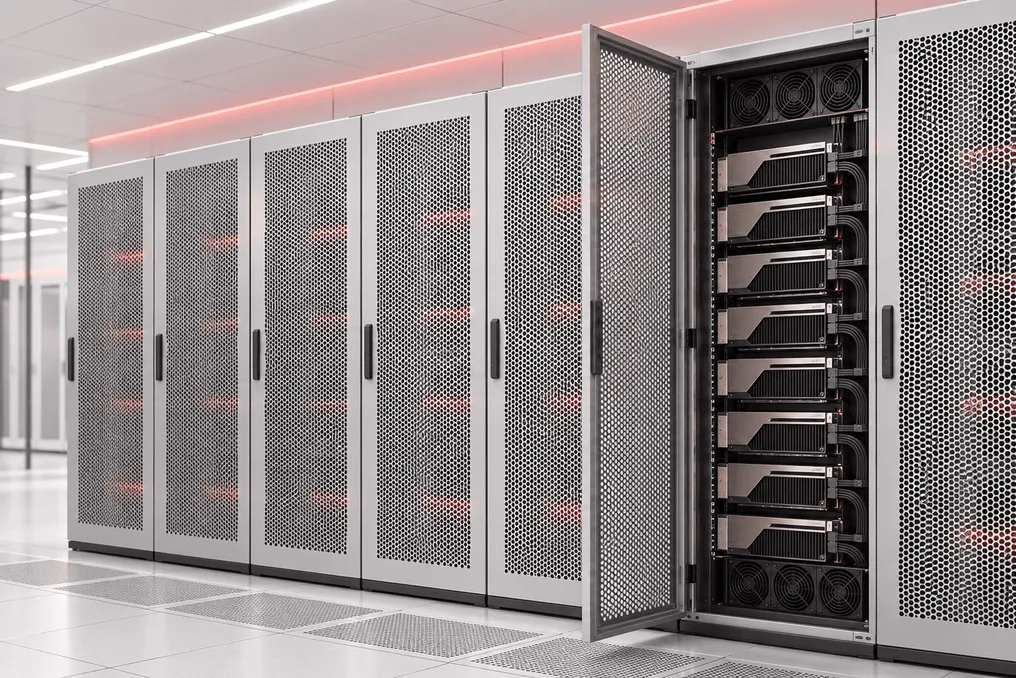
Beijing-based AI company HongYun has unveiled HyperLM V2.5, a new version of its platform for combined training and inference of large models. This was reported by IT Home and ifeng Tech on November 3rd. The company claims to be the first to achieve deep adaptation to the Huawei Ascend 950DT chip, full compatibility with the air-cooled Atlas 850E SuperPoD system, and successful technical certification from Huawei for Ascend Native.
HongYun believes that defining support is often too vague, where a model is only considered supported after installation and token generation. The company aims to assist government and enterprise clients using private deployments in achieving maximum performance from new accelerators.
The company describes the Ascend 950DT as a flagship chip for high-throughput tasks such as extended chat interactions, processing long documents, and continuous agent reasoning. Furthermore, it is noted that the air-cooled Atlas 850E system can be integrated into existing data centers without requiring infrastructure upgrades.
HyperLM V2.5 adapts at multiple levels. At the interconnect level, the platform supports Huawei's UnifiedBus 2.0 technology, which provides a system interconnect bandwidth of 13.4 TB/s, preventing bottlenecks during traffic transfer between cards—a crucial factor for long contexts or splitting prefill and decoding stages. At the operator level, the system is optimized for mxFP4 inference, enabling 14.2 PFLOPS per node.
The platform supports the latest open-source models, including Qwen, GLM, and DeepSeek, and its scheduler has been rebuilt considering the memory profile and throughput of the 950DT.
The release of HyperLM V2.5 includes five new features. Prefill and decoding splitting allows the two stages to be isolated into independent resource pools so they do not compete during peak loads. Multi-level KV caching reuses system prompts, frequently encountered contexts, and fixed session templates to reduce redundant computations. vNPU virtualization segments the Ascend 950DT, 910C, and 910B chips, providing granular quotas and isolation for AI Core computation and HBM memory, and also supports hot migration and automatic rescheduling upon hardware failure.
A unified gateway model, compatible with the OpenAI protocol, has also been added, which manages routing, rate limiting, beta releases, and A/B testing. Comprehensive monitoring across the entire stack tracks load, memory usage, throughput, latency, and QPS, providing alerts and automated fault localization.
For regulated industries such as government administration, energy, transportation, and finance, the platform provides role separation for administrator, security officer, and auditor, multi-level classification control, complete operation logs, and tracking of computational resources, model call audits, and usage statistics per project.
HongYun was incubated by the Western Institute of Computing Technology of the Chinese Academy of Sciences, and its core team consists of employees from the Institute of Computing Technology and Sugon. In 2020, the company joined Huawei's Ascend partnership program. The company plans to continue development based on Ascend and Hygon DCU hardware, focusing particularly on heterogeneous scheduling, inference acceleration, caching, and agent applications.