A couple turned 2.5 acres of land into a guesthouse while growing their own food
Read more
The Better India
thebetterindia.com

A couple turned 2.5 acres of land into a guesthouse while growing their own food

In 1994, during a trip through the hills of Aravalli near Udaipur, Major Durga Das and his wife Jyoti Jaso started dreaming of a home in the region. They acquired a plot of land measuring 2.5 acres, but the land proved unsuitable for habitation.

Jyoti recalls: 'When we first visited the land, we only saw cacti. The land did not support the growth of anything else.' At that time, Major Durga was serving in the army, and Jyoti managed the Textile Gallery in the Citadel. She notes that both felt their lives were not being used creatively.

After 13 years of military service, the Major decided to leave the armed forces to focus on developing this land. He viewed this place (Devra) as an opportunity to raise a generation deeply aware of the environment.

The initial plan was to grow flowers for the Taj Palace in Udaipur. When this business failed, the couple moved to Delhi in 1997. Nevertheless, Jyoti's dream of creating a guesthouse remained with her.

In 1999, Jyoti returned to Udaipur to give her dream a second chance. She traveled between Delhi and the plot for many years, establishing connections with local artisans before Devra began hosting guests in 2004.

Local craftsmen helped bring the vision to life. Shivji participated in the construction of the structure, and his wife Rupa Bai continues to work at Devra, observing the changes in the guesthouse and the town.

What started as a three-room space evolved into a historic ten-bedroom guesthouse built from Rajasthani stone. However, before fields could flourish around it, the couple had to find a way to revitalize the soil.

To help the land grow, they brought nutrient-rich loam soil from Pichola Lake when it dried up in the summer. Along with this, they began planting trees and gradually improving the once barren plot.

Devra grows wheat, seasonal vegetables, sorghum, mint, and various fruits. They harvest chickpea, and a significant portion of the guesthouse's produce comes from their own land. Guests can attend Jyoti's cooking classes, visit neighboring villages, and experience local life. Jyoti shares that 'The whole village is needed. But God is good, and dreams come true,' reflecting on the journey of Devra.

Similar stories

Ten Ways to Use Every Part of the Banana Plant, From Leaves to Fibers
Read more
thebetterindia.com

Ten Ways to Use Every Part of the Banana Plant, From Leaves to Fibers

The study '1 Plant, 100 Uses' examines numerous applications of familiar Indian plants, including leaves, fruits, and trees, which are used in daily life—from culinary arts and agriculture to traditions and natural remedies.

In many Indian homes, the banana plant is a common sight. People purchase its fruits at local markets, and the leaves are used during festivals and family gatherings. However, the potential of this plant extends far beyond what is typically seen in kitchens.

Farmers and artisans have found ways to utilize parts that often remain after harvesting. Some of these parts are part of Indian culinary traditions spanning generations, while others help transform agricultural waste into useful products.

Below are some examples of how the banana plant is used across India.

  1. Ripe bananas serve as a simple snack. They are consumed throughout India as a snack or with breakfast. They are convenient to carry and can be eaten raw once ripe.

    Fruits are also used to create longer-lasting products; for instance, the ICAR banana research center documents the processing of bananas into products such as juice and banana-fig. Banana pulp is also suitable for making jams and other dishes.

  2. Unripe bananas are a staple in the kitchen. They are prepared at home across India, added to curries and dry vegetable dishes, and used for fried snacks.

    In Kerala, unripe bananas are popular for making favorite banana chips, especially the Nendran variety. Unripe bananas can also be dried and ground into flour for various food items.

    The Indian Council of Agricultural Research has documented methods for processing bananas into products with an extended shelf life, which helps reduce losses when fresh produce cannot be sold or consumed in time.

  3. The banana flower is cooked as a vegetable. The purple flower hanging beneath the banana bunch is used in various regional cuisines. After removing the outer bracts, the small flowers can be cleaned and cooked in curries and stir-fries.

    Dishes made from banana flowers are found in the southern and eastern parts of India. The flower can also be used for making marinades. The ICAR banana research center has documented a banana flower marinade as a value-added product.

    Preparing the flower requires time, as the flowers must be cleaned individually. However, in families where this is a familiar ingredient, it is usually part of cooking using this plant.

  4. The tender inner stalk is edible. The part commonly called the banana stem is actually a pseudostem, composed of tightly packed leaf sheaths. A tender core is located in the center, which is used in cooking.

    In South India, this core is sliced and cooked as a vegetable. It is also used in juices and other dishes. The ICAR banana research center has documented products such as candies and pickles made from the central core.

    Using the inner core for food provides households with another way to utilize the plant after its fruit harvest.

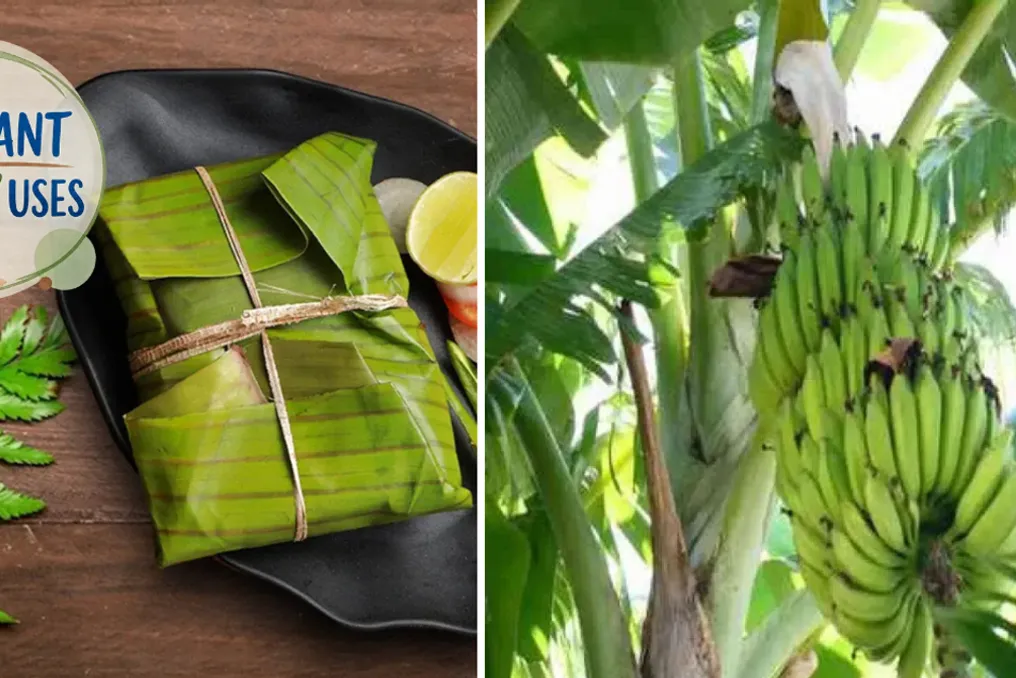
  5. Banana leaves are used for serving food. A common sight in many parts of South India is a meal served on a banana leaf. The wide leaf accommodates rice and various side dishes and is widely used at weddings and festivals.

    Leaves are also used for packaging certain products and serving dishes at public gatherings. Their size makes them convenient for serving a full meal on one surface.

    Leaves hold a place in both traditional culinary practices and everyday hospitality. Their application varies depending on the region and occasion.

  6. The pseudostem is turned into fiber. After harvesting the banana bunch, the pseudostem is cut. Instead of letting all this material go unused, farmers and entrepreneurs can process it to extract natural fiber.

    The ICAR banana research center has documented the technology for processing banana fiber and its transfer to an entrepreneur in Uttar Pradesh. The fiber can be used to make ropes, clothing, as well as mats and carpets. Bags and baskets are other possible products.

    Processing the pseudostem requires equipment and suitable conditions. Where possible, the material can become a source of raw material for small businesses.

  7. Banana fiber is used in crafts. Fiber extracted from the banana plant material can be used to make items such as table coasters and cushion covers. These items offer another use for material left over after harvesting.

    In January 2024, the ICAR banana research center organized a workshop in Tamil Nadu on banana fiber crafts and value addition. The goal of the program was to train women in skills that could be used to create items from banana peel and its byproducts.

    The ICAR report on the program describes this initiative and its focus on developing craft skills. For those with access to training and buyers, such work can provide an additional source of income.

  8. Banana peels do not necessarily have to be thrown away. Peels are usually discarded after the fruit is eaten. Nevertheless, they can be used in food processing and composting.

    The ICAR banana research center has documented a banana peel marinade as one way to use this part of the fruit. At home, peels can be chopped and added to a compost heap along with other kitchen waste and dry material.

    As the organic matter decomposes, it becomes part of the compost. This is a practical option for households that grow plants or maintain a garden.

  9. Banana plants are used during ceremonies. Banana plants are often used for decoration at entrances and ceremonial spaces during weddings and religious events in different parts of India. Their green leaves and vertical pseudostems are a familiar part of these arrangements.

    The plant is associated with auspicious occasions in many communities. Specific customs vary across regions, but banana plants continue to participate in traditional celebrations.

    Their role during these events differs from their use as food or raw material. They are part of how families celebrate important occasions.

  10. Banana residues can be used on farms. Banana harvesting leaves behind a significant amount of plant material. The pseudostem and other suitable residues can be considered for composting or other forms of farm use instead of simply being discarded.

    Research published through the Indian Council of Agricultural Research discusses the parts of the banana plant and their place in integrated farming systems.

    The best use depends on the farm and available resources. Some farmers may supply material to fiber processors, while others may find composting more practical.

Utilization of Residues

The banana plant serves various functions in different parts of India. Its fruits and flowers are cooked at home, and its leaves are used for serving food. These applications also provide farmers and small businesses opportunities to derive greater value from the harvest. With appropriate processing and local demand, the remaining parts of the plant can become useful materials.

How to use eggplant peels: 5 beneficial ways for health and home
Read more
www.aajtak.in

How to use eggplant peels: 5 beneficial ways for health and home

When cooking dishes with eggplants, such as ragout or bharta, the peel is often discarded, considered useless waste. However, it is known that eggplant peels contain a large amount of antioxidants, vitamins, and nutrients that can be very beneficial for health, skin, and houseplants.

Next time you slice eggplants, do not throw away the peel. By collecting it, you can use it in various effective ways. Below are five wonderful and effective methods for using eggplant peels.

Five excellent ways to use eggplant peels

Organic fertilizer for plants: Eggplant peels are rich in potassium, iron, and many minerals. They can be dried and ground in the sun or simply buried in the soil, which will provide excellent nutrition for plants and help them grow faster.

Removing spots and tanning from skin: The inner part of the eggplant peel is considered very beneficial for the skin. By easily crushing the peel and rubbing it onto the face or affected area, you can reduce the effect of tanning and dark spots.

Shine and deep conditioning for hair: If you boil eggplant peels well in water, washing your hair with this water will give it a natural shine and eliminate dryness.

Restoring shine to kitchenware: To restore shine to dishes, you can boil eggplant peels and add a little lemon and salt to the water. Washing copper or brass pots with this water will help them shine, even with stubborn stains.

Natural compost for the home: As part of household waste management, eggplant peels should be added to the composting container along with the peels of other vegetables. It decomposes quickly and provides excellent homemade fertilizer.

Political dynamics related to agriculture and social factors are being decided in Bijaur
Read more
www.aajtak.in

Political dynamics related to agriculture and social factors are being decided in Bijaur

The Bijaur district, situated on the banks of the Ganges, is known for its greenery, sugarcane cultivation, sugar mills, and historical attractions. Due to beliefs associated with Mahatma Vidur, it is also called 'Vidur Bhumi'. To understand the political situation here, it is necessary to consider the agricultural sector, social relations, and the results of past elections.

Bijaur is predominantly an agricultural district where sugarcane, wheat, and rice are grown on a large scale. Sugarcane production plays a vital role in the district's economy. In addition to sugar mills, oil presses and sugar mills operate in the rural areas, which are part of the local business and provide employment. Issues such as fair crop prices for farmers, payment delays, farming costs, and irrigation are of great importance. These issues affect the income of rural families, so agrarian problems often become subjects of political discussion during elections. To understand the politics of the district, it is important to observe how different parties highlight the problems of farmers and local needs.

Bijaur's geographical location also makes it unique: its borders adjoin districts of Uttarakhand. Thanks to the abundance of greenery and agricultural land, most of the district retains a distinct rural lifestyle. Compared to the capital of Uttar Pradesh, Lucknow, Dehradun is relatively closer to this district.

The history and religious identity of Bijaur are also distinctive. There is a belief that during the Mahabharata era, Mahatma Vidur left Hastinapur and settled here. The place where his hut is believed to have been on the banks of the Ganges is known as Vidur Kuti, and it is located about 10 kilometers from the town of Bijaur. The district is also known for numerous historical and religious sites, including Kanva Ashram, Vidur Kuti, Najibuddal Fort, Parsanat Fort, and the Dargha-e-Aliya Najfe-Hindu Mosque in Jogirampur. These places demonstrate the historical and cultural diversity of Bijaur.

According to the 2011 census data, the population of Bijaur was approximately 36.08 million people. A significant number of both Hindus and Muslims reside in the district. According to available information, the Hindu share is about 55 percent, and Muslims are about 45 percent. Among Hindus, there is also a significant proportion of Dalit community members. Furthermore, the influence of communities such as Jat, Chauhan, and Tyagi is noted in different parts of the district. Muslim voters also play an important role in the electoral equations of the district.

Bijaur has eight constituencies: Bijaur, Chandpur, Nurur, Dhampur, Badhapur, Nagina, Najibabad, and Nahatur. The Nagina and Nahatur constituencies are reserved for Scheduled Castes. In the 2022 legislative assembly elections, the competition in the district was between the Bharatiya Janata Party (BJP) and the Socialist Party (SP). Both parties secured four victories each. The difference in votes also varied depending on the constituency. For example, in Chandpur, Swami Omvesh of SP defeated Kamlesh Sani of BJP by a margin of 234 votes. In Dhampur, Ashok Kumar Rana of BJP defeated Naim Ul Hasan of SP by a margin of 203 votes. In Nagina, Manoj Kumar of SP defeated Dr. Yashwant Singh of BJP by a margin of over 26 thousand votes. In Najibabad, Taslim Ahmed of SP defeated Rajaarendra Singh of BJP by a margin of 23,770 votes. In Nahatur, Omkumar of BJP defeated Munsiram of Ralod by a narrow margin of only 258 votes. In Nurur, Ram Avatar Singh of SP beat Chandra Prakash of BJP by a margin of 6,065 votes. In Badhapur, Kunwar Sushant Singh of BJP defeated Kapil Kumar of SP by a margin of 14,345 votes. In Bijaur, Suchi of BJP defeated Niraj Chaudhary of Ralod by a margin of 1,445 votes. These results show that the vote difference was quite small in constituencies like Chandpur, Dhampur, and Nahatur, whereas SP candidates achieved convincing victories in Nagina and Najibabad, reflecting the differences in the district's political landscape.

A comparison of the 2017 and 2022 results showed a change in the electoral equations. In the 2017 elections, the BJP won six out of eight constituencies in the district: Bijaur, Chandpur, Nurur, Dhampur, Badhapur, and Nahatur; representatives of the SP won in Nagina and Najibabad. Subsequently, by-elections were held in Nurur, where Naimul Hasan of SP won after the death of a BJP MLA in a road accident. Comparing the 2017 and 2022 results demonstrates a shift in the district's politics: the BJP, which won six seats in 2017, reduced to four in 2022, while the SP captured four seats. This contrast indicates that the electoral equations in Bijaur are not constant and can change depending on the elections.

Another picture was observed in the Lok Sabha elections. Bijaur has two Lok Sabha constituencies: Bijaur and Nagina. In the 2019 elections, the BSP-SP coalition succeeded in both constituencies. Maluk Nagar from BSP and Girish Chandra from Nagina were elected as MPs from BSP. However, the results changed in the 2024 elections. In the Bijaur constituency, Chandan Chauhan of the National People's Party defeated Dipak of SP. Meanwhile, from the Nagina constituency, Chandra Shankar of the Azad Samaj Party (Kanshiram) won.

Popular