Peppermint Robotics raises 100 crore rupees in pre-Series B round
Read more
YourStory [india, en]
yourstory.com

Peppermint Robotics raises 100 crore rupees in pre-Series B round

Peppermint Robotics, a company that manufactures autonomous cleaning robots, has successfully raised 100 crore rupees (equivalent to approximately 10.5 million US dollars) in a pre-Series B round. pi Ventures, Crane Venture Partners, and Asiana Fund participated in this round.

The funds were raised amid the company's rapid growth. The startup, based in Pune and Austin, reported that its revenue doubled over the last year, and overall growth between fiscal years 2024 and 2026 reached almost six times. Previously, in April 2025, Peppermint had raised 34 crore rupees ($4 million) in a Series A round.

Peppermint has representatives in nine countries, with the US being its largest market. The company was founded in 2019 as part of the Society for Innovation and Entrepreneurship at IIT Bombay. The autonomous cleaning robots created by the company are used in various commercial and industrial environments, including hospitals, airports, shopping malls, warehouses, hotels, factories, and universities.

The company's machines are designed for floor cleaning and material transport in enterprises, engineered to integrate into existing workflows rather than disrupt them. Peppermint's main clients are facility management companies that oversee cleaning processes, including the selection of equipment, chemicals, and cleaning methods.

Peppermint stated that one of the most challenging applications for its robots is a global pharmaceutical company. There, cleanroom robots underwent qualification testing in an EU GMP class cleanroom, which is one of the most strictly regulated environments where a cleaning robot can operate.

Cleanroom robots are specialized manipulators designed to operate in controlled, contamination-free conditions. The company independently develops the hardware, software, and perception systems, while the robots are assembled in Pune. They function on the patented Peppermint OS, utilizing computer vision and LiDAR for spatial mapping, route planning, and collision avoidance. Operators can monitor the robots' performance in real-time via a cloud control panel. For high-security facilities, the company offers fully autonomous 'invisible' robots that comply with strict information security requirements.

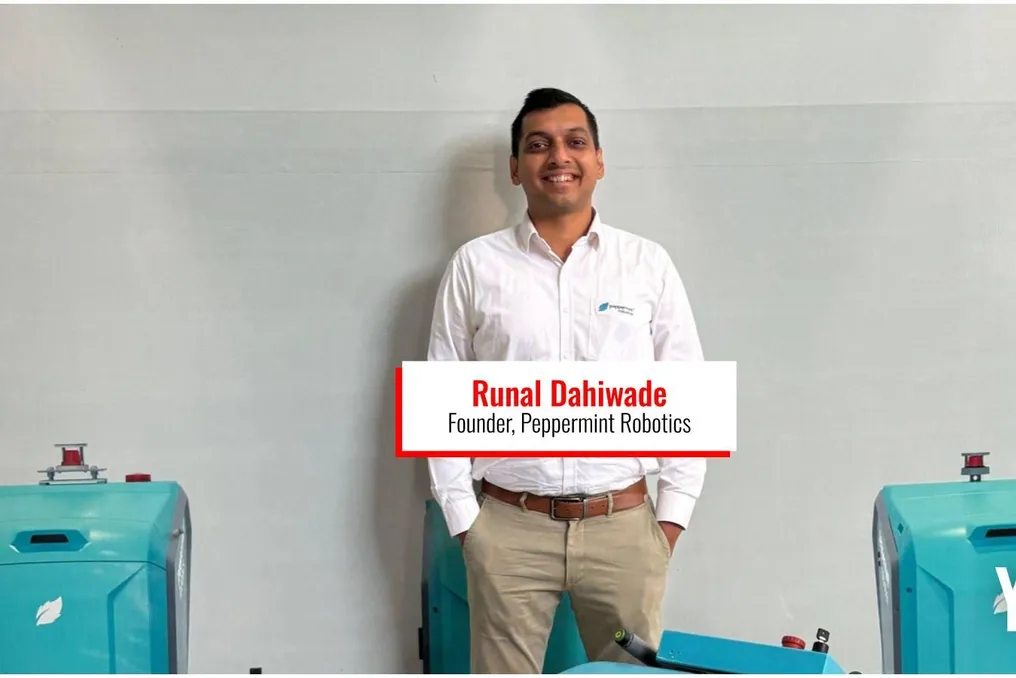
Runal Dahivade, founder and CEO of Peppermint Robotics, noted that cleaning teams ensure the functioning of hospitals, factories, and airports. He emphasized that their robots work alongside these teams, taking on the most monotonous and physically demanding tasks, such as mopping floors and transporting materials. According to Dahivade, clients evaluate the company based on one criterion—the cleanliness of the floor per shift. Therefore, the company builds durable robots designed for multi-year operation and supports each machine throughout its entire lifecycle. The capital raised will allow them to produce more robots and get closer to customers worldwide.

The new investments will be directed towards developing next-generation robotics and expanding production capacity. Furthermore, a final assembly line is planned for North America in the coming months. Peppermint also intends to strengthen its business development in the United States and Asia, increase its presence in Europe, and hire senior executives and engineers. In terms of products, the company plans to expand its range of floor cleaning and material handling robots, as well as develop its cleanroom robot line.

Investors expressed optimism about Peppermint's potential. Shubham Sandip, a partner at pi Ventures, highlighted the company's 'clear return on investment' in demanding sectors such as healthcare and hospitality. Anandamoy Roychoudhury from Crane Venture Partners stated that Peppermint has developed an industrial cleanroom robot for critical enterprises. Neha Aggarwal from Asiana Fund called the company an example of India's advanced manufacturing business capable of competing in global markets.


Similar stories

GenRobot AI startup specializing in robot training data raises $100 million in Series A+ funding round
Read more
technode.com

GenRobot AI startup specializing in robot training data raises $100 million in Series A+ funding round

GenRobot AI, a Beijing-based company that provides data infrastructure for robot development, has successfully closed a Series A+ funding round totaling $100 million. This financing closure occurred in the third quarter of the year, as announced on November 2.

Investors participating in the funding round included SAIC Motor, Eastworlds from Malaysia, Baidu, Shoucheng Holdings, and Galaxy General Robotics. Additionally, financial investors included GL Ventures, CITIC Goldstone, CCB International, and Huatai Zijin.

GenRobot AI is engaged in creating software and hardware for collecting demonstrations of human actions, which are subsequently used to train robots. The company's recording systems capture visual information along with hand and body movements when performing tasks in daily life, manufacturing, and logistics. Subsequently, the company's Matrix platform synchronizes, cleans, and labels these recordings, providing robot developers with the necessary data for training and evaluation.

Startup MoSense, developing electronic skin for robots, raised nearly 100 million yuan in an angel-plus round
Read more
technode.com

Startup MoSense, developing electronic skin for robots, raised nearly 100 million yuan in an angel-plus round

MoSense, a Shanghai-based startup specializing in developing tactile sensing systems for robots, successfully raised nearly 100 million yuan in an angel-plus round.

The leaders of this round were CDH Investments and Oasis Capital. Other participants in the investment included LimX Dynamics, Loongson Venture Capital, CAS Star, Hua Capital, and Pudong Venture Capital Group.

The company was founded in May 2026 by a team with education from the Hong Kong University of Science and Technology. MoSense is engaged in creating electronic skin and algorithms that allow robots to sense physical contact.

The MoSkin hardware integrates sensors directly into structural elements, while the MoTact system is responsible for processing tactile signals. Currently, the company is collaborating with robot manufacturers to implement its technologies and is working on developing MoWorld—a model designed to improve robot motion control using tactile feedback.

Reliable Robotics raises $115 million to advance autonomous aviation
Read more
ventureburn.com

Reliable Robotics raises $115 million to advance autonomous aviation

Reliable Robotics has secured $115 million in funding for the further development of autonomous aircraft technologies. The Mountain View-based company announced the funding on October 20th. This injection increases the Series D round total to $275 million and values the company at over one billion dollars.

Nimble Partners led this venture financing round as a repeat investor. Additionally, the round includes $90 million in equity capital and $25 million in a term loan from Silicon Valley Bank. New investors participating in the funding include Gideon Strategic Partners, Rock Creek, Geek Ventures, Gold Hill Capital, and Sparkwave Capital. Island Green Partners also invested again.

The company has now accumulated over $380 million in equity financing. Plans include expanding its fleet of aircraft and manufacturing capabilities. The funds will also be used to accelerate hiring engineers and advancing technological development. Crossing the billion-dollar valuation threshold is a significant achievement.

Reliable Robotics' core technology combines the Reliable Autonomy System with a proprietary radar. This system is designed to manage aircraft operations from gate to gate. Its capabilities include taxiing, takeoff, flight control, and landing.

The technology aims to minimize serious risks in aviation, such as loss of control and controlled flight in rugged terrain. Safety is ensured through high-precision navigation, automated flight control systems, and support for four-dimensional flight planning.

Reliable is pursuing Federal Aviation Administration (FAA) certification for commercial operations on the Cessna 208B Grand Caravan. The first phase involves implementing a continuous autopilot system. CEO Robert Rose expects to receive this certification within 18–24 months.

A later phase will allow pilots to operate aircraft from ground control stations. Rose forecasts that approval for this stage will take at least three years. Furthermore, the company is developing a solid-state radar intended to improve collision detection, and Rose anticipates radar certification by the end of 2027.

Reliable Robotics is exploring opportunities in both commercial and military aviation. The company has secured contracts with several US Armed Forces units and completed several flightworthiness verification processes for military purposes with the USAF. The company's participation in the FAA's Air Mobility Pilot Project supports pre-certification operations. These flights will involve cargo delivery to small towns in New Mexico and Colorado. The program allows for demonstrating the technology in real operational conditions.

These activities provide practical experience alongside certification efforts. The company's technology is designed for use on existing aircraft, not for creating entirely new airframes. This approach may lower barriers to technology adoption if regulators approve commercial use.

John Warburg, founder of Nimble Partners, noted that the potential extends beyond creating a single autonomous aircraft. He believes this technology could ultimately support various types of aircraft. However, widespread adoption will depend on certification results and operational reliability.

The new funding will be directed toward accelerating the company's growth phase. Reliable Robotics has opened new offices in Seattle, Washington, and San Diego, California, while maintaining operations in Mountain View, San Martin, and Albuquerque. The company currently employs over 250 people and will continue to hire staff in the engineering department, as well as opening a radar center of excellence in Seattle. Moreover, increased production capacity will allow the company to meet its growing aircraft order book.

Although certification timelines may affect the pace of commercial deployment and revenue generation, the expanded funding provides additional resources for engineering and operational development.

Popular