Five Factors Supporting Indian Stock Market Growth Despite Downturn in the US
Read more
Aaj Tak
www.aajtak.in

Five Factors Supporting Indian Stock Market Growth Despite Downturn in the US

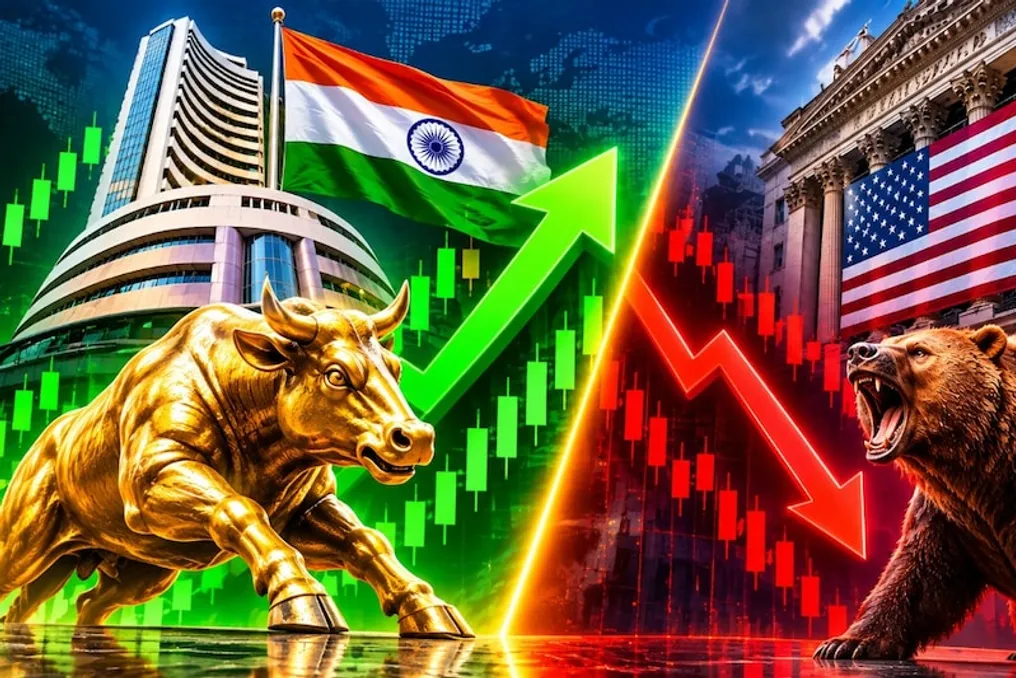
The Indian stock market has shown unexpected growth, demonstrating a steady trend for five consecutive days. During this period, the Sensex index increased by approximately 4000 points, corresponding to a rise of over 5%. Meanwhile, American markets are showing declines: the Nasdaq index fell by almost 5% over five days and decreased by 10% in a month, which is technically classified as a 'bear market' phase.

This raises the question of what caused such a recovery in the Indian market, as previously any increase in pressure on the American market negatively affected India, such as during the conflict between the US and Iran, when the market dropped by more than 15%. However, the market is now trying to stabilize, ignoring external shocks.

A partial support for the market was provided by the decrease in crude oil prices, although this is not yet enough to form a full rally. Corporate reports added further stability. Nevertheless, analysts believe that the most significant positive signal was the announcement by Finance Minister Nirmala Sitharaman regarding the consideration of reducing the Long Term Capital Gains (LTCG) tax. This potential supportive measure strengthened investor confidence.

Thanks to efforts to reduce tensions and attempts at reconciliation between the US and Iran, there is a noticeable drop in crude oil prices in the international market. Since India imports a significant portion of its energy needs, easing oil prices could be a substantial stimulus for the Indian economy.

Although high crude oil costs previously put pressure on the government budget, the government is being aided through the collection of GST. In October 2026, GST collection in India reached 2.31 lakh rupees, which is 22.9% higher compared to the previous year. For the first seven months of the current fiscal year (April-October), total GST collection amounted to 14.78 lakh rupees, exceeding the figures for the same period last year by 13.2%.

This data indicates the maintenance of a high pace of domestic trade, production, and consumption. Strong GST revenue helps the government control the budget deficit, thereby strengthening India's credit rating in the eyes of global rating agencies and investors.

Parallel to global instability, quarterly results from Indian companies are supporting the domestic market. Despite pressure in some sectors, strong performance by certain large companies prevented a market crash. The continuous green momentum over the last five days confirms a high level of confidence among Indian and institutional retail investors.

The Finance Minister acknowledged the need to stabilize the stock market amid the changing global environment and the constant outflow of foreign institutional investors. Significant capital is required to maintain India's GDP growth rate above 7%, making the stability of the stock market critically important. If a tax concession on LTCG is provided in the upcoming budget, it could be a turning point for the Indian stock market.

Despite the current growth, the Indian stock market is still approximately 10% below its peak. The historical high for the Nifty 50 index is 26,373.20 points, reached at the beginning of this year. Over the last 28 months, the Indian market traded within a certain range. The main reasons for the decline were mass selling by foreign institutional investors, pressure in global markets, and weakening valuations in certain sectors.

Despite active selling by foreign investors, domestic institutional and retail investors, who are highly confident in their strength, managed to protect the market from serious shocks. Money flowing through the SIP system helps prevent a market fall, but the long-term sustainability of this trend remains an open question, given that most retail investors who invested in the market over the last two or three years are currently at a loss due to lack of market movement.

Over the past two years, despite turbulence in the stock market, the Indian economy has demonstrated exceptional resilience. Today, India is among the fastest-growing major economies in the world, maintaining a growth rate of around 7%. The main and reliable pillar of the Indian economy is domestic demand. Unlike many developed countries, which are susceptible to global recession due to small populations or reduced demand, India, with a population of over 140 million people, forms a large market independently.

Rising income and changes in the middle class lifestyle stimulate demand in sectors such as automotive, FMCG, real estate, and digital services. Although exports suffer due to the global crisis, domestic demand remains stable, allowing the Indian economy to continue steady growth despite external pressures.
Similar stories

Indian stock market falls by ₹21.79 trillion due to geopolitical tensions and oil prices
Read more
www.aajtak.in

Indian stock market falls by ₹21.79 trillion due to geopolitical tensions and oil prices

Tensions in West Asia are having a serious negative impact on the Indian stock market. Amid rising crude oil prices and inflation concerns, selling pressure is observed. On Friday, the Sensex index closed down for the fourth consecutive working day. Over the last four trading sessions, the total market capitalization of companies listed on the Bombay Stock Exchange (BSE) has decreased by approximately ₹20.79 trillion.

The Sensex on the BSE fell by 125.56 points, or 0.17%, on Friday, closing at 73,123.83. Despite the shortened working week due to holidays, the Sensex overall dropped by 1605.44 points, or 2.15%. This decline was reflected in the market capitalization of companies. If the total market capitalization on the BSE was ₹472,62,167.42 trillion on October 16, it reduced to ₹451,83,393.14 trillion over four working days, corresponding to a loss of about ₹20.79 trillion.

There are five key factors that have led to the sustained fall of the Indian stock market over four days. Firstly, growing tensions in the Middle East, causing investor concern over potential US-Iran tensions and threats of American strikes on Israel. Secondly, the sharp rise in crude oil prices; Brent Crude reached $116.73 per barrel, increasing the risk of inflation in India. Thirdly, inflation fears related to expensive fuel intensified selling in the market. The fourth factor is the downturn in American stock markets, which prompted Indian investors to exercise caution. Finally, the weakening rupee and rising yields on US bonds added anxiety for investors and put pressure on the domestic market.

The primary reason for the stock market decline is the significant jump in crude oil prices. Increasing geopolitical instability in the Middle East raises the probability of oil supply disruptions. On Friday, the price of Brent Crude rose by approximately 3%, reaching $116.73 per barrel, exceeding the $116 mark. The rise in oil prices to a five-month high caused concern among investors. Siddharth Kemka, Head of Wealth Management at Motilal Oswal Financial Services, noted that geopolitical tensions and high crude oil costs could continue to pressure the Indian market.

The risk of increased inflation due to rising oil prices can affect the economy and company costs. Tensions between the US and Iran, setbacks in diplomatic negotiations, and reports of possible new American strikes on Iranian nuclear and military targets have heightened uncertainty. Furthermore, supply concerns intensified after Houthi attacks on Saudi Arabian oil facilities from Yemen.

On Friday, shares of Tata Steel and Adani Ports were among the most affected companies listed in the Sensex, falling by more than 3%. In addition to them, shares of Trent, Tech Mahindra, Bharat Electronics Limited (BEL), Indigo, Bajaj Finserv, Kotak Mahindra Bank, Titan, Bajaj Finance, NTPC, State Bank of India (SBI), and Hindustan Unilever also closed lower. Nevertheless, some stocks showed growth: Eternal, Larsen & Toubro (L&T), Reliance Industries, Tata Consultancy Services (TCS), Ultratech Cement, Asian Paints, Maruti Suzuki India, Infosys, and ICICI Bank closed with positive momentum.

Ankur Punj, Managing Director of Equirus Wealth, stated that the downturn in American stock markets made Indian investors more cautious. This decline, combined with the rise in global crude oil prices and the weakening rupee, intensified selling pressure. He added that although most Asian markets showed improvement, India remained concerned about inflation due to expensive crude oil and rising US bond yields, which impacted the domestic market.

Next week, investors will also be watching the listing of Jio Platforms shares. The company's IPO, valued at ₹30,213 trillion, was subscribed 22.19 times. The shares are planned to be listed on BSE and NSE on October 28. The listing may provide insight into market trends. Additionally, investors will closely monitor the Federal Reserve System meeting scheduled for October 27 and 28. Market sentiment may also be influenced by initial unemployment data in the US, GDP growth figures, and the Bank of Japan's decision on interest rates. Second-quarter results from companies will also be crucial in determining the market direction. Results for companies such as Paytm, Tata Consumer, L&T, Maruti Suzuki, Hindustan Unilever, Adani Ports, Trent, Sun Pharma, Bharat Electronics Limited, and others will be announced next week.

Currently, the market direction is being determined by crude oil prices and events in the Middle East.

Stock Market Decline: Three Main Reasons, Losses of 700 Billion Rupees, and Popular Stocks Dropped by Up to 17%
Read more
www.aajtak.in

Stock Market Decline: Three Main Reasons, Losses of 700 Billion Rupees, and Popular Stocks Dropped by Up to 17%

A decline was observed in the stock market on the last trading day and throughout the fourth consecutive session. The Sensex index fell by 1250 points from its daily high, but after the market closed, it showed a significant recovery. Nevertheless, investors in the Indian market incurred losses amounting to about 700 billion rupees.

The market capitalization of the BSE reached 458 billion rupees on Thursday, and by Friday, it decreased by approximately 700 billion rupees to 451 billion rupees. The main reason for this sharp drop was the massive sell-off of stocks in the small and mid-cap segments.

After the sharp fall on Friday, the BSE Sensex recovered, declining by only 125 points and settling at 73,123.83. The Nifty index dropped by 87 points, reaching the level of 22,600. Previously, Nifty had touched the lower level of 22,372, and Sensex had touched 72,452.37.

On Friday, stocks of mid-cap and small-cap companies experienced a serious decline. At the close of trading, the BSE 150 Midcap index fell by 2.10%, closing at 15,143.47, while the BSE 250 Smallcap declined by 2.68%, ending trading at 6,440.65. Shares of Jammu & Kashmir Bank lost more than 16 percent, while Swiggy shares fell by approximately 17%. These two companies became the stocks of the day in the mid-cap and small-cap sectors.

Most stocks in the small and mid-cap segments were in a decline zone of more than 3 percent on Friday, leading to a significant reduction in investor portfolios. Among the top 30 BSE stocks, the largest drop was recorded by Tata Steel, which fell by 3.21 percent. Twenty stocks closed in the red, and the remaining ten closed in the green. Eternal's shares, conversely, closed with a gain of about 4 percent.

The primary reason cited for the decline is the crude oil situation, whose price reached $115 per barrel. Brent Crude Oil rose by 1.33% on Friday, reaching $114.67 per barrel. This rise is attributed to the Houthi attack on Saudi Arabia. Furthermore, foreign investors continue to increase their selling. On October 22, foreign investors sold Indian stocks worth 16,113.89 crore rupees, while DII supported the market by buying stocks worth 14,519.12 crore rupees.

Large-scale selling was observed among both retail investors and foreign participants in the small and mid-cap segments. The results of some companies' reports also influenced the market.

Goldman Sachs recommended selling two popular defense stocks after an 8% drop
Read more
www.aajtak.in

Goldman Sachs recommended selling two popular defense stocks after an 8% drop

Despite the previous boom in defense stocks on the stock market, there has been a sustained decline in the prices of these securities recently. Both discussed defense stocks are trading at their 52-week lows. The stocks in question are Mazagon Dock Shipbuilders and Garden Reach Shipbuilders.

Goldman Sachs also issued a sell recommendation for these shares, believing they could fall even further. Following this update on Thursday, both stocks fell by up to 8 percent.

Goldman Sachs set a target price of 1,515 rupees for Garden Reach Shipbuilders & Engineering (GRSE) shares, representing a 25 percent drop from the current level. For Mazagon Dock Shipbuilders shares, Goldman Sachs provided a target of 1,855 rupees, corresponding to a decrease of 7.13 percent from the current price.

As a result, GRSE fell by 7.63 percent, reaching 1,868.15 rupees, while Mazagon Dock shares declined by 6.69 percent, amounting to 1,863.75 rupees. However, both stocks later showed some recovery, and the overall drop was corrected by approximately 4 percent.

Previously, on October 7, DAM Capital noted in its report that due to a significant portion of high-profit orders in the defense sector, shipbuilding companies could expect peak revenue and margin growth in the 2027 fiscal year. Furthermore, it was projected that margins might stabilize in the 2028 fiscal year due to a reduction in low-margin contracts.

Goldman Sachs indicated that delays in approving and concluding major programs and contracts for building warships remain an obstacle in the near future, negatively affecting the probability of receiving orders for MDL, GRSE, Cochin Shipyard, and other companies.

Nevertheless, analysts noted that the recent decline in the shares of shipbuilding companies has made their valuation more reasonable, improving the risk-to-reward ratio. They believe that investors should start investing in quality stocks.

Popular