DeepBlue Technology and Huawei Unveil Wowoker — A HarmonyOS Work Phone for Sales Agents
Read more
Pandaily
pandaily.com

DeepBlue Technology and Huawei Unveil Wowoker — A HarmonyOS Work Phone for Sales Agents

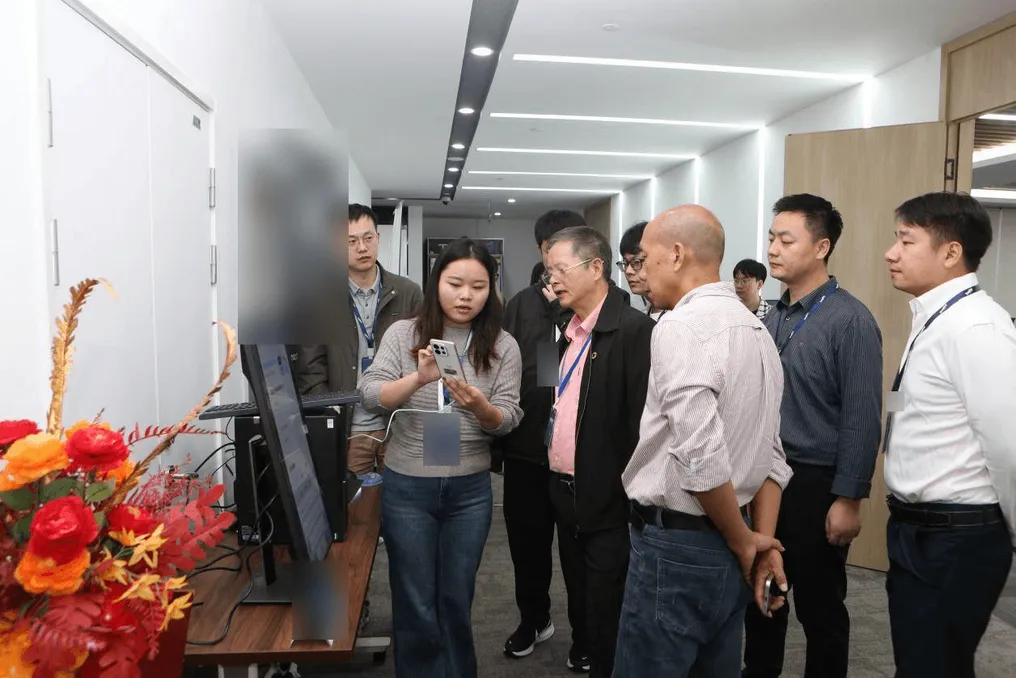
DeepBlue Technology launched Wowoker on October 29th—a corporate work phone developed in collaboration with Huawei. The Chinese company, specializing in artificial intelligence, positions this gadget as the world's first work phone featuring a large agent model.

According to DeepBlue, the device operates on Huawei Kirin chips, utilizes Huawei hardware, and runs on the HarmonyOS operating system, which is integrated with DeepBlue's multimodal large model, its Decision Making Model, and the AgentOS orchestration system.

Huawei provided the HarmonyOS ecosystem, the hardware adaptation basis, and the foundations of corporate security, offering 12 phone models for customization. This allows for selecting suitable equipment for teams ranging from ten people up to groups purchasing hundreds of devices.

Device Focus on Sales Operations

The phone is exclusively oriented towards sales teams, not end consumers. Built-in agents perform tasks such as lead generation, automated outbound calls, and buyer intent analysis. The lead generation agent accepts industry settings and keywords from the manager, then searches for potential clients on Xiaohongshu, WeChat, and Douyin, initiating dialogue with them.

DeepBlue reported that during testing with an early client, the OPC community of Greenland, the agent was able to process over 200 potential leads in half a day, more than 50 of which led to substantive conversations. The presentation demonstrated the operation of an AI agent that called a parent to confirm the child's age, offered a trial lesson, and organized subsequent communication via WeChat.

Additional features include the ability to make and receive calls using a voice mimicking the owner's voice, publishing content across various platforms, tagging clients, and screening leads. On the management side, all calls, text messages, and chats in WeChat, WeCom, Feishu, and Douyin are encrypted and synchronized with the company's cloud. Furthermore, the AI conducts quality checks, noting incorrect phrasing in real time.

Client contact details and WeChat IDs are stored only on the company's backend, so salespeople see masked details, cannot delete chat history, and cannot save contacts personally. Upon an employee's departure, the devices can be remotely disabled.

Reasons for Choosing Hardware Solution

When asked about the reason for creating dedicated hardware instead of an application, DeepBlue explained that a significant portion of sales department work occurs within third-party applications where cloud software is limited by system permissions and interfaces. The phone, however, provides vendor-level adaptation and retains some data on the device itself for processing. Chairman Chen Haibo noted that business clients with real needs are more likely to receive support from major platforms.

Regarding concerns about intrusive calls, the company stated that the system has built-in rules that block high-frequency outbound calls, terminate contact if the client explicitly refuses, and allow the user to take control at any moment.

Wowoker is not sold individually; companies purchase a three-year agent service package that includes the phone. The cost of this package is 5,299 RMB or 4,999 RMB initially, with no additional fees throughout the term.

Similar stories

HongYun Company Releases HyperLM V2.5 with Support for Huawei Ascend 950DT and Atlas 850E SuperPoD
Read more
pandaily.com

HongYun Company Releases HyperLM V2.5 with Support for Huawei Ascend 950DT and Atlas 850E SuperPoD

Beijing-based AI company HongYun has unveiled HyperLM V2.5, a new version of its platform for combined training and inference of large models. This was reported by IT Home and ifeng Tech on November 3rd. The company claims to be the first to achieve deep adaptation to the Huawei Ascend 950DT chip, full compatibility with the air-cooled Atlas 850E SuperPoD system, and successful technical certification from Huawei for Ascend Native.

HongYun believes that defining support is often too vague, where a model is only considered supported after installation and token generation. The company aims to assist government and enterprise clients using private deployments in achieving maximum performance from new accelerators.

The company describes the Ascend 950DT as a flagship chip for high-throughput tasks such as extended chat interactions, processing long documents, and continuous agent reasoning. Furthermore, it is noted that the air-cooled Atlas 850E system can be integrated into existing data centers without requiring infrastructure upgrades.

HyperLM V2.5 adapts at multiple levels. At the interconnect level, the platform supports Huawei's UnifiedBus 2.0 technology, which provides a system interconnect bandwidth of 13.4 TB/s, preventing bottlenecks during traffic transfer between cards—a crucial factor for long contexts or splitting prefill and decoding stages. At the operator level, the system is optimized for mxFP4 inference, enabling 14.2 PFLOPS per node.

The platform supports the latest open-source models, including Qwen, GLM, and DeepSeek, and its scheduler has been rebuilt considering the memory profile and throughput of the 950DT.

The release of HyperLM V2.5 includes five new features. Prefill and decoding splitting allows the two stages to be isolated into independent resource pools so they do not compete during peak loads. Multi-level KV caching reuses system prompts, frequently encountered contexts, and fixed session templates to reduce redundant computations. vNPU virtualization segments the Ascend 950DT, 910C, and 910B chips, providing granular quotas and isolation for AI Core computation and HBM memory, and also supports hot migration and automatic rescheduling upon hardware failure.

A unified gateway model, compatible with the OpenAI protocol, has also been added, which manages routing, rate limiting, beta releases, and A/B testing. Comprehensive monitoring across the entire stack tracks load, memory usage, throughput, latency, and QPS, providing alerts and automated fault localization.

For regulated industries such as government administration, energy, transportation, and finance, the platform provides role separation for administrator, security officer, and auditor, multi-level classification control, complete operation logs, and tracking of computational resources, model call audits, and usage statistics per project.

HongYun was incubated by the Western Institute of Computing Technology of the Chinese Academy of Sciences, and its core team consists of employees from the Institute of Computing Technology and Sugon. In 2020, the company joined Huawei's Ascend partnership program. The company plans to continue development based on Ascend and Hygon DCU hardware, focusing particularly on heterogeneous scheduling, inference acceleration, caching, and agent applications.

Huawei introduces CANNLab, CANNBot, and CANNJudge as an open developer base for Ascend
Read more
pandaily.com

Huawei introduces CANNLab, CANNBot, and CANNJudge as an open developer base for Ascend

At the GOSIM Shenzhen 2026 event on October 16, Huawei introduced developer tools that operate on top of its open CANN stack, rather than simply reiterating a previous statement about open source. Lisin Shao, General Manager of CANN Business at Huawei, explained that CANN acts as a heterogeneous computing layer between AI frameworks and Ascend processors, and detailed community services designed for practical application by students and engineers.

Previously, in 2025, English-language publications mentioned Huawei's plan to widely open CANN. The new information concerns the working platform. CANNLab provides free online cloud environments for working with Ascend C, PyPTO, and related operators, and includes model deployment checks and tuning. CANNBot is presented as a multi-agent assistant capable of generating code, autonomously troubleshooting, closing the repair loop, and performing end-to-end tuning.

CANNJudge adds online competition boards, allowing students to practice on graded tasks, while CANN-Learning-Hub consolidates educational materials and interactive examples for working with operators from beginner to advanced levels. Management is overseen by a technical steering committee, a project management committee, and special interest groups.

Interest groups already list areas such as intelligent transportation, embodied intelligence, energy, and life sciences, with corresponding code repositories open for collaboration among universities, laboratories, and companies. CANN-Samples contains optimization examples for training and inference, including single-chip paths aimed at classes with limited computational power.

Huawei ties all these elements into a 'learn-practice-compete-certify-hire' pathway, aiming to provide students with real-world tasks involving operators and models before they graduate. Ecosystem partners report hiring strong community participants, although external referral channels are still under development. Furthermore, the company does not claim that all CANN code is fully ready for open source; it describes the services and governance surrounding the parts that are currently open.

For Ascend developers, the most significant news is the free cloud lab, the operator assistant agent, and the public leaderboard, announced together as a unified developer base. Previous English reports covered the open-source direction; this presentation focused on tools intended to make that direction applicable in daily work.

DeepSeek released DeepInfer framework for inference supporting Nvidia and Huawei chips
Read more
technode.com

DeepSeek released DeepInfer framework for inference supporting Nvidia and Huawei chips

DeepSeek has released DeepInfer, an inference execution framework that forms the basis of its large model services. This release occurred on October 20th.

DeepInfer supports Nvidia GPUs as well as Huawei Ascend processors. The framework provides several features, including distributed inference, speculative decoding, and structured output.

According to DeepSeek's statement, the goal of this release is to help developers and enterprises increase throughput and reduce latency while decreasing computational costs and energy consumption.

Furthermore, the company made the deepseek-recipe component publicly available. It is responsible for transforming API requests and handling model input and output in accordance with DeepSeek's proprietary services. Currently, DeepInfer supports the DeepSeek-V4.1-Flash-1017 model, and the company intends to continue releasing inference code and optimizations for future models through this project.

Popular