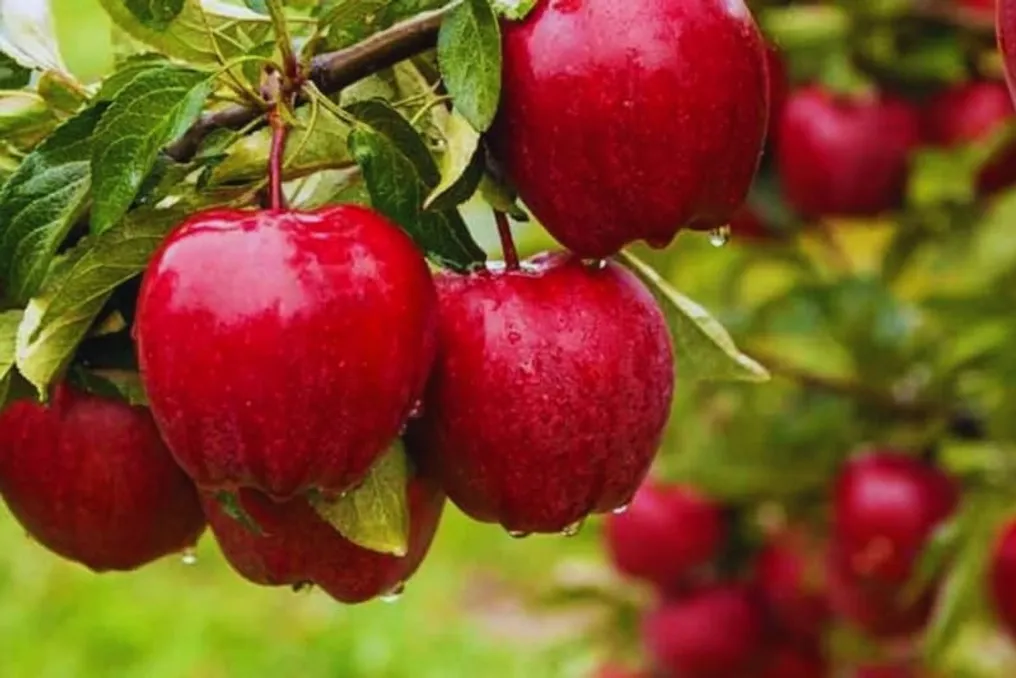
Agricultural Produce: Apple Harvest in Himachal Decreased, Leading to Losses of 2000 Crore Rupees
Read more
Aaj Tak
www.aajtak.in

Agricultural Produce: Apple Harvest in Himachal Decreased, Leading to Losses of 2000 Crore Rupees

Apple producers in Himachal have faced a severe financial blow, estimated at approximately 2000 crore rupees, as the volume of apple production in the region has significantly dropped compared to last year.

In 2025, the cost of apple production reached about 5200 crore rupees, but this season is expected to decrease to around 2200 crore rupees. This has had a direct and substantial impact on both farmers' income and the regional apple farming economy.

The most alarming aspect is that this year's harvest was less than half of previous figures. According to the Department of Horticulture data, the apple season is over, and only 1.37 crore boxes have entered the regional markets so far. Even accounting for apples acquired under the Market Intervention Scheme (MIS) and stored in CA shops, the total production volume is projected to be within 1.60–1.70 crore boxes.

Satish Sharma, Director of the Department of Horticulture, stated that the current apple harvest is the second lowest in the last fifteen years. Similar declines were observed in 2011–12, when only 1.37 crore boxes were collected, and in 2018–19, when production fell to 1.84 crore boxes. The forecast for this season is at the lowest level after these periods, making this season extremely weak for the Himachal apple economy.

A significant reason for the drop in yield is the presence of old traditional orchards in the region. Many trees in these orchards are severely aged, and their ability to bear fruit is gradually declining. Himachal farmers are beginning to transition from traditional horticultural methods to High Density Planting (HDP), but the full impact of the new orchards will take time to reflect in production statistics.

According to Satish Sharma, Director of the Department of Horticulture, the real benefit of implementing high density planting is expected within the next four to five years. The department is focused on providing quality saplings to farmers. Around 8–10 lakh high-quality saplings are planned for distribution during the current season. There is hope that this will not only lead to an increase in production volume in the coming years but also to an improvement in apple quality.

Another problem in Himachal is low yield. On average, about 5–6 metric tons of apples are harvested per hectare in the region. This sharply contrasts with figures in developed apple-producing countries such as New Zealand, where yields exceed 55 metric tons per hectare, and in some modern technology orchards, reach 80 metric tons. This is precisely why the government and the Department of Horticulture are actively promoting High Density Planting. The goal is to achieve higher yields and better quality from limited area.

However, the success of HDP depends not only on replacing trees; irrigation systems, modern technologies, proper management, quality saplings, and a scientific approach to horticulture are also necessary. This season's data presents a serious challenge to traditional apple farming in Himachal. The significant drop in production and the estimated economic damage of 2000 crore rupees once again raise the question of how long traditional orchards can be relied upon. Attention is now focused on how the apple farming landscape in Himachal will change over the next four to five years thanks to high density planting.

Similar stories

Uzbekistan's fruit and vegetable exports decreased by 10.9% from January to September 2026
Read more
uzdaily.uz

Uzbekistan's fruit and vegetable exports decreased by 10.9% from January to September 2026

According to data from the National Statistical Committee of Uzbekistan, the export of fruits and vegetables from Uzbekistan decreased by 10.9% year-on-year, reaching a volume of 1.299.1 million US dollars for the period from January to September 2026.

Over the nine-month period, the country exported 1,560.6 thousand tons of fruits and vegetables, which is 3.0% less than the previous year, or 48.2 thousand tons less. In the same period in 2025, exports reached 1,608.9 thousand tons worth 1.457.4 million US dollars.

Fruits and vegetables accounted for 5.0% of Uzbekistan's total exports for the reporting period. Fruit exports reached 393.0 thousand tons worth 445.2 million US dollars, compared to 413.7 thousand tons worth 489.2 million US dollars the previous year.

Grape exports brought in 123.0 million US dollars through shipments of 151.6 thousand tons. In the corresponding period in 2025, Uzbekistan exported 150.7 thousand tons of grapes worth 145.6 million US dollars. Peach exports showed growth in both volume and value: shipments increased from 111.5 to 119.9 thousand tons, and export revenues grew from 105.1 million to 116.8 million US dollars.

Export of dried grape bunches decreased to 63.2 thousand tons worth 74.2 million US dollars, and sweet cherry shipments fell to 25.2 thousand tons worth 59.9 million US dollars. Export of dried plum decreased to 20.6 thousand tons worth 38.1 million US dollars. Shipments of dried apricots also decreased to 12.5 thousand tons, although export revenue increased from 31.8 million to 33.1 million US dollars.

In contrast, vegetable exports showed growth in both volume and value. Shipment volume increased from 493.8 to 557.2 thousand tons, and export revenues grew from 172.1 million to 206.2 million US dollars. Among vegetables, onions accounted for 317.3 thousand tons, bringing in 92.4 million US dollars. Cabbage shipments amounted to 139.8 thousand tons worth 55.1 million US dollars, and tomato exports reached 34.2 thousand tons worth 35.5 million US dollars.

Carrot exports amounted to 59.8 thousand tons worth 13.4 million US dollars, and garlic shipments reached 6.1 thousand tons worth 9.8 million US dollars. Exports of melons and watermelons decreased from 229.2 to 206.3 thousand tons, but their export value increased to 64.7 million US dollars compared to 56.5 million US dollars the previous year.

Additionally, Uzbekistan exported 16.7 thousand tons of peanuts and nuts worth 38.8 million US dollars, as well as 36.8 thousand tons of mung beans worth 34.7 million US dollars. The total export of other fruits and vegetables amounted to 350.6 thousand tons worth 509.4 million US dollars, which is lower than the figure of 418.0 thousand tons worth 659.2 million US dollars in the same period in 2025.

Overall, Uzbekistan's total exports for January-September 2026 reached 25.8 billion US dollars, a decrease of 5.5% year-on-year. Nevertheless, commodity exports excluding gold increased by 31.6% to 13.3 billion US dollars for the same period.

Apple's Revenue in India Grew by 32% and Exceeded 1 Trillion Rupees in FY2026
Read more
business-standard.com

Apple's Revenue in India Grew by 32% and Exceeded 1 Trillion Rupees in FY2026

According to data provided by the market analysis firm Tofler, Apple's revenue in India increased by more than 32 percent, reaching 104,607 crore rupees in the 2026 fiscal year.

The company registered revenue of 79,060.5 crore rupees in the 2025 fiscal year. Tofler reported that Apple India Private Limited is engaged in the sale and promotion of products and software under the Apple brand, and for the 2025-2026 fiscal year, the company reported revenue of 104,607 crore rupees, which represents a 32 percent increase compared to the previous fiscal year.

Apple's net profit in India also showed significant growth, increasing by 66 percent to reach 5,311 crore rupees for the same fiscal period. The company's total expenses for this fiscal year were recorded at 96,224 crore rupees, according to Tofler.

Popular