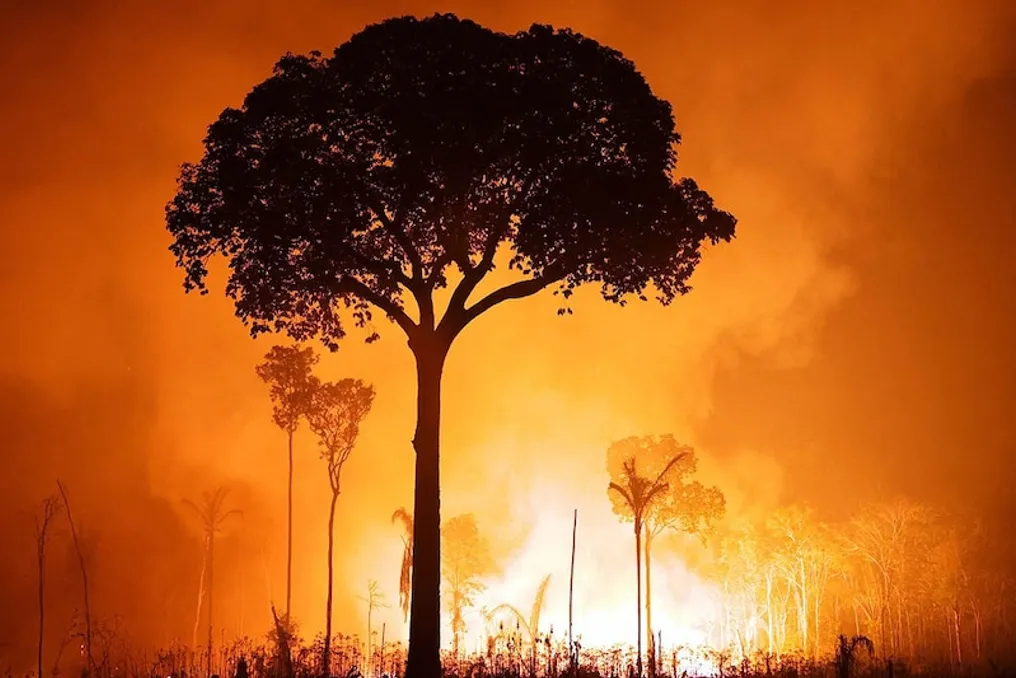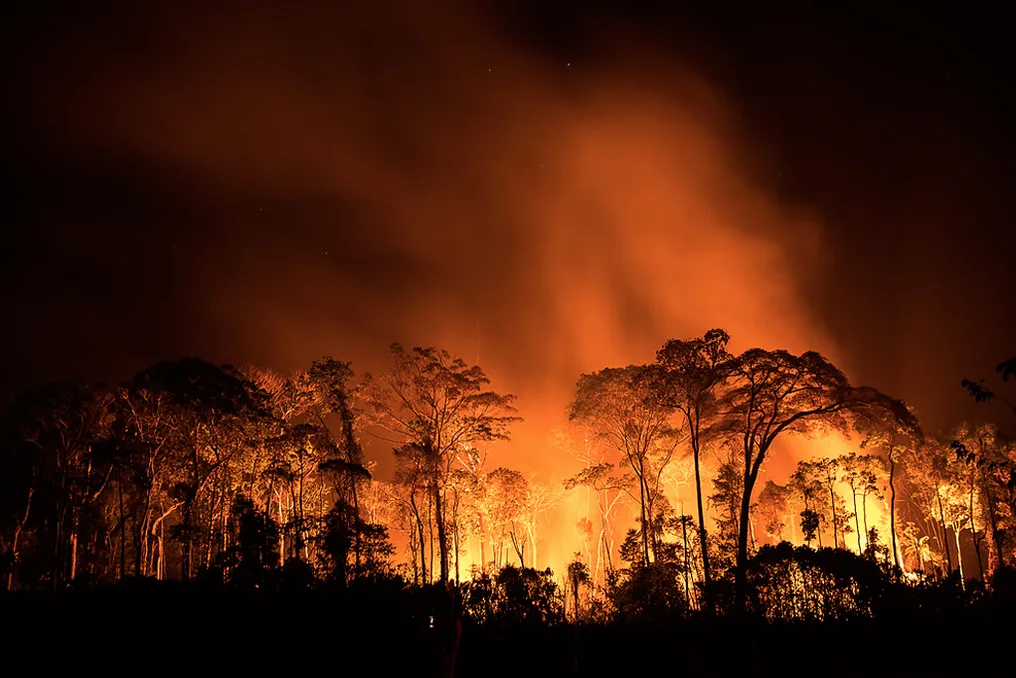
The Amazon, the world's largest tropical forest, began emitting more carbon dioxide (CO2) into the atmosphere than it absorbed annually between 2010 and 2024, totaling 1.17 billion tons more. Fires were the main cause of this emission, releasing approximately 1.47 billion tons of CO2 per year, a value significantly higher than the forest's absorption capacity, which is 300 million tons annually.
This conclusion was presented in a study published in the journal Nature, recognized as one of the most important scientific publications globally. The study was conducted by scientists from the National Institute for Space Research (Inpe), with financial support from FAPESP and other national and international entities.
15-year analysis points to human activities as the cause of the imbalance
Based on a 15-year analysis of atmospheric carbon measurements, the main greenhouse gas, the research identified human actions as the determining factor for the environmental imbalance. The authors emphasize that it is crucial to implement a sharp reduction in fires, along with a zero deforestation policy and forest restoration, to prevent the forest from reaching a tipping point—a moment when it would lose its ability to recover and give way to another type of vegetation.
This warning gains urgency given the current scenario, where fire outbreaks in the Amazon are approaching the 2025 threshold. According to Inpe data, over 41,300 hotspots were recorded in less than ten months (with 58% concentrated in September and October), compared to 43,130 recorded in the entire previous year. Intense smoke affected municipalities in Amazonas, including the capital Manaus, resulting in the suspension of classes, overload of the health system due to respiratory problems, and environmental crime investigations suspected of intentional human action.
The central message: the impact of human action
Luciana Vanni Gatti, a climate scientist and coordinator of the Greenhouse Gas Laboratory (LaGEE) at Inpe, and the article's lead author, stated that the central message of the research is alarming: the problem with the Amazon lies in human intervention. She stated that the forest is being lost because the region's development model was based on destruction, necessitating public policies that promote the value of standing forests.
Additionally, the study detailed changes in the region's climatic conditions over several decades. By examining data from the last 46 years, scientists found that deforestation and degradation in the Amazon caused an 8% decrease in annual precipitation and a 20% decrease during the peak of the dry season (between August and October). Simultaneously, the average annual temperature rose by 1.13°C, and this increase was 1.81°C during the dry season.
Gatti explained that such modifications harm the conditions necessary for maintaining the humid forest and fuel a feedback loop: loss of vegetation decreases rainfall and raises temperatures, which, in turn, encourages new fires and intensifies the degradation of remaining vegetation. The researcher described this as a 'very great stress on the forest that remains.'
Comparison of climatic and intervention scenarios
The scientists organized the data into three distinct scenarios, comparing periods with different climatic conditions and levels of human interference. They grouped the years: rainy years (2011, 2012, 2013, 2014, 2017, and 2018), characterized by low intensity of anthropic activities; low climatic stress years (between 2019 and 2022), marked by high rates of deforestation (a 97% increase) and fires (a 25% growth); and hot and dry years (2010, 2015, 2016, 2023, and 2024), influenced by events such as El Niño and the warming of the tropical North Atlantic, associated with a strong increase in fires (92%).
The results showed that in groups 2 and 3, the Amazon transitioned from a carbon reservoir to a CO2 source. This occurred due to a surplus in emissions within the so-called 'carbon balance,' which considers all release and absorption processes, whether natural or human-induced.
In group 2, emissions were almost four times higher than in group 1, reaching an average balance of about 1.58 billion tons of CO2 per year. The highest volume was recorded in group 3, whose average balance reached 1.8 billion tons of CO2 annually.
Although the carbon balance can be affected by natural or human factors (such as burning fossil fuels, including oil, natural gas, and coal), the vital process for removing CO2 from the atmosphere is plant photosynthesis, essential for plant growth. Therefore, forests are considered large carbon sinks, which return to the atmosphere when vegetation dies or decomposes slowly. Fires, on the other hand, release the CO2 contained in plant biomass suddenly and immediately.
In all three groups of analyzed years, after discounting emissions from fires, the Amazon absorbed an amount of CO2 almost equal to what it returned to the atmosphere, keeping the biome's 'net carbon exchange (NCE)' close to neutrality. Consequently, there was little or no absorption left to compensate for the greenhouse gases released by the fire, reinforcing the role of human activities in the imbalance.
Influence of climatic phenomena and research methods
Gatti clarified that without the occurrence of La Niña, emissions in the years of group 2 could have been even more severe. The La Niña phenomenon allowed the Amazon's carbon absorption during the rainy season to compensate for 75% of the emissions recorded during the dry period.
Unlike El Niño, La Niña is characterized by the cooling of the equatorial Pacific Ocean waters by at least 0.5°C below the historical average. These cycles usually last from nine to twelve months and occur every two to seven years, generating various global climatic effects, such as reduced rainfall in Southern Brazil and increased precipitation in the North and Northeast.
Between 2020 and 2023, the so-called 'triple dip' of La Niña occurred, implying the persistence of this abnormal cooling of the Pacific for three consecutive summers in the Southern Hemisphere.
To obtain these results, the team used data collected between 2010 and 2024, obtained through flights in small aircraft and the quantification of CO2 and carbon monoxide (CO) carried out at the Inpe Greenhouse Gas Laboratory. Collections were made at four points to cover all Amazonian regions (northeast, southeast, southwest, and northwest). The methodology integrated carbon measurements with data on deforestation, fires, precipitation, air temperature, and sea surface temperature indicators.
This methodological approach, based on carbon balance data since 2010, also led to three other articles led by Gatti and published in Nature: in 2014, 2021, and 2023. The two most recent already indicated that the biome was becoming a carbon source, although this situation was more evident in areas with a higher deforestation rate.
In addition to these impacts, scientific literature proves that the Amazon faces periods of extreme drought and heatwaves more frequently, as evidenced by a study that recorded an increase of over 3°C in maximum temperature during the dry season, even in preserved areas. Another study indicated that the extreme drought and heat caused by the last El Niño could become the 'new normal' in tropical forests if greenhouse gas emissions are not reduced.
Gatti stressed the need to answer crucial questions: whether the decrease in carbon absorption is due to lower plant photosynthesis, increased decomposition, or if human actions are exceeding this capacity, or if it is a combination of factors. She highlighted that answering these questions is vital to determine if trees will be able to maintain their life in that environment.
To advance this understanding, the group began a new phase of analysis in 2022 focused on carbonyl sulfide (COS), a chemical variant of CO2. COS serves as an atmospheric tracer of photosynthesis, functioning as a molecular marker that allows for a more precise measurement to aid in finding the answers mentioned by Gatti.
The study was supported by FAPESP, through the Global Climate Change Research Program (projects 16/02018-2, 11/51841-0, and 08/58120-3), and scholarships for Inpe researcher Camilla Lima Cunha, one of the authors. Cunha emphasized the importance of continuous funding to sustain long-term research, essential for understanding the mechanisms affecting tropical forests. According to her, 'Continuous investment in science is fundamental to understanding the transformations underway in the Amazon and identifying the factors compromising its ability to absorb carbon. This knowledge is essential for deepening the understanding of environmental changes, in addition to contributing to subsidies for decision-making and defining forest conservation strategies.'