
President of the Provisional Government of Venezuela calls on Portuguese companies to participate in the country's economic recovery
Read more
Noticias ao Minuto
noticiasaominuto.com

President of the Provisional Government of Venezuela calls on Portuguese companies to participate in the country's economic recovery

The President of the Provisional Government of Venezuela, Delcy Rodriguez, addressed Caracas with a call for active participation from Portuguese companies and the local Portuguese community in the country's economic recovery process, noting the start of a new cycle of bilateral cooperation.

She stated that she desires growth to occur in close partnership with the business sectors of Portugal and Europe, emphasizing the need to participate in a unified process of restoring relations, including trade ties.

Delcy Rodriguez's speech took place in Caracas before hundreds of entrepreneurs at the Portugal-Venezuela Business Forum, which was held at the Portuguese Center as part of the Portuguese business mission to the country. The mission was headed by the Minister of Economy and Territorial Cohesion of Portugal, Manuel Castro Almeida.

The head of state emphasized the historical significance and unbreakable ties between Portuguese and Venezuelan people, calling them 'two peoples who decided to become brothers, who were never a wall but always a bridge.'

She noted that the visit of the Portuguese delegation reflects an 'interest in the new' economic cycle.

Delcy Rodriguez mentioned the difficult times Venezuela experienced due to the economic embargo, stating that over the last decade this had negatively affected bilateral trade relations. She stressed that this decade became 'a lost generation' and negatively impacted trade between Venezuela and Portugal. A diagram was presented showing how trade between the countries was affected after sanctions, starting in 2015.

During this address, the provisional president presented data indicating that trade turnover between the two states was about $637 million in 2012, but dropped to $26 million by 2025.

Nevertheless, she stressed that the current situation is characterized by hope and growth. She noted that Venezuela leads in Latin American economic growth, a trend also projected by the Economic Commission for Latin America and the Caribbean (ECLAC) for 2026. Furthermore, domestic consumption increased by 23% over the last 12 months.

Delcy Rodriguez stated that the country's development plan until 2040 aims to strengthen Venezuela as a diversified power, opening immediate opportunities for Portuguese businesses in sectors such as construction and infrastructure, energy, oil, currency intermediation, trade, lodging, and catering.

The head of state also expressed deep gratitude to the local Portuguese community, stating that the presence of Portuguese in the DNA of Venezuela is linked to their dreams and historical roots, and today they can consider themselves having two homelands.

In conclusion of her address, the provisional president publicly thanked Portugal for its support during the double earthquake in June, recalling that Lisbon declared a day of mourning and sent rescue teams and humanitarian aid, calling it an act that made them feel like brothers again.

Similar stories

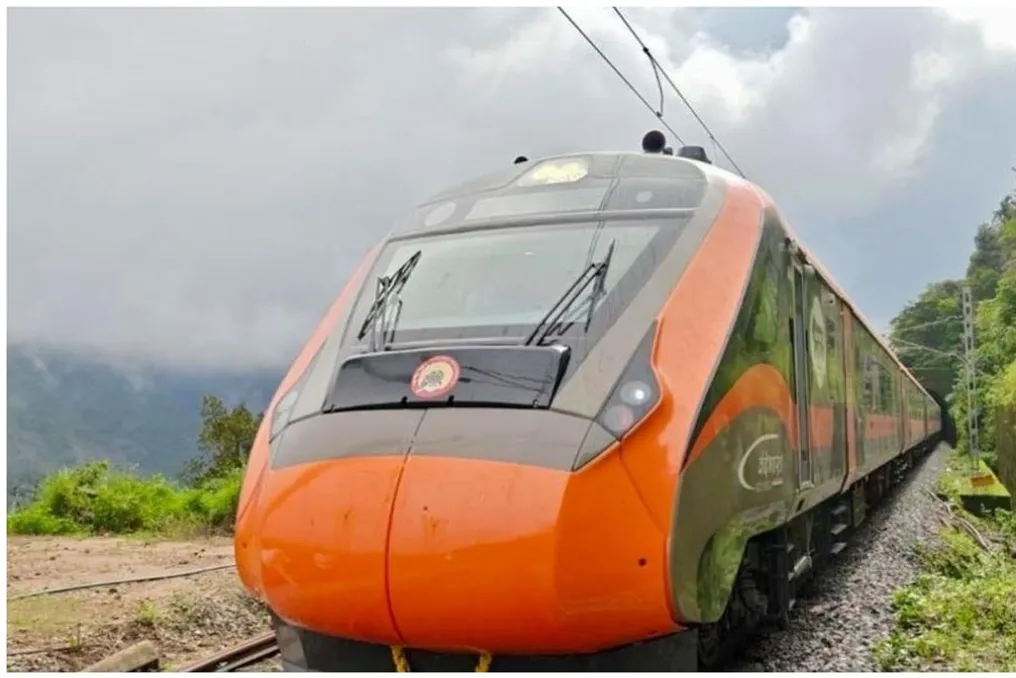
Approval granted to launch Vande Bharat high-speed train between Goa and Bangalore
Read more
www.aajtak.in

Approval granted to launch Vande Bharat high-speed train between Goa and Bangalore

Passengers traveling from Bangalore to Goa will receive a new option for rail travel. The Railway Board has approved the launch of a new Vande Bharat express on the Yashwanpur-Madgaon route. This train will run through Mangaluru and connect many important cities in Karnataka with coastal areas. The train will operate in both directions six days a week. The journey time from Yashwanpur to Madgaon will be 13 hours and 20 minutes, and the return journey will take 12 hours and 55 minutes.

The Railway Board approved the launch of the Yashwanpur-Madgaon Vande Bharat express in a letter dated October 30, 2026, under numbers 26655/26656. The train will travel from Yashwanpur station in Bangalore to Madgaon in Goa. This rake was manufactured by Bharat Earth Movers Limited (BEML) using Integral Coach Factory (ICF) technologies in Chennai. It is expected that this will improve rail connectivity between Karnataka and Goa.

The new Vande Bharat express will pass through Mangaluru Junction and stop at 12 stations between Yashwanpur and Madgaon. These stops include Shravanabelagola, Hassan, Sakleshpur, Subrahmanya Road, Kabaka Puttur, Mangaluru Junction, Udupi, Kundapura, Mukambika Road Bindur, Murudeshwar, Gokarna Road, and Karwar. Thanks to this route, passengers traveling between Bangalore and Goa will be able to use Vande Bharat services during the day.

Train number 26655 will depart from Yashwanpur at 7:35 AM and arrive in Madgaon at 8:55 PM, taking 13 hours and 20 minutes. The schedule of stops on this route is as follows: Shravanabelagola — from 09:03 to 09:05, Hassan — from 09:38 to 09:40, Sakleshpur — from 10:20 to 10:22, Subrahmanya Road — from 12:40 to 12:42, Kabaka Puttur — from 13:25 to 13:27, Mangaluru Junction — from 15:05 to 15:15, Udupi — from 16:20 to 16:22, Kundapura — from 16:38 to 16:40, Mukambika Road Bindur — from 17:20 to 17:22, Murudeshwar — from 18:00 to 18:02, Gokarna Road — from 19:00 to 19:02, Karwar — from 19:45 to 19:47.

Return, train number 26656 will depart from Madgaon at 8:20 AM and arrive in Yashwanpur at 9:15 PM, taking 12 hours and 55 minutes. The stopping schedule for the return direction is as follows: Karwar — from 09:03 to 09:05, Gokarna Road — from 09:48 to 09:50, Murudeshwar — from 11:00 to 11:02, Mukambika Road Bindur — from 11:20 to 11:22, Kundapura — from 11:48 to 11:50, Udupi — from 12:18 to 12:20, Mangaluru Junction — from 13:50 to 14:00, Kabaka Puttur — from 14:43 to 14:45, Subrahmanya Road — from 15:28 to 15:30, Sakleshpur — from 17:30 to 17:32, Hassan — from 18:13 to 18:15, Shravanabelagola — from 18:43 to 18:45.

The new train will operate in both directions six days a week. However, the Yashwanpur to Madgaon train will not run on Wednesdays, and the Madgaon to Yashwanpur train will not run on Thursdays. Thus, passengers can use this service on the remaining days of the week. Nevertheless, the railway has not yet announced the exact date of regular operation for the train.

With the launch of the new train 20645/20646 Madgaon-Mangaluru Central Vande Bharat Express, the existing Vande Bharat Express will be discontinued. The Railway Board also notified the cessation of this train's service. That is, after the new Vande Bharat service starts on this route, the Yashwanpur-Madgaon train will replace the existing line.

The electrification of the mountain section has enabled the movement of high-speed electric trains on this route. Previously, the Minister of Railways Ashwini Vaishnaw stated that a Vande Bharat train could now be launched on this route up to Mangaluru. Work on the electrification of the Bangalore-Mangaluru railway line began in December 2023 and was completed in December 2025. A trial run using an electric engine was conducted on December 28, 2025. As part of the project, five switching stations were built and an overhead electrification system was installed along the entire route. To ensure safety, the maximum distance between traction poles was set at 67.5 meters.

The new Yashwanpur-Madgaon Vande Bharat will provide direct connectivity for passengers traveling between Bangalore and Goa, as well as for residents of cities such as Hassan, Sakleshpur, Mangaluru, Udupi, and Karwar. Since the train will run during the day and reach its destination on the same day in both directions, passengers are left to await the next announcement from the railway regarding the start date and ticket booking.

Analysts believe large-cap stocks are regaining strategic leadership amid market uncertainty
Read more
business-standard.com

Analysts believe large-cap stocks are regaining strategic leadership amid market uncertainty

Despite significant selling pressure from foreign institutional investors (FII), which has long negatively impacted Indian stocks, a shift in trends is being observed. Analysts note that after mid and small-cap stocks led the market growth for most of 2026, they are beginning to lose momentum, while large-cap stocks are demonstrating greater resilience amidst growing market uncertainty.

According to a note from Bajaj Broking dated November 2, large-cap stocks appear better suited for achieving superior risk-adjusted returns over the next six to eighteen months. This is attributed to the maintenance of relatively stable fundamental metrics, increased attractiveness of their valuations, and persistent liquidity advantages.

Listen to this article

Payal V. Pandya, Vice President of Prive-Research at Bajaj Broking, asserts that strong domestic institutional flows, ample liquidity, and sustained risk appetite supported mid and small-cap stocks for most of the year. However, the situation began to change during the festive season around September 11, when blue-chip stocks significantly outperformed their mid and small-cap counterparts.

Between September 11 and November 2, 2026, the Nifty 50 index fell by only 0.5 percent, whereas Nifty Midcap 100 lost 7 percent, and Nifty Smallcap 100 lost 6.6 percent. Pandya observes that this divergence indicates a developing preference among increasingly cautious investors for quality, liquidity, and greater earnings predictability.

The note emphasizes that while mid and small-cap stocks drove the market for most of the current cycle, the recent divergence suggests that investors are placing greater value on valuation discipline, revenue visibility, and downside protection. The question arises whether the risk-reward balance is shifting towards large-cap companies, or if they can simply outperform other segments at any market phase.

This shift occurs against a backdrop of numerous factors clouding market prospects, including the implications of upcoming US midterm elections, corporate earnings trajectories, geopolitical tensions, and the overall global economic growth outlook. Nevertheless, Pandya believes that in the coming quarters, large-cap stocks may offer investors greater stability. Although they may not deliver the sharpest gains during periods of abundant liquidity and aggressive risk-taking, their scale, stronger balance sheets, and relatively predictable earnings make them attractive as market volatility increases.

Furthermore, Bajaj Broking believes that the valuations of these stocks are becoming increasingly reasonable compared to historical levels, strengthening the investment case for this segment.

FII Selling

Selling by foreign institutional investors (FII) remained a significant hurdle for Indian stocks in the recent market cycle. However, this pressure also affected some heavyweights in the large-cap index, including companies that continued to show healthy operational results.

Pandya suggests that this could create an opportunity if global risk appetite improves, geopolitical uncertainty subsides, or India attracts additional foreign investment. According to the note, the most likely beneficiaries of a recovery in foreign flows will be large-cap stocks, particularly those in the Nifty 50, leading private banks, and major financial service companies. Their advantage over mid and small-cap stocks lies in deeper liquidity, larger market capitalization, and the ability to absorb substantial institutional investment.

Pandya concludes that the investment potential of large-cap companies is increasingly focused on their ability to withstand market volatility rather than delivering impressive short-term returns.

Samhi Hospitality's net profit fell by 59% to 41 crore rupees in the second quarter despite revenue growth
Read more
business-standard.com

Samhi Hospitality's net profit fell by 59% to 41 crore rupees in the second quarter despite revenue growth

Samhi Hospitality Limited reported a decrease in net profit of approximately 59% during the July-September 2026-27 fiscal year (Q2FY27). Meanwhile, the company demonstrated a 15% increase in revenue this quarter.

According to the report, net profit amounted to 41.07 crore rupees, which is significantly lower than the 99.79 crore rupees recorded in the same period last year. In consolidated terms, the company's operating revenue increased by 15%, reaching 338.07 crore rupees compared to 292.9 crore rupees in Q2FY26.

Total income also rose to 342.6 crore rupees from 296.3 crore rupees a year earlier. The EBITDA margin grew by almost 12%, reaching 123.7 crore rupees in Q2FY27 compared to 110.4 crore rupees in the previous quarter.

The occupancy rate reached 78.6%, higher than the 75.0% in Q2FY26. Furthermore, Revenue Per Available Room (RevPAR) increased by more than 14.3% year-on-year, supported by an increase in Average Room Rate (ARR) of over 9.2%, despite geopolitical difficulties.

For the first six months of the 2027 fiscal year, the gaming company reported consolidated operating revenue of 643.28 crore rupees, which is 13.8% more than 565.19 crore rupees for the same period last year. However, consolidated net profit for the period from April to September decreased to 66 crore rupees from 119.01 crore rupees a year earlier.

The company also reported earnings before interest, depreciation, extraordinary items, and taxes of 225.89 crore rupees for the first half, slightly exceeding 216.08 crore rupees a year ago. Management expects the second half of the 2027 fiscal year to be stronger in terms of operational performance, and the expected EBITDA growth should lead to an increase in free cash flow while maintaining stable interest payments.

Currently, the company has 4,899 operational rooms and plans to increase or renovate 1,669 rooms through expansion and opening new properties. This will increase the total number of rooms to 6,568 and support revenue growth in the midscale, upper midscale, upper premium, and leisure segments.

Popular