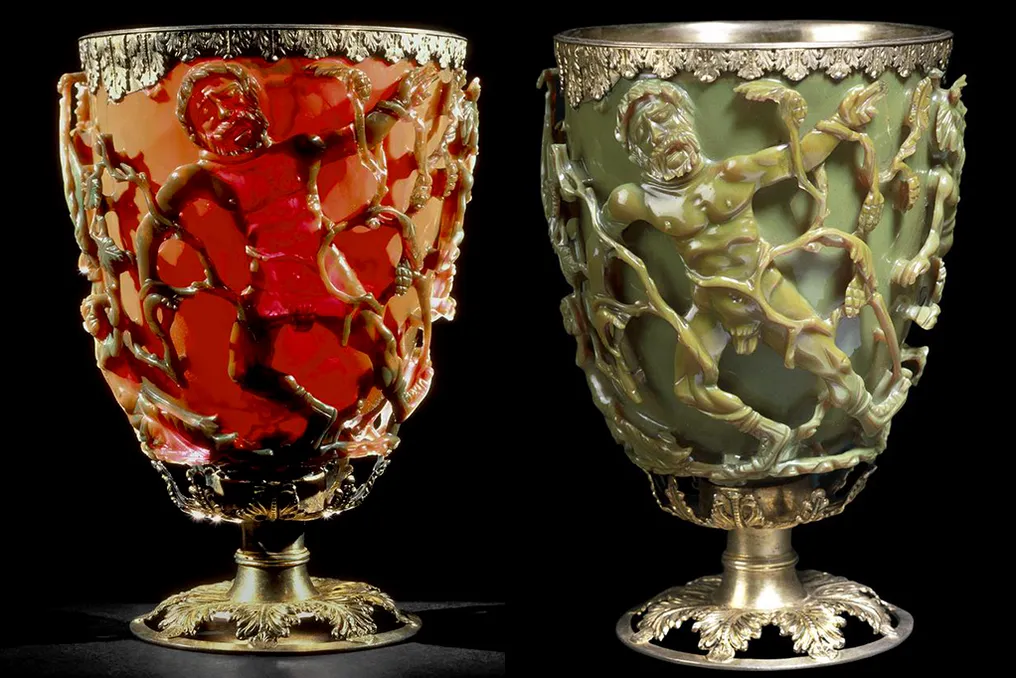
The Chalice of Lycurgus, a piece of Roman-era glassware, is notable not only for its high-relief depiction of a Greek myth involving Lycurgus, King of Thrace, and Dionysus, the god of wine, but also for its ability to change color.
This chalice displays an jade-green hue when illuminated from the front, but takes on a ruby-red coloration when light shines through it from behind. One theory suggests that this chromatic variation could symbolize the grape maturation process.
Measuring 16 cm in height and weighing 700 g, the chalice features a glass body surrounded by an openwork structure called a 'cage,' which is decorated with the mentioned mythological motifs. Although it is in excellent state of preservation, its exact origin remains a mystery to specialists.
The artifact was acquired by the British Museum in 1958, originating from a family collection that had possessed it since the 19th century. Research indicates that the chalice was manufactured between 290 and 325 AD, in Alexandria or Rome, and was intended for events of great importance. The metallic elements on the rim and base were added centuries later, around 1800.
The technique responsible for the color change is considered an early manifestation of nanotechnology. The glass incorporates minuscule particles of gold and silver in minimal quantities. These particles modify the way the glass disperses light, favoring certain frequencies and consequently, specific colors over others.
When light passes through the glass, the nanoparticles absorb blue and green tones, allowing red to pass through. Conversely, when light is reflected by the material, the chalice acquires the jade-green appearance, resulting in distinct colors depending on the position of the light source relative to the observer.
Several attempts have been made to replicate this type of glass. In October 2026, a team from the University of Sheffield, England, succeeded in developing a reproducible recipe. This research was conducted by Lisa Hollands, in collaboration with archaeologist Caroline Jackson, a specialist in Roman glass.
One undefined point is whether Roman artisans intentionally added these metals to the glass nearly two millennia ago, or if the nanoparticles were incorporated accidentally during production. The Sheffield recipe offers some clues about the process.
Hollands began the work by reproducing common glass from the period, using raw materials similar to those available to the Romans, without resorting to commercial reagents. The subsequent challenge was to integrate minute amounts of gold, silver, and copper so that they dispersed and formed particles of the appropriate size during manufacturing.
This process was successful. In the Sheffield recipe, the metals dissolve in the molten glass and, upon cooling, coalesce into crystals of 50 to 80 nanometers, corresponding to the size of the particles in the original chalice. This occurs without the need for special heat treatments.
The furnace plays a crucial role in this process. While electric furnaces did not produce the effect, it manifested in a gas furnace, supplemented with a touch of sugar in the mixture. According to Hollands, the sugar helped simulate the chemical composition of the internal atmosphere of a wood-fired oven, such as those used by the Romans.
Although the Sheffield recipe is not an exact copy of the ancient method—as it required higher temperatures than Roman furnaces and Hollands doubts the use of sugar—it aids in understanding the uniqueness of the chalice. In tests, the glass color varied according to the piece's location within the furnace, making the result unpredictable even with modern equipment.
For archaeologist Ian Freestone, from University College London, one of the greatest experts on the chalice, this suggests that the Romans probably did not master the process; with the Chalice of Lycurgus, they must have had extraordinary luck. The most accepted view combines intention with chance.
The quantities of metal are too small to be measured directly in a single chalice; it is more likely that the glassmakers diluted silver, perhaps deliberately, in a larger batch of glass. As for gold, it may have been introduced incidentally—Roman silver often contained a little of it—or from residues of gold leaf on workshop tools. The few surviving fragments of Roman dichroic glass show quite diverse colors, indicating the difficulty of reproducing the result. The Romans were competent glassmakers, but they were unaware of nanoscale work; they created nanotechnology without knowing it.