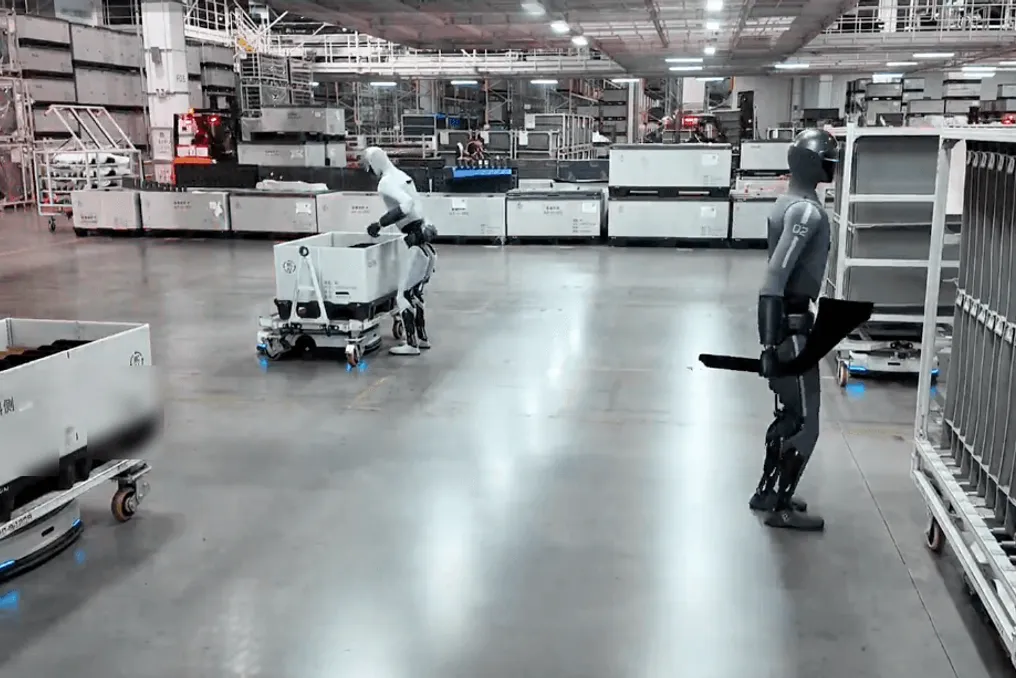
Xiaomi has announced that its humanoid robot has completed its first eight-hour working cycle at an automotive plant. During this shift, the robot ensured full daily production demand on the central console side cover sorting station.
This significant milestone was presented by the company during the World Internet Conference Summit in Uzhgen in 2026. There, the robotics team received the 'Leading Technology' award for the base model technology designed for large-scale robotic manipulation.
According to Xiaomi, the robot independently resolved detected anomalies during the shift and interacted with production line systems, which the company views as a preliminary check of capabilities at the line level. This launch is part of an internship at the factory that began in March. At that time, the robot worked autonomously for three hours at the self-tapping screw loading station, achieving a two-sided installation success rate of 90.2% while maintaining a 76-second line cycle.
By July, the success rate increased to 98%, and the robot took over work at two additional stations: side cover sorting and container stacking. The overall success rate across these three stations ranges from 94% to 98%.
In a domestic setting, Xiaomi has begun trial operations in the Xiaomi Youth Apartment—the company's residential complex for employees. Engineers developed an agent system built upon the pre-trained Xiaomi-Robotics-1 model. This system covers data collection, model output, and task execution, and was refined after several rounds of additional training.
During the test run, the system functioned continuously for over 30 minutes across three rooms, completing more than 50 tasks. These included tool preparation, tidying up the sofa and tables, cleaning up trash, placing items back in place, inspecting the premises, re-checking the entire area, and exiting.
A video published by Xiaomi demonstrates this launch as a single 32-minute segment. Xiaomi-Robotics-1 was introduced on July 16th and made public in August. The company reports that the model was pre-trained on over 100,000 hours of manipulation trajectories in real-world conditions, covering more than 1700 scenes and 260 types of tasks. It was then further trained on over 10,000 hours of cross-embodiment data, allowing it to adapt to mobile manipulators and two-armed robots.
The company also noted that in July, the model ranked first in the overall RoboCasa 365 and RoboDojo rankings. A separate vision, language, and action model, Xiaomi-Robotics-0, uses a hybrid architecture that, according to Xiaomi, provides an output latency of 80 milliseconds on a consumer graphics card.
Xiaomi presents both applications—industrial and domestic—as a unified model stack. The company did not disclose how many robots are participating in the apartment trials, which specific apartment is being used for testing, or how long the trial period will last.